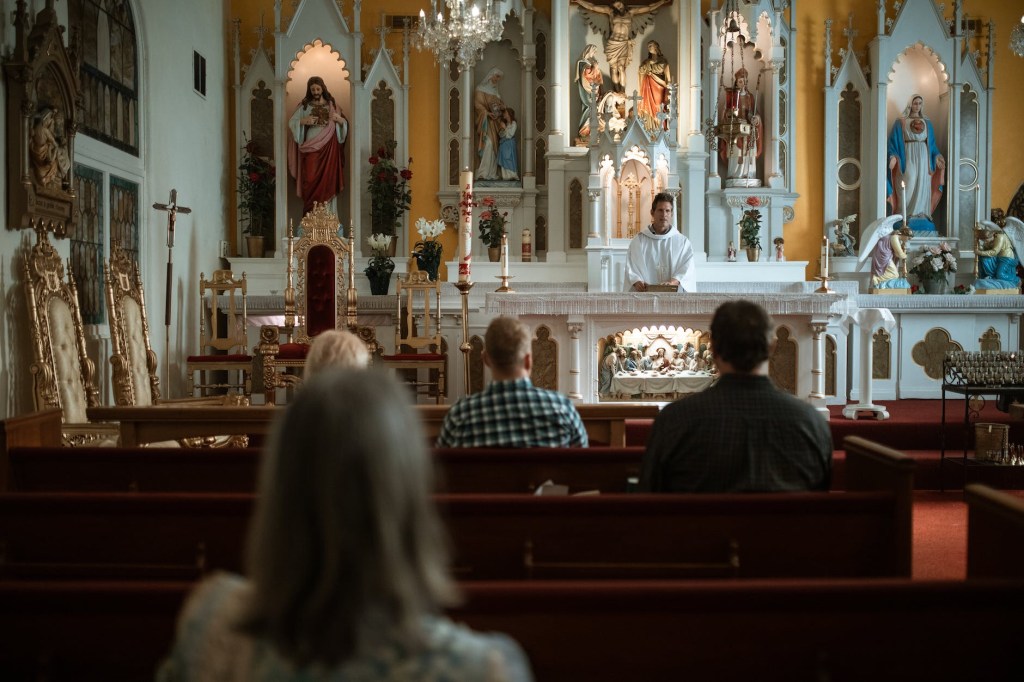
“He said to her, “Conjure up for me, please, and bring up [from the dead] for me [the spirit] whom I shall name to you.” But the woman said to him, “See here, you know what Saul has done, how he has cut off (eliminated) those who are mediums and spiritists from the land.” – “For false christs and false prophets will rise and show great signs and wonders to deceive, if possible, even the elect” – “No wonder! For even Satan disguises himself as an angel of light.” ~ 1 Samuel 28:7-10; Matthew 24:24; 2 Corinthians 11:13.
Praying to the dead is strictly forbidden in the Bible. Deuteronomy 18:11 tells us that anyone who “consults with the dead” is “detestable to the Lord.” The story of Saul consulting a medium to bring up the spirit of the dead Samuel resulted in his death “because he was unfaithful to the LORD; he did not keep the word of the LORD and even consulted a medium for guidance” (1 Samuel 28:1-25; 1 Chronicles 10:13-14). Clearly, God has declared that such things are not to be done.
Consider the characteristics of God. God is omnipresent—everywhere at once—and is capable of hearing every prayer in the world (Psalm 139:7-12). A human being, on the other hand, does not possess this attribute. Also, God is the only one with the power to answer prayer. God is omnipotent—all powerful (Revelation 19:6). Certainly, this is an attribute a human being—dead or alive—does not possess. Finally, God is omniscient—He knows everything (Psalm 147:4-5). Even before we pray, God knows our genuine needs and knows them better than we do. Not only does He know our needs, but He answers our prayers according to His perfect will.
So, in order for a dead person to receive prayers, the dead individual has to hear the prayer, possess the power to answer it, and know how to answer it in a way that is best for the individual praying. Only God hears and answers prayer because of His perfect essence and because of what some theologians call His “immanence.” Immanence is the quality of God that causes Him to be directly involved with the affairs of mankind (1 Timothy 6:14-15); this includes answering prayer.
Even after a person dies, God is still involved with that person and his destination. Hebrews 9:27 says so: “…Man is destined to die once, and after that to face judgment.” If a person dies in Christ, he goes to heaven to be present with the Lord (2 Corinthians 5:1-9, especially verse 8); if a person dies in his sin, he goes to hell, and eventually everyone in hell will be thrown into the lake of fire (Revelation 20:14-15).
God has provided His Son, Jesus Christ, to be the mediator between man and God (1 Timothy 2:5). With Jesus Christ as our mediator, we can go through Jesus to God. Why would you want to risk the wrath of God?
7 Prayers You Must Stop Praying
Not all prayers are the same. In fact, some prayers are not only unpleasing to God, but they can even border on witchcraft. Praying the wrong type of prayer can introduce problems in life rather than blessings. Here are the seven prayers that you should stop saying today.
1. Praying to Saints or Angels
The first type of prayer to stop is praying to saints or angels. The Bible clearly instructs Christians to pray directly to God through Jesus by the power of the Holy Spirit (1 Timothy 2:5). Nowhere in Scripture are we told to pray through saints, angels, or Mary. These figures did not die for us, nor do they intercede for us at God’s right hand. We must use the direct access we have to God through Jesus.
2. Using Repetitive, Formulaic Prayers
Next, stop using ‘meaningless’ repetitive, formulaic prayers. Jesus warned against babbling like pagans who think they will be heard because of their many words (Matthew 6:7). Genuine prayer must come from the heart, not from mindless babbling. It’s about the sincerity of your heart, not the repetition of your words, even if it’s the same prayer, it must be meaningful, with a burden.
3. Praying for Harm or Curses on Others
Another prayer to avoid is praying for harm or curses on others. Romans 12:14 tells us to bless those who persecute us, not curse them. Using prayer to curse others is a form of witchcraft and is not aligned with Christian principles. Even when Jesus was on the cross, He did not curse His enemies. Instead, He prayed for them.
4. Praying with Manipulative Intentions
Another important reminder is to stop praying with manipulative intentions. James 4:3 warns us that prayers asked with wrong motives will not be answered. Prayer should not be used to manipulate situations or people for selfish gains. Instead, align your desires with God’s will, testing them through your delight in Him.
5. Invoking Spirit Guides or Using Occult Practices
Another prayer to avoid is prayers invoking spirit guides or engaging in occult practices. Deuteronomy 18:10-12 strictly prohibits practices like divination, sorcery, and interpreting omens. Mixing occult practices with prayer is dangerous and unbiblical.
6. Seeking Signs Instead of Trusting God’s Word
Another mistake is seeking signs or omens instead of trusting God’s Word. Jesus warned that a wicked generation seeks after signs (Matthew 12:39). While God can confirm signs through His Word, our faith should be based on His promises, not on supernatural signs.
7. Using Objects as Sources of Power
Avoid using objects as sources of power in prayer. Using things like crystals, rosaries, or any other form of objects to help you connect with God or pray is not biblical and should be avoided. However, the Bible does tell us one thing that helps us to strengthen our prayer. That is fasting (Acts 19:19).
8. Praying for Material Wealth Without Seeking God’s Kingdom
Finally, stop praying for material wealth without seeking God’s Kingdom first. Matthew 6:33 reminds us to seek God’s Kingdom and righteousness before anything else. Prioritizing wealth or fame over spiritual growth leads to misguided prayers. In the Kingdom, the King cares for His citizens. He will provide for us when we prioritize Him first.
Five Short Prayers to Pray
In the Bible, we see that Jesus often prayed all night, Daniel prayed for three weeks, and Nehemiah and the Israelites prayed a lengthy confession and repentance prayer in Nehemiah chapter 9. Longer prayers are needed in our walk with the Lord and provide a lengthy set of benefits. They help us focus, deepen our relationship with God, allow us to pour out our hearts, develop persistence, and promote spiritual growth.
While I often encourage people to go further in their prayer time and to push to know the Lord more, I do want to acknowledge the power that a short and sincere prayer can have on your life.
Matthew 6:7 says, “And when you pray, do not use vain repetitions as the heathen do. For they think that they will be heard for their many words.” The heart of prayer lies in revelation, not repetition. While it’s not wrong to repeat the same prayer multiple times, because Jesus prayed the same prayer three times and so did Paul, the heart of prayer is not in repetition; it’s in revelation. In other words, a prayer’s impact lies in its heartfelt connection with God, not its length. A prayer’s value doesn’t depend on how long it is.
Here are 5 prayers that are powerful if you pray them with the sincerity of your heart
1. Lord, Help Me (Matthew 15:25)
This prayer is for the deliverance of others. A mother worshiped Jesus and then she prayed a sincere, humble, but very short prayer, “Lord, help me!” That prayer was so powerful that Jesus delivered her daughter.
2. Have Mercy on Me (Mark 10:47)
“Jesus, Son of David, have mercy on me!” This is a prayer for a miracle. In God’s mercy, you will find your miracle. We must understand that when God extends His mercy, the miracle is on its way.
3. Lord, Save Me (Matthew 14:30)
This prayer is a plea for intervention and rescue. When you’re overwhelmed by fear or when your life feels like it’s spinning out of control, cry out to the Lord and He will intervene.
4. Show Me Your Ways, Lord (Psalm 25:4)
This prayer is for guidance. When we don’t know which way to go, this short, sincere prayer can help us lean on God’s understanding rather than our own. Prayers that align with God’s will and His purpose recognize and receive His power.
5. Not My Will Be Done But Yours (Luke 22:42)
“Father, if it is Your will, take this cup away from Me; nevertheless not My will, but Yours, be done.” This is a prayer of surrender, aligning your will with God’s will. The ultimate success of prayer is to surrender to God’s will, His plan, and His timing.
What Makes Short Prayers Powerful?
1. Faith Short prayers require faith. It’s not the shortness of the prayer that guarantees the answer, but the faith in that short prayer. The Bible emphasizes that prayers made in faith will be heard and answered by God.
2. Humility Short prayers require humility. They express the true condition of the heart without pretense. God opposes the proud but gives grace to the humble.
3. Urgency Short prayers often arise in moments of great need or urgency, reflecting a deep dependence on God.
4. According to God’s Will Powerful prayers align with God’s will and purpose, recognizing His sovereignty.
Remember that short prayers can be as dynamic and powerful as long ones because the heart of prayer is in its revelation, not in its repetition.
Final Thoughts
We need to be mindful of the prayers we offer to God. I encourage you to avoid prayers that are unbiblical, manipulative, or focused on material gain without spiritual growth. Instead, focus on prayers that align with God’s will, seek His Kingdom, and come from a sincere heart.
God blesses things that are in line with God’s Word.
————
***By Got Questions + Vladimir Savchuk at HungryGen / Photo by Faizi Ali at Pexels
Jezebel is mentioned in the Bible over 22 times, mostly in 1 Kings 18, but also again in Revelation 2. In other portions of Scripture, fear and heaviness are called spirits, but the Bible does not directly call Jezebel a spirit.
So why do Christians call Jezebel a spirit?
It is because of her reappearance in the book of Revelation that the idea of a spirit was derived.
Due to this verse, we can assume that Jezebel is a demonic spirit that inhabits a person and causes them to be control-driven, a promoter of false teaching, and heavily driven by sexual appetite.
The best way to define this spirit is by looking at the example Jezebel herself lived (1 Kings 18). She lived a life of immorality, idolatry, false teachings, and unrepented sins. She was not guided by principles or restrained by a fear of God or man. She was passionate in her pursuit and heavily attached to heathenistic worship.
Jezebel in The New Testament
If you read the context of this chapter, you will notice that it was the church that had Jezebel operating in high levels of the church. As surprising as that may seem, it is not at all uncommon to see. So here are a few characteristics and truths to note and be aware of so you can steer clear of this spirit.
8 Characteristics of the Spirit of Jezebel
1. It Operates in Men and Women
I remember a time when I was doing deliverance on this man and the spirit of Jezebel manifested. It had been causing lust in his life and after the guy was delivered, he was free from pornography. It is a lie that this spirit only operates in women through the means of control.
2. It Causes Control, Manipulation, & Domination (A Form of Witchcraft)
Manipulation, intimidation, and the desire or impulse to control people is a characteristic of Jezebel.
The Bible says the fruit of the Holy Spirit is,
The fruit of Jezebel is people-control. It causes a desire to control the surroundings and even people, while never producing “self-control.”
3. It Causes Fear, Flight, and Discouragement
Jezebel is good at causing intimidation in people.
Scripture highlights that she didn’t kill Elijah, she simply sent a messenger to discourage him and make him run in fear of his life.
Elijah was a powerful man of God. He brought fire down from heaven with his command; he seemed fearless! However, this threat was enough to instill fear and even depression in his life. This happened shortly after he had such a great victory on Mount Carmel (1 Kings 18).
A lot of times, after great victories, this spirit will try and bring deep despair to a person. They might even feel as though they don’t want to live, and it causes cycles of burnout.
4. It Seduces and Provokes Sexual Immorality
Revelation says,
Many of us have heard stories of men of God who have fallen into this sin. They have been seduced, have come under discouragement, and have fallen into the enemy’s trap.
When Jehu came to destroy Jezebel, she came out of the window and made sure to have makeup on. Her plan was to seduce Jehu.
Jezebel is after ministers of God. This is very common because of the authority in which they stand. When someone in authority falls, the news doesn’t just affect the immediate family, but they also affect those who believed in them and followed their ministry.
Take time to pray for your pastors, for the men and women God has placed in leadership roles around you. The higher that God takes a person, the more the enemy wants to attack them and so they will fall into sin, affecting the faith of many as a result.
When David committed sexual immorality with Bathsheba, the Lord said,
His sin had given leeway for others to doubt and blaspheme the God that David served. The enemy will often use this tactic to cause ministers of God to fall into pornography, adultery, and other sexual sins.
5. Teaches False Doctrine
In the Old Testament, Jezebel was in full control of religion. Not only was she a queen, but Scripture describes her as a religious leader in charge of many prophets who worked alongside her to control the religious climate of that time.
In Revelation, we see the same thing. She calls herself a prophetess, and we see that she is influential enough to persuade the culture of the church through her teachings.
Jezebel is someone who preaches other truths other than the Gospel. No matter how good a person’s outward appearance is, if the doctrine they are presenting goes contrary to that of Scripture, steer clear from them and their message.
Jezebel is not just seductive and controlling, it also has the characteristic of a teacher. Always be cautious that you don’t fall under the influence of Jezebel by teaching something that is not true according to the Scriptures.
6. Loves Leadership Positions
Jezebel was not just a servant; she was a queen. In Revelation, we see that she was a prophetess. I am always cautious when I see young men or women who seem to love the spotlight. They can’t live without a microphone or a podium because it feeds a sense of worth and value.
It is dangerous to feed this insecurity through this means. By doing so, you can unknowingly allow this spirit to overtake you, and begin to influence the church and the kingdom of God through your desire for fame. Then, instead of being used by God, you will be a puppet for the enemy’s schemes.
7. Thrives Where Leadership is Weak
For every Jezebel, there is an Ahab.
Ahab has a very passive character and was unwilling to confront Jezebel. God had to send Jehu to take her out because Ahab couldn’t.
Jezebel thrives in areas where leadership is afraid of confrontation.
When leadership is passive and fears any conflict that may occur when confronting Jezebel, they are acting just as Ahab did –enabling.
We don’t have to love confrontation, but part of the challenge of being in leadership in the church or being a pastor is spotting and confronting Jezebel. To do that you must have the spirit of Elijah, the characteristic that he displayed when he fought the evil brought about by her.
Before you run off and confront everyone that you don’t get along with within the church, deal with Jezebel within your own life. Certain habits, desire for control, discouragements, sexual sins, desires for fame – deal with these areas first before you deal with them in others. Afterward, don’t be afraid of men, but confront those behaviors.
8. Not Repentant
Jezebel is usually not repentant. We see in 1 King that she never repented, she had to be punished. And in the book of Revelation, God gives her a chance to repent, but she was unwilling.
There are consequences to allowing this wicked spirit to operate in your life. If you notice your behavior being influenced by this spirit, or others around you, repent and confront that witch head-on.
Don’t give a place to Jezebel in your life.
You can overcome Jezebel by the blood of Jesus, repentance of sin, and seeking to bear the fruit of the Holy Spirit.
Sadly there are many false believers who will be expecting to go to Heaven and will be denied entrance. The best way to avoid being one is to make sure you have truly put your trust in Christ alone for salvation.
When you have repented and put your faith in Christ that will lead to a change of life. Follow God and educate yourself with his Word.
Many people follow false teachings from the Bible given by false preachers or they just refuse to obey instructions from God and follow their own minds.
There are many people who throw on the Christian name tag and think by just going to church they will be granted Heaven, which is false. You know there are people like that in your church and especially in the youth today.
You know there are people still having sex outside of marriage, still going to clubs, they still have a continuous willful potty mouth. Hell will be worse for these people than atheists. They are just Sunday Christians and they don’t care about Christ. Am I saying that a Christian is perfect? No. Can a Christian backslide? Yes, but there will be growth and maturity in a true believers life because it is God working in them. They won’t just remain in darkness if they are the Lord’s sheep because God will discipline them and also His sheep hear His voice.
Fake Christians quotes
Laurence J Peter – “Going to church doesn’t make you a Christian any more than going to the garage makes you a car.”
“Don’t let your lips and your lives preach two different messages.”
“Your most powerful testimony is how you treat others after the church service is over.”
“What a heartbreak it would be to live an “almost” Christian life, then “almost” get into heaven.”
Beware, there are many fake Christians
1. Matthew 15:8 These people honour me with their lips, but their hearts are far from me.
2. Isaiah 29:13 And so the Lord says, “These people say they are mine. They honor me with their lips, but their hearts are far from me. And their worship of me is nothing but man-made rules learned by rote.
3. James 1:26 If a person thinks that he is religious but can’t control his tongue, he is fooling himself. That person’s religion is worthless.
4 1 John 2:9 Those who say that they are in the light but hate other believers are still in the dark.
5. Titus 1:16 They claim to know God, but they deny him by what they do. They are detestable, disobedient, and unfit to do anything good.
Fake Christians don’t care about God’s Word
Fake Christians sin on purpose saying, “I’ll just repent later” and disobey God’s teachings. Even though we are all sinners and we still struggle with sin, Christians don’t live a lifestyle of willfully and deliberately sin.
6. 1 John 2:4 Whoever says, “I know him,” but does not do what he commands is a liar, and the truth is not in that person.
7. 1 John 3:6 Those who live in Christ don’t go on sinning. Those who go on sinning haven’t seen or known Christ.
8. 1 John 3:8-10 The person who practices sin belongs to the evil one, because the Devil has been sinning from the beginning. The reason that the Son of God was revealed was to destroy what the Devil has been doing. No one who has been born from God practices sin, because God’s seed abides in him. Indeed, he cannot go on sinning, because he has been born from God. This is how God’s children and the Devil’s children are distinguished. No person who fails to practice righteousness and to love his brother is from God.
9. 3 John 1:11 Dear friend, do not imitate what is evil but what is good. Anyone who does what is good is from God. Anyone who does what is evil has not seen God.
10. Luke 6:46 Why do you call me Lord but don’t do what I tell you?
Fake Christians think that there is another way to get into heaven besides Jesus.
11. John 14:6 Jesus said to him, “I am the way, and the truth, and the life. No one comes to the Father except through me.”
True Christians love Jesus and have new desires and affection for Him.
12. John 14:23-24 Jesus replied, “Anyone who loves me will obey my teaching. My Father will love them, and we will come to them and make our home with them. Whoever does not love me does not keep my words. And the word that you hear is not mine but the Father’s who sent me.”
13. 1 John 2:3 We know that we have come to know him if we keep his commands.
14. 2 Corinthians 5:17 Therefore, if anyone is in Christ, he is a new creation. The old has passed away; behold, the new has come.
Fake Christians are hypocrites
Even though the Bible says we are to lovingly, kindly, and gently go to our brothers and sisters alone to correct them of their sins, how can you do that, but you’re doing the same thing as them just as much or even more than them? People who do things for show such as give to the poor and other acts of kindness to be seen by others are also hypocrites.
15. Matthew 7:3-5 Why do you see the speck that is in your brother’s eye, but do not notice the log that is in your own eye? Or how can you say to your brother, ‘Let me take the speck out of your eye,’ when there is the log in your own eye? You hypocrite, first take the log out of your own eye, and then you will see clearly to take the speck out of your brother’s eye.
16. Matthew 6:1-2 Beware of practicing your righteousness before other people in order to be seen by them, for then you will have no reward from your Father who is in heaven. Thus, when you give to the needy, sound no trumpet before you, as the hypocrites do in the synagogues and in the streets, that they may be praised by others. Truly, I say to you, they have received their reward.
17. Matthew 12:34 You brood of vipers, how can you who are evil say anything good? For the mouth speaks what the heart is full of.
18. Matthew 7:21-23 “Not everyone who says to me, ‘Lord, Lord,’ will enter the kingdom of heaven, but the one who does the will of my Father who is in heaven. On that day many will say to me, ‘Lord, Lord, did we not prophesy in your name, and cast out demons in your name, and do many mighty works in your name?’ And then will I declare to them, ‘I never knew you; depart from me, you workers of lawlessness.’
19. 1 Corinthians 6:9-10 Or do you not know that the unrighteous will not inherit the kingdom of God? Do not be deceived: neither the sexually immoral, nor idolaters, nor adulterers, nor men who practice homosexuality, nor thieves, nor the greedy, nor drunkards, nor revilers, nor swindlers will inherit the kingdom of God.
20. Revelation 22:15 Outside are the dogs, those who practice magic arts, the sexually immoral, the murderers, the idolaters and everyone who loves and practices falsehood.
Fake Christians are false preachers and false prophets just like the cast of Preachers of LA.
21. 2 Corinthians 11:13-15 For such men are false apostles, deceitful workmen, disguising themselves as apostles of Christ. And no wonder, for even Satan disguises himself as an angel of light. So it is no surprise if his servants, also, disguise themselves as servants of righteousness. Their end will correspond to their deeds.
22. Jude 1:4 For certain people have crept in unnoticed who long ago were designated for this condemnation, ungodly people, who pervert the grace of our God into sensuality and deny our only Master and Lord, Jesus Christ.
23. 2 Peter 2:1 But there were false prophets also among the people, even as there shall be false teachers among you, who privily shall bring in damnable heresies, even denying the Lord that bought them, and bring upon themselves swift destruction.
24. Romans 16:18 For they that are such serve not our Lord Jesus Christ, but their own belly; and by good words and fair speeches deceive the hearts of the simple.
Reminders
25. 2 Timothy 4:3-4 For the time is coming when people will not endure sound teaching, but having itching ears they will accumulate for themselves teachers to suit their own passions, and will turn away from listening to the truth and wander off into myths.
***By Fitz Cherry at Bible Reasonings / Photo from pexels
Therefore, my beloved, as you have always obeyed, so now, not only as in my presence but much more in my absence, work out your own salvation with fear and trembling, for it is God who works in you, both to will and to work for his good pleasure. ~ Philippians 2:12-13
SUMMARY
This message explains why divorce, alcohol and drug addiction, immorality, and abortion are so prevalent within the church today. Are our churches really filled with true believers?
TRANSCRIPT
I wonder if you have ever heard a testimony like this:
“I gave my heart to Jesus when I was a child. Then I became involved in drugs, robbery, muggings, rape, murder, pornography, torture, gambling, money laundering, adultery, perjury, treason, extortion…and other things I’d rather not mention. I was filled with anger, hatred, and greed. But all the time I knew the Lord and gave my heart back to Him when I was forty years old.”
If you’ve heard something like that and said to yourself, “Something doesn’t sound quite right about that,” I trust that this teaching called “True and False Conversion” will shed light on that subject.
One hundred fifty years ago, a great preacher said, “Evermore the law must prepare the way for the gospel.” He said, “To overlook this in instructing souls is almost certain to result in false hope”—people believing they are saved when they are not—“and the introduction of a false standard of Christian experience, and to fill the church with false converts.” And then he said, “Time will make this plain.” And it certainly has.
D. James Kennedy said, “The vast majority of people who are members of churches in America today are not Christians. I say that without the slightest fear of contradiction. I base it on empirical evidence of 24 years of examining thousands of people.”
A. W. Tozer said, “It is my opinion that tens of thousands, if not millions, have been brought into some kind of religious experience by accepting Christ and they have not been saved.”
And, of course, Jesus warned that on the Day of Judgment, many would come to Him and say, “Lord, Lord,” and He will say, “I never knew you; depart from Me, you worker of iniquity” (Matthew 7:22,23). That word “iniquity” means “lawlessness.” That Law is pivotal in conversion. How can a man repent if he does not know what sin is?
The Bible says, “Let everyone who names the name of Christ depart from iniquity” (2 Timothy 2:19). That is the same word: lawlessness.” If there is no knowledge of sin—and Paul says, “I had not known sin but by the law” (Romans 7:7)—then there is no understanding that we have sinned against God and there will be no vertical repentance. Without repentance there is no salvation.
Bring Forth Fruit Unto God
Romans 7:4 says: “Wherefore, my brethren, you also have become dead to the law by the body of Christ; that you should be married to another, even to Him who was raised from the dead, that we should bring forth fruit unto God.”
In our book Hell’s Best Kept Secret, we share a story about a speedster. He was drunk and he drove through his hometown at a dangerous speed of 120 miles per hour. The town had no law against speeding, so they passed a law saying 65 miles per hour was the maximum speed. The speedster comes through again at 120 miles per hour, and this time he was in transgression. They grabbed him and leveled a $6,000 fine against him.
With no money and no words in his defense, the youth was led off to prison. As he sat in prison with no hope, no means of payment, his father arrives at the door and says, “Son, I know you are guilty, but because I love you, I sold all my worldly goods to raise the money to pay the fine for you. You are free to go.”
What then will the attitude of the youth be to the law? Well, he is dead to the law by the sacrifice of his father. His father paid his fine; now the law holds no dominion over him.
And what’s his attitude now toward his father? Why, in the light of his father’s sacrifice, he is filled with a humble gratitude at such a demonstration of love. Now he will bring forth the fruit of a new lifestyle that is pleasing in his father’s sight. He will no longer be lawless.
Look at Romans 7:4 again: “Wherefore, my brethren, you also have become dead to the law by the body of Christ.” There is the sacrifice of the Father. The law has no dominion over the Christian. “There is no condemnation to them that are in Christ Jesus” (Romans 8:1). The law holds no dominion because the Father paid the fine for us.
D. L. Moody said, “The law can only chase a man to Calvary, no further.” The Scripture says “that you should be married to another, even to Him who was raised from the dead, that we should bring forth fruit unto God” (Romans 7:4). So the law holds no dominion over us. We are filled with a humble gratitude to God for His mercy demonstrated in Christ—His wonderful sacrifice expressed in the cross—and now we bring forth the fruit of a new lifestyle that is pleasing to God. We are no longer workers of iniquity.
Characteristics of a True Convert
So what are the fruits of a new convert? Well, according Matthew 3:8, there is the fruit of repentance. If we are soundly saved, we will have evidence of repentance. Zacchaeus said, “Behold, Lord, I give half my goods to the poor; and if I have wronged anyone, I will pay back fourfold” (Luke 19:8).
Colossians 1:10: The fruit of good works. If you read the book of Titus, Titus continually says things like, “Let those who have believed in God be careful to maintain good works” (Titus 3:8). Jesus Himself said, “Let your light so shine before men, that they may see your good works and glorify your Father who is in heaven” (Matthew 5:16).
Hebrews 13:15: The fruit of thanksgiving. Oh, once you’ve seen the cross, you will say, “O thanks be to God for the unspeakable gift” (2 Corinthians 9:15).
Galatians 5:22: The fruit of the Spirit. If you are soundly saved, if you are a genuine convert, you will manifest the fruit of love, joy, peace, patience, goodness, gentleness, faith, meekness, and temperance.
Philippians 1:11: The fruit of righteousness. You will do that which is right. “He will lead you in the paths of righteousness” (Psalm 23:3).
And then Matthew 3:10 warns that “every tree that brings not forth good fruit”—not ordinary fruit, but good fruit—“will be cut down and cast into the fire.” So as witnesses of Christ we should do everything we can, not just to get church members, not just to get decisions or youth group members; but with God’s help, we must make sure that those we bring to the Savior have the things that accompany salvation (Hebrews 6:9).
The Key to Unlocking the Parables
Let’s now look at Mark 4:3. Whenever Scripture uses the word “hearken,” I once heard this said, it is like a little trumpet sounding, Hearken. It’s saying, “Listen carefully, something important is about to be said.” Same with the word “behold.” If you see the word “behold,” some great truth is going to be manifested.
But here in the Parable of the Sower in Mark 4 Jesus said, “Hearken; behold”—a double trumpet—“there went out a sower to sow. And it came to pass, as he sowed, some seed fell by the wayside, and the fowls of the air came and devoured it up. And some fell on stony ground, where it had not much earth; and immediately it sprang up, because it had no depth of earth. But when the sun was up, it was scorched; and because it had no root, it withered away. And some fell among thorns, and the thorns grew up, and choked it, and it yielded no fruit. And other fell on good ground, and did yield fruit that sprang up and increased; and brought forth, some thirty, some sixty, and some a hundred” (verses 3–8).
And then Jesus gave the interpretation, and we know this is the preaching of the gospel and the seed falls on hard hearts, on stony-ground hearts, on thorny-ground hearts, and on good soil. But it seems the disciples didn’t understand what Jesus was speaking about. And this is what the Lord said to them: “Do you not know this parable? How then will you understand all parables?” (verse 13). In other words, the Parable of the Sower, which speaks of true and false conversion, is the key to unlock the mystery of all the other parables. Once we understand that when the gospel is preached there is true and false conversion, then the other parables begin to make sense. The sheep and the goats dwelling together—the true and the false. The foolish virgins and the wise—the true and the false together. The bad fish and the good fish drawn into the gospel net, sitting together. The wheat and the tares growing alongside one another.
Characteristics of a False Convert
The Parable of the Sower is also in Matthew 13 and Luke 8, so we are going to use the harmony of the Gospels to look at six characteristics of a false conversion.
Mark 4:5: There are immediate results with a false convert. That is, he hears the modern message of everlasting life and says, “I want that.” There is no weighing of the issues. And yet Jesus said, “What man goes to war without checking out what the enemy’s got? What man builds a tower without seeing if he’s got enough materials?” (Luke 14:28–31).
Luke 8:6: There is a lack of moisture. There is no thirst for the living God.
Matthew 13:6: There is no root. There is no depth of godly character.
Mark 4:16: They received the word with gladness. And this is the key. You see, when the Law is not preached, sin is not seen as being exceedingly sinful. Paul said, “By the commandment, sin became exceedingly sinful” (Romans 7:13). And when sin is not seen in the light of what it is—being exceedingly sinful—there is no trembling before a holy God. There is no contrition, no sorrow for sin. So the false convert receives the word with gladness.
Matthew 13:20: They receive the word with joy. Their laughter isn’t turned to mourning, and their joy isn’t turned to heaviness (James 4:9).
Luke 8:13: For a while they do believe. They have a genuine “false conversion” experience.
Shielded from the Sunlight
Imagine two plants are growing alongside each other. One is a small plant and doesn’t look very impressive; the other is a large plant and looks like it is growing very well. And if we had to pull a plant out to make room, most of us would say that the little plant is not doing very well, so let’s pull it out and give that big plant plenty of room to grow. And then something interesting happens. The sun comes out and the little plant that didn’t look very impressive seems to be thriving under the heat of the sunlight. The second plant, the big one, seems to be withering under the heat of the sun. If we could see through the soil, we would realize why this is happening: under the soil of the big plant there is bedrock, so it can’t send its roots in deep after moisture.
Now, it was the sunlight that revealed what we couldn’t see. We couldn’t see the soil condition, but the sunlight revealed that there was something wrong under the soil.
The same is true in the spiritual realm. The sunlight in the spiritual—that which reveals what we cannot see—is tribulation (Matthew 13:21), temptation (Luke 8:13), and persecution (Mark 4:17). These three factors reveal what you and I cannot see: the heart condition of the professing convert. Now, if you purchase an expensive house plant, one of the worst things you can do is to take that plant home and say, “This plant cost me a lot of money, so I am going to keep it away from the sunlight. I am going to put it in a closet and shut the door.” No, that is the worst thing that you can do. If you know what you are doing, you will put the plant in the sunlight and you will even rotate it to make sure it gets plenty of balanced light. In the same way, the worst thing that you and I can do with the new convert is shield him from the sunlight of tribulation, temptation, and persecution. If he is genuine, the sunlight will cause him to grow. If he is false, the sunlight will cause him to wither and die.
Years ago, when Russia was under communism, the story is told of two Russian guards who burst into a prayer meeting, fully armed. They said, “If you are not prepared to die for your faith, get out of here!” And half of those professing Christians left. When the doors were closed, the guards put their guns down, got their Bibles out and said, “We are believers but we didn’t want to risk fellowship until we sorted out the sheep from the goats.”
If severe persecution fell upon the contemporary Church, if we had a Russian guard clean-out, the effect would be, first, that it would purify the Church. It would rid the Church of murmurers and complainers and those who cause division. But secondly and more importantly, it would reveal to the stony-ground hearer, the false convert, the error of his ways.
Can you imagine the tragedy of using the modern method of evangelism? That is, you preach the modern gospel—you go up to someone and say, “Excuse me, if you died tonight, would you have assurance that you would go to Heaven?” He says, “Well, I’d hope I would.” And you say, “You can know that if you died tonight you would go to Heaven. Would you like me to share with you how you can know?” He says, “Yeah, sure.”
And you say, “Well, Jesus Christ died on the cross for your sins and He rose again on the third day. If you repent and put your faith in Him, you can pass from death to life today, and you can know that if you died tonight, you’d go straight to Heaven.”
There is no preaching of future punishment. There is no mention of Judgment Day, the very reason that men are commanded to repent. There is no mention of Hell, there is no opening of the divine Law to show the exceeding sinfulness of sin. And you get a decision for Jesus, but you notice something isn’t quite right. This guy has no zeal for the lost. He has no hunger for the Word. He doesn’t really get into fellowship. And so you make it your job to make sure that he is continuing in his faith. You read his Bible to him, you take him to fellowship, etc.
You shield him from the sunlight of tribulation, temptation, and persecution. And you manage to do so right up until Judgment Day, when the eyes of a holy God burn their way into his guilty soul; when the books are opened and he stands before a holy, wrath-filled Law and he is exposed to be a worker of iniquity. What a tragedy that you shielded him from the sunlight! Wouldn’t it have been better to stand back and let the sunlight reveal to him his true condition, rather than give him a false assurance that he is saved?
For years, I spent my energies running after those who proved to be false converts, and I would say, “Are you reading your Bible?” You see, a true convert will desire the sincere milk of the Word (1 Peter 2:2). He will say, “I rejoice at Your Word as one who finds great spoil” (Psalm 119:162). I’d say, “Are you getting into fellowship?” A true convert knows that he has passed from death to life because he loves the brethren (1 John 3:14). He will get himself into fellowship. He puts his hand to the plow and doesn’t look back, because he is fit for the kingdom. In Luke 9:62 Jesus says, “No man, having put his hand to the plow, and looking back, is fit for the kingdom.” That word “fit” in the Greek is euthetos, which means “ready for use.” The soil of his heart was turned that he might receive the engrafted Word, which is able to save his soul (James 1:21).
Soundly Saved
This is going to sound a little radical, but if someone is soundly saved, he will never fall away. He will say with Peter, “Lord, to whom shall we go? You have the words of eternal life” (John 6:68). The true convert says, “I know whom I have believed and am persuaded that He is able to keep that which I have committed to Him against that day. He is able to keep me from falling and to present me faultless before the presence of His glory with exceeding joy” (2 Timothy 1:12; Jude 1:24).
Listen to Psalm 26:1: “I have trusted also in the Lord; therefore, I will not slide.”
Psalm 37:30,31: “The mouth of the righteous speaks wisdom, and his tongue talks of judgment. The law of his God is in his heart; none of his steps shall slide.” You see, that is a reference to the New Covenant. When someone is soundly saved, God says, “I will take My law and write it on his heart and cause him to walk in My statutes” (Ezekiel 36:27).
That’s what happens when somebody is soundly saved. They have regard to the divine Law. No longer are they workers of iniquity. They don’t lie, they don’t steal, they don’t kill, they don’t commit adultery, they don’t lust. They don’t hate, they don’t get angry without cause, they don’t covet. It’s those we erroneously call “backsliders” who fall away because they never slid forward in the first place. Scripture says, “According to the true proverb, the dog returns to his vomit and the pig goes back to its wallowing in the mire” (2 Peter 2:22).
Do you know why a pig goes back to wallowing in the mire? Is it because he is a dirty creature? No. He goes back to cool his flesh. That’s why pigs get into the mire and wallow, and that’s what happens with a false convert.
You see, the modern gospel does not use the Law as Jesus did. So the sinner is not crucified with Christ. Paul said, “The law was death to me” (Romans 7:13). It was the Law that killed me, Paul said.
If the Law is allowed to do its work, it drives us to the new life that is in Christ. It is only a matter of time before the false convert is drawn back to the filth of this world to cool his sinful flesh—because it is still alive within his heart. He has never been crucified with Christ.
George Whitefield said these words: “That is the reason we have so many mushroom converts”—that is, converts that spring up out of nowhere and then disappear—“because their stony ground is not ploughed up. They have not got a conviction of the law.”
Examine Yourself
Am I saying a genuine convert never sins? Of course not! A Christian, every Christian, has a battle with the world, the flesh, and the devil. And sometimes he does fall into sin, but that’s the point: he falls into sin, while the hypocrite, the false convert, dives into sin.
The Christian sins against his will, but the hypocrite, the false convert, makes provision for the flesh. If you’ve ever got up and said, “It’s Monday, today I’ll sin,” then you are making provision for the flesh and you need to examine yourself and see if you are in the faith (2 Corinthians 13:5).
A Christian fall and the hypocrite dives. That’s the difference between the true and the false, the Christian and the hypocrite, life and death, and Heaven and Hell.
A young man once sat in my office and said, “Ray, I’ve been looking at you guys, and I don’t have what you’ve got. I have no zeal for the lost. I don’t have a hunger for the Word. Something is wrong in my Christian walk.”
I asked him, “Do you have love, joy, peace, patience, goodness, gentleness, faith, meekness, and temperance?” (Galatians 5:22). And he said “No” to seven of the nine fruits of the Spirit. So, I said, “By your own confession, I don’t see any evidence that you are soundly saved.”
Now at that point he did exercise the fruit of self-control. Because he told me later that he wanted to rearrange my face. But instead of doing that he went home, examined himself to see if he was in the faith, concluded that he wasn’t, and got on his knees and repented before a holy God. And within three months he was such a fruit bearer that he was entrusted with a ministry within our church.
False Converts in the Church
Colossians 4:5 says, “Walk in wisdom toward them that are without, redeeming the time.” I used to think, “Okay, I will walk in wisdom toward them that are without…the church.” But the false convert sits within the church—the tares growing alongside the wheat, the bad fish alongside the good. They are without (outside) the body of Christ but they are in the midst of God’s people.
The false converts will waste your time. They will be hearers of the Word and not doers (James 1:22). And I have spent hours and hours counselling those who prove to be false converts—just wasting my time. And I came to realize that they didn’t need counsel, they needed repentance. Remember that big plant as it began to wither? If we looked at it and said, “Something is wrong there; I am going to get fertilizer and put it on the top leaf or branch,” is that going to help it?
No! It doesn’t need fertilizer; it needs good soil. And the false convert does not need the fertilizer of counsel. He needs the repentant soil of a good and honest heart before God.
Years ago, I was one of the pastors of a very large church and the senior pastor was really skinny. And he used to make jokes about it. He had only one stripe on his pyjamas. He used to run around in the shower to get wet. And he said, “I eat and eat and eat, and I never put on weight!” I think he had his glorified body.
He was about six feet something and about 120 pounds—a very slight man—and I tell you that for a reason. This pastor had a shepherd’s heart; he just loved the flock. He would take up a lamb in his arms and just so love his people. He was a very godly man, filled with the fruit of God’s Spirit. One night there was knock at the door of his home at 3 a.m.
One of his teenage sons got up and opened the door. It was some guy wanting counsel—at 3 o’clock in the morning. But knowing his father’s heart, the son didn’t hesitate to go to the bedroom, knock on the door and say, “Father, someone wants counsel.” He said, “I’ll be out in a minute. Tell him to wait the living room.”
So, the father got up, got dressed, came down the hallway, and walked into the living room. And as he stepped into the room, a 14-inch machete blade came down upon that pastor and so sliced into him that when his two teenage sons heard him scream and rushed in, they found his blood around the walls of the living room.
They thought their father had been killed. They just about killed the guy who did it. The guy was a very angry man. The next day another pastor called me and said, “Ray, did you hear what happened last night?” and I said, “Yeah…heavy.” He said, “Heavy? That guy went to my church!” Then he added, “Fancy that—another Christian doing that to the pastor!”
I said, “Hang on a minute. If some guy tries to cut the head off a senior pastor, you could probably come to the conclusion that he lacks somewhat in the area of love, goodness, gentleness, self-control.”
We have got to stop embracing everyone who names the name of Christ and saying, “You are a Christian; you’ve given your heart to Jesus.” The Bible speaks of false brethren, false apostles, false prophets, false teachers, and true and false conversion.
A Fruitless Tree
I was walking along the street once, and as I was about to cross the street I stepped onto the road and heard KRRRRRRR KURR. I looked around and saw a car coming down the middle of the road. It didn’t have a muffler and was making a terrible KURRRR KURR noise. So I jumped back off the road, and as the car screamed past me it suddenly slammed on its anchors, which is a Down-Under colloquialism meaning he stopped. And he backed up, URRR URR-RR, and a gentleman got out. Now I wished I’d had a video camera because this was a classic stony-ground hearer. I knew this guy had threatened pastors in the inner city. I noticed he had three Jesus stickers on the front windshield of his car. As he stepped out, his shirt was unbuttoned to his navel and in the midst of his hairy chest—a bit of jealousy there…I confess that—amidst the bush there was this great big wooden cross. He said, “Ray, can I see you for some counsel?” I told him I was busy for that decade.
You see, a false convert will try to impress you with branches and leaves because he lacks fruit. Listen to Matthew 7:15–18: “Beware of false prophets,” Jesus said, “which come to you in sheep’s clothing, but inwardly they are ravening wolves. You will know them by their fruits. Do men gather grapes of thorns or figs of thistles? Even so, every good tree brings forth good fruit, but a corrupt tree brings forth evil fruit.” Now listen to His words: “A good tree cannot bring forth evil fruit.”
“Oh, So-and-So has given his heart to Jesus. He’s coming along okay except he keeps beating up his wife.” No, no. “A good tree cannot bring forth evil fruit, neither can a corrupt tree bring forth good fruit” (verse 18). A fountain cannot bring forth sweet water and bitter water, and Scripture says, “Every tree that brings not forth good fruit will be hewn down and cast into the fire. Wherefore, by their fruits you shall know them” (verses 19,20). Folks, we need to do what Scripture says: to know them by their fruits. In Acts 20:29 Paul says, “For I know this, that after my departing shall grievous wolves enter in among you, not sparing the flock.” And then Paul says, “Also of your own selves shall men arise, speaking perverse things, to draw away disciples after them” (verse 30). Of your own selves. And you start looking at the background of weird sects, such as David Koresh and Jim Jones, and you will find they once “gave their hearts to Jesus.”
The Spirit speaks expressly that in the latter times some shall depart from the faith and begin listening to seducing spirits and doctrines of devils (1 Timothy 4:1). You look at the backgrounds of those who are into the occult, or into heavy metal, occultic rock music, and do a little digging, and you will often find they are sad products of the modern gospel—false converts.
Again, the true convert will never even look back, according to Jesus, let alone depart from the faith. If he finds himself in a lion’s den, he doesn’t hold his fist to the heavens. He gets on his knees before God. Fiery furnaces, lion’s dens, and Red Seas will establish, strengthen, and settle the true convert (1 Peter 5:10). The genuine believer brings forth fruit with patience (Luke 8:15). In other words, with the genuine convert there is not spectacular, quick growth. Why? Because the roots are going deep into the soil of God’s Word and drawing up the moisture. The reason there was quick growth with that plant on bedrock was that the goodness that should have been going into the root system was being pushed into the branches and leaves.
Same with the false convert. You’ve got two people who have made decisions for Christ in your church. One guy is a trophy of grace. He says “Amen” and “Hallelujah” louder than anyone else in the church. He carries a BIG Bible. He has more stickers, wear flashier T-shirts, and has “Jesus saves” tattooed in all-caps on his forehead.
The other guy who made a decision for Christ sits in the front row listening to every word that’s preached and is always taking notes. Always taking notes. He is practicing closet prayer, confession of sin, returning things that he’s stolen, going to his parents and apologizing for dishonouring them. He’s bringing forth fruit with patience, sending the roots deep down into God’s Word. Suddenly, Loud Mouth falls away, while Humble Heart remains faithful. What’s happened? The sunlight of tribulation and temptation causes the false convert to wither and the true convert to send his roots deep into God and His Word.
In Luke 10:3, Jesus did something totally contrary to modern evangelism: He sent His lambs among wolves! That is so contrary to what we do with those who make decisions for Christ. “Oh, he’s made a decision—keep him away from his old friends!” No, no, no. Let the sunlight of tribulation, temptation, and persecution come upon him. If he’s genuine, he will grow. If he’s false, he will wither and die.
Judas: Genuine or False?
Some people think Judas was a Christian who loved the Lord and he somehow backslid. Well, was Judas genuine or false? Jesus said, “One of you is a devil” (John 6:70). There’s a good clue.
Well, should we run around looking for Judases, and if we see them, throw them out of the church? If we see a tare, should we pull it out? No, Jesus said don’t do that, because if you run around pulling out tares you may pull out a wheat (Matthew 13:28,29). Don’t do that; just leave them. On Judgment Day, God will sort out the sheep from the goats, the wheat from the tares. Because we really, truly don’t know. Only God truly knows the genuine from the false.
A friend of mine said every time he’d see a painting of The Last Supper, he’d look for Judas: big hook-nose, warts, down on the end counting money. But that’s so contrary to Scripture. Judas was probably as good looking as me—he was probably good looking. When a woman broke an alabaster box of expensive ointment, one of the disciples complained, “Why wasn’t this sold and the money given to the poor?” That was Judas, because he cared for the poor. No, he didn’t. The Bible tells us he was a worker of iniquity: he was the treasurer, and he was stealing money from Jesus and the disciples (John 12:4–6).
Judas was a hypocrite, but he hid it so well that when Jesus said, “One of you will betray Me,” the disciples didn’t say, “Oh, yah, there’s old hook-nose down there; that’s no surprise to me…” They didn’t say that. They suspected themselves rather than the honest treasurer who cared for the poor. They said, “Is it I, Lord? Is it me?” Jesus said, “It is he who puts the sop in the dish” (Matthew 26:21–23): Judas. The disciples didn’t realize it was him even then. When he went out to betray Jesus, some of them thought he had gone to give money to the poor. He hid it well…from the disciples, but not from God. And you and I may hide it, from those around us, but not from God.
Listen to Colossians 4:7–14, and notice how Paul puts a seal of approval on certain believers. He says, “All my state shall Tychicus declare to you, who is a beloved brother, and a faithful minister and fellow servant in the Lord.” Well, there’s a word of approval, a seal of approval, on Tychicus. He’s a faithful minister and fellow servant in the Lord. With Onesimus, “a faithful and beloved brother, who is one of you.” See, when Christians were being martyred for their faith, it’s important that there was a seal of approval on believers. When you write a letter you say, “He’s one of you; you can trust him.”
“Marcus, sister’s son to Barnabas, touching whom you’ve received commandments, if he comes to you, receive him.” There’s an endorsement.
“Epaphras, who is one of you”—again, a seal of approval—“a servant of Christ, salutes you.”
And Luke, who needed no approval, “a beloved physician.”
And then Paul said, “And Demas greets you.” It’s as though Paul looked at Demas and said, “Uh, I really don’t know about you. I can’t see any fruit in your life.” And further over in Scripture, in 2 Timothy 4:10, we see Scripture says, “For Demas has forsaken me, having loved this present world.” A false convert.
Refined in the Fire
A group of about 200 people moved out of a church building into another building that had been a jewellery factory. As they started cleaning it up and had gathered a pile of dust, someone had the good sense to say, “Hey, take this dust to a refinery.” So, they took it to a gold refinery. Because it was a jewellery factory, there might be something precious in the dust. Well, the dust yielded $8,500 worth of gold dust.
The refinery asked, “Got any carpet?” “Yes, we’ve got a 12-foot-square piece.” They said, “Bring it in and we’ll burn it.” It yielded $3,500 worth of gold dust. They even got $350 worth of dust from the roof.
God often sends us to the refinery because He wants to purify us. Look at 1 Peter 1:6,7: “Wherein you greatly rejoice, though now for a season, if need be…”—God will only put you in the sunlight if need be; it’s for your good—“you are in heaviness through manifold temptations: that the trial of your faith, being much more precious than of gold that perishes, though it be tried with fire, might be found to the praise and honor and glory at the appearing of Jesus Christ.”
Psalm 66:10–12: “For you, O God, have proved us. You have tried us as silver is tried. You brought us into the net. You laid affliction on our loins. You caused men to ride over our heads. We went through fire and through water, but You brought us out into a wealthy place.”
God takes us through fire, not to burn us but to purify us. He takes us through water, not to drown us but to cleanse us. And if you and I are genuine in our faith, we can say, “This light affliction, which is but for a moment, works for us”—not against us—“a far more exceeding and eternal weight of glory” (2 Corinthians 4:17).
Let me pinpoint what I am trying to say. The great determining factor in whether we, with God’s help, produce true or false converts is the right use of the Law of God. Let me repeat that. The great determining factor in whether we produce genuine or false converts comes back to whether or not we imitate Jesus, follow in the way of the Master, and use the Law lawfully to bring the knowledge of sin.
Remember the words of that great preacher 150 years ago? He warned,
“Evermore the law must prepare the way for the gospel. To overlook this in instructing souls is almost certain to result in false hope, the introduction of a false standard of Christian experience, and to fill the church with false converts. Time will make this plain.”
——————
*** By Evangelist Ray Comfort founder and CEO of Living Waters
In light of the United States Supreme Court’s decision on June 24, 2022, to overturn federal abortion legislation, it is critical we subjectively discern from a Biblical perspective how a Christian should respond to the abortion debate.
The landmark decision of Roe vs. Wade (410 U.S. 113) by the U.S. Supreme Court on January 22, 1973, ruled that the U.S. Constitution protects a pregnant woman’s right to have an abortion without government restriction, if she so chooses.
Therefore, abortion has been legal in the United States for the past 49 years, resulting in the death of an estimated 63,459,781 babies since the court decision passed, which likely does not capture all undocumented abortions performed as well.
Keep in mind, the topic of abortion is incredibly divisive in political and religious communities because it magnifies whose life we are ultimately protecting under judicial law: Mother (pro-choice) or Baby (pro-life).
“Abortion is the most serious ethical issue that the United States has ever faced.”
— R.C. Sproul
Pro-choice proponents, which refer to themselves as pro-reproductive rights, believe a woman has the right to choose for herself what she does to her body, which includes whether she wants to have children at all and when. They believe timing of the pregnancy is of little to no consequence, because a woman should have the right to terminate her abortion at any time as the law allows.
Conversely, pro-life supporters within the religious, scientific, and medical fields, such as the American College of Pediatricians, believe life begins at conception-fertilization. Therefore, one can conclude that aborting a single-celled embryo is equivalent to ending the life of a human being and should be disallowed.
However, where the debate becomes difficult to discern hinges on the extremes. What if the mother’s life is at risk if she carries the baby full term? What if doctors predict the baby will be born with disabilities or handicaps? What if the pregnancy is the result of rape or incest?
All are valid questions and difficult to discern, which is why we must reconcile what God’s Word says regarding the abortion debate if we profess ourselves as followers of Jesus Christ.
TRUTH:
Christianity’s response to the abortion debate is simple. For if we identify as “born-again” (John 3:3), we are held accountable by the absolute truth of God’s Word to trust and obey what it teaches entirely. Therefore, whatever the Bible teaches regarding the sanctity of human life SHOULD BE what every Christian adopts as their personal doctrine of ethics and morality.
“All Scripture is breathed out by God and profitable for teaching, for reproof, for correction, and for training in righteousness, that the man of God may be complete, equipped for every good work” (2 Timothy 3:16–17).
The challenge is pro-choice proponents do not adhere to the same foundation of truth, therefore using the Bible to defend a position which refuses a woman’s right to access and choose an abortion is considered, in their opinion, an infringement on basic human rights.
Again, extreme instances (rape, incest, at-risk pregnancy, etc.) are typically used to challenge and refute the Biblical argument that unequivocally, abortion is murder and should not be allowed. Their argument is that the pregnancy was either nonvolitional due to a crime committed or has the potential to catastrophically impact the mother or baby’s life, hence abortion is a reasonable and justifiable alternative.
What is sad is the pro-choice camp has successfully used religious imposition and extreme arguments to gain support for their abortion agenda from the faith community, hence why so many self-proclaimed Christians (and even church denominations) waffle on the issue under the following premises.
“I personally would not have an abortion, but I cannot impose my religious beliefs on someone else.”
“I personally would not have an abortion, but I believe it is okay under extreme circumstances.”
Unfortunately, many Christians fail to comprehend that if abortion is allowed under ANY circumstance, what the Bible says in correlation to the issue is irrelevant, therefore calling into question EVERYTHING the Bible teaches universally. In other words, if you can refute one point of Scripture you can refute it all, which is why Jesus repeatedly emphasized the validity of Scripture as the absolute truth of God.
“Sanctify them in the truth; your word is truth” (John 17:17).
“Do not think that I have come to abolish the Law or the Prophets; I have not come to abolish them but to fulfill them. For truly, I say to you, until heaven and earth pass away, not an iota, not a dot, will pass from the Law until all is accomplished” (Matthew 5:17–18).
Jesus did not provide opportunity for doubting Scripture’s inerrancy. Therefore, we cannot hold to what the Bible says about abortion yet have an escape clause attached to it, even in extreme circumstances.
CONSEQUENCES:
What we cannot miss from the Biblical position is that abortion is equated to murder, which no born-again Christian should endorse. For God is the sole creator of mankind and each life is precious to Him because He foreknew us before He created us.
“Before I formed you in the womb I knew you, and before you were born I consecrated you; I appointed you a prophet to the nations” (Jeremiah 1:5).
Consequently, to understand the Bible’s position more clearly, we must first consider the grave consequences attributed to committing murder from God’s perspective.
“You shall not murder” (Exodus 20:13).
“Whoever takes a human life shall surely be put to death” (Leviticus 24:17).
“Whoever sheds the blood of man, by man shall his blood be shed, for God made man in his own image” (Genesis 9:6).
Simply stated, God does not want mankind to make foolish choices which require equivalent retribution (i.e. eye for an eye, tooth for a tooth). Therefore, the wise decision for us to live by would be to avoid committing murder in any form or fashion (abortion included).
However, the greater issue at hand is how abortion allows consequences of action to be minimized. Case in point, pregnancy is the result of unprotected sex. Therefore, to avoid getting pregnant, choose abstinence since the decision to have sex in most cases is a personal choice and not the result of rape or incest.
“For this is the will of God, your sanctification: that you abstain from sexual immorality; that each one of you know how to control his own body in holiness and honor, not in the passion of lust like the Gentiles who do not know God” (1 Thessalonians 4:3–5).
Unfortunately, abortion has literally been used as a means to an end to avoid consequences because it allows a couple to enjoy the pleasures of sex with no strings attached. It provides an escape opportunity to avoid accountability (extreme cases excluded), which only exacerbates the problem further rather than forcing people to take personal responsibility instead.
“It isn’t sex by itself that makes abortion. It is sex plus covetousness: desiring things that God does not will for us to have because we are not willing to find our satisfaction in him. Illicit sex and unencumbered freedom without children: for these we covet, and abortion is the result.”
— John Piper
The same justification holds true from pro-choice advocates under the justification that perhaps a woman is unable to rear the child properly. In other words, it would do more harm than good to birth a child into an unfavorable environment, therefore avoid it altogether.
What we must understand about the pro-choice position is their argument is all about ACCESS. In other words, don’t infringe upon a woman’s freedom or “basic human right” to ACCESS an abortion. Because according to them, if Roe vs. Wade is overturned, ACCESS to birth control, sex education, and reproductive health care suddenly disappear as well.
Unfortunately, that argument is nothing more than a scare tactic to make people believe ALL their freedoms and access to general health care will be stripped away if abortion is specifically banned. However, preventing a pregnancy through birth control methods is completely different than ending a pregnancy via abortion. Therefore, they should not be a package deal in the abortion debate.
EXTREME CIRCUMSTANCES:
Where the rubber meets the road for most Christians who struggle with banning ALL abortions is due to extreme circumstances. How can a woman or young girl be forced to carry a pregnancy full term if it was the result of rape or incest, or if the pregnancy poses a life-threatening risk?
Keep in mind, extreme circumstances account for a small % of abortions in the United States. For example, rape, incest, and life endangerment to the mother accounted for only 0.36% of all accounted abortions in the state of Florida during 2020 (out of a total of 74,868), yet these are the predominate reasons pro-choice advocates use to justify abortions.
Regardless of how small a percentage they are, though, extreme circumstances are an extremely difficult position to address and undoubtedly, a hyper-sensitive issue as well. However, Psalm 139:13-16 provides a clear answer regarding God’s sovereignty concerning the sanctity of life.
“For you formed my inward parts; you knitted me together in my mother’s womb. I praise you, for I am fearfully and wonderfully made. Wonderful are your works; my soul knows it very well. My frame was not hidden from you, when I was being made in secret, intricately woven in the depths of the earth. Your eyes saw my unformed substance; in your book were written, every one of them, the days that were formed for me, when as yet there was none of them” (Psalm 139:13–16).
What Psalm 139:13-16 affirms is that nothing we experience, good or bad, happens by accident without God knowing. More importantly, it affirms that God foreknew the choices we would make in our lives and the trials we’d face regarding pregnancy, whether the result of sins committed against us or potential life-threatening circumstances. However, Scripture’s response to both situations is clear.
“For I know the plans I have for you, declares the LORD, plans for welfare and not for evil, to give you a future and a hope” (Jeremiah 29:11).
“And we know that for those who love God all things work together for good, for those who are called according to his purpose” (Romans 8:28).
“This is my commandment, that you love one another as I have loved you. Greater love has no one than this, that someone lay down his life for his friends” (John 15:12–13).
“As for you, you meant evil against me, but God meant it for good, to bring it about that many people should be kept alive, as they are today” (Genesis 50:20).
In other words, God encourages us to trust Him completely, come what may. For we may not be able to see the future nor understand the reasons our lives come to various crossroads, but God knows what lies beyond the horizon if we’d simply trust His omniscient sovereignty amidst our trials, worry, and confusion.
“In their book, ‘Victims and Victors,’ David Reardon and associates draw on the accounts of 192 women who experienced pregnancy as the result of rape or incest. It turns out that when victims of violence speak for themselves, their opinion of abortion is nearly unanimous and the exact opposite of what most would predict: Nearly all the women interviewed said they regretted aborting their babies conceived via rape or incest. Of those giving an opinion, more than 90 percent said they would discourage other victims of sexual violence from having abortions. Not one who gave birth to a child expressed regret.”
— Randy Alcorn
Undoubtedly, no Christian wishes harm to come on another person. Therefore, we pray all people would come to salvation through Jesus Christ according to His Word so that all their choices are God-honoring.
Granted, it doesn’t make the abortion debate any easier to reconcile nor appease pro-choice advocates in any way, but knowing what Scripture says about abortion does provide adequate rationale from a Biblical perspective regarding why pro-life supporters believe the way we do.
BOTTOM-LINE:
If we’re honest with ourselves, in most situations, the crux of the abortion debate hinges upon whose interest we’re looking out for most.
As Christians, we are called to consider others more worthy than ourselves. Therefore, we must reconcile WHO we feel is more important in the abortion debate: The mother who has a choice or the innocent child who does not.
“There are six things that the LORD hates, seven that are an abomination to him: haughty eyes, a lying tongue, and hands that shed innocent blood, a heart that devises wicked plans, feet that make haste to run to evil, a false witness who breathes out lies, and one who sows discord among brothers. (Proverbs 6:16–19).
“So whoever knows the right thing to do and fails to do it, for him it is sin” (James 4:17).
Therefore, abortion is truly a debate about self-interest vs. self-sacrifice, and pro-life supporters feel compelled to speak on behalf of the unborn and protect their lives since they cannot defend themselves.
“Do nothing from selfish ambition or conceit, but in humility count others more significant than yourselves. Let each of you look not only to his own interests, but also to the interests of others. Have this mind among yourselves, which is yours in Christ Jesus” (Philippians 2:3–5).
It does not alleviate the difficulty of disallowing abortion under extreme circumstances, but it places the reality of the situation in plain sight if we consider, as John Piper explains, what happens during an abortion procedure.
“If we were made to watch a doctor pull off the little baby’s legs and arms one by one and place them on the table like a dentist removing cotton from your mouth – if all Americans were made to see what it really is, the pro-life goal of abortion being unthinkable (not just illegal) would be much nearer.”
— John Piper
Abortion is not an easy issue to address, especially for those who’ve had an abortion or are considering one in the future. However, Scripture affirms we can rest confidently in the assurance that God will make all things new to those who repent of their sins and reconcile their hearts to Him.
For He alone can heal the brokenhearted (Psalm 147:3), create beauty from ashes (Isaiah 61:3), and restore the years we have wasted away (Joel 2:25). Yes, He can even provide a way of escape in extreme circumstances so abortion is never an option we would ever consider or allow in the future.
We simply need to put our complete trust in His sovereignty forevermore because He knows what it is best for us and will never forsake us, no matter how far we’ve fallen away from His grace and mercy.
“Have mercy on me, O God, according to your steadfast love; according to your abundant mercy blot out my transgressions. Wash me thoroughly from my iniquity, and cleanse me from my sin! For I know my transgressions, and my sin is ever before me. Against you, you only, have I sinned and done what is evil in your sight, so that you may be justified in your words and blameless in your judgment” (Psalm 51:1–4).
“Create in me a clean heart, O God, and renew a right spirit within me. Cast me not away from your presence, and take not your Holy Spirit from me. Restore to me the joy of your salvation, and uphold me with a willing spirit” (Psalm 51:10–12).
GET INFORMED:
Please be informed and educated about abortion procedures and gain a better understanding of what they entail, visit: PRO LIFE CONNECT. This resource provides accurate, evidence based information designed to educate and inform people about the medical, emotional, and social aspects of abortion. Understanding the facts is a critical step in making informed decisions and engaging thoughtfully in the abortion debate.
BIBLE VERSES ADVOCATING FOR THE PRE-BORN
Psalm 139:13-16 “For You created my inmost being; You knit me together in my mother’s womb. I praise You because I am fearfully and wonderfully made; Your works are wonderful, I know that full well. My frame was not hidden from You when I was made in the secret place, when I was woven together in the depths of the earth. Your eyes saw my unformed body; all the days ordained for me were written in Your book before one of them came to be.”
Genesis 1:27 “So God created man in His own image, in the image of God he created him; male and female he created them.” Human beings are created in the image of God in their moral, spiritual, and intellectual nature.”
Job 33:4 “The Spirit of God has made me, and the breath of the Almighty gives me life.”
Psalm 119:73 “Your hands made me and formed me.”
Job 10 :11-12 “You clothed me with skin and flesh, and knit me together with bones and sinews. You have granted me life and steadfast love.”
Matthew 1:20 “But as he considered these things, behold, an angel of the Lord appeared to him in a dream, saying, ‘Joseph, son of David, do not fear to take Mary as your wife, for that which is conceived in her is from the Holy Spirit.’”
Psalm 100:3. “Know that the Lord is God. It is he who made us, and we are his; we are his people, the sheep of his pasture.”
Isaiah 44:24 “Thus says the Lord, your Redeemer, who formed you from the womb: ‘I am the Lord, who made all things, who alone stretched out the heavens, who spread out the earth by myself.’”
Isaiah 64:8 “But now, O Lord, you are our Father; we are the clay, and you are our potter; we are all the work of your hand.”
Psalm 127:3-5 “Behold, children are a heritage from the Lord, the fruit of the womb a reward. Like arrows in the hand of a warrior are the children of one’s youth. Blessed is the man who fills his quiver with them!”
Jeremiah 1:5 “Before I formed you in your mother’s body I chose you. Before you were born I set you apart to serve me. I appointed you to be a prophet to the nations.”
Luke 1:15 “He will be filled with the Holy Spirit, even from his mother’s womb.”
Luke 1:41, 44 “When Elizabeth heard the greeting of Mary, the baby leaped in her womb. [And she exclaimed], ‘when the sound of your greeting reached my ears, the baby in my womb leaped for joy.’”
Isaiah 49:1, 5 “The Lord called me from the womb… formed me from the womb to be his servant.”
Galatians 1:15 “But God set me apart from the time I was born. He showed me his grace by appointing me.”
Isaiah 45:9-11 “How terrible it will be for anyone who argues with his Maker! He is like a broken piece of pottery lying on the ground. Does clay say to a potter, ‘What are you making?’ Does a pot say, ‘You don’t have any skill’? How terrible it will be for anyone who says to his father, ‘Why did you give me life?’ How terrible for anyone who says to his mother, ‘Why have you brought me into the world?’ The Lord is the Holy One of Israel. He made them. He says to them, ‘Are you asking me about what will happen to my children? Are you telling me what I should do with what my hands have made?’”
Exodus 4:11 “The Lord said to him, ‘Who makes a man able to talk? Who makes him unable to hear or speak? Who makes him able to see? Who makes him blind? It is I, the Lord.’”
1 Corinthians 1:27 “But God chose what is foolish in the world to shame the wise; God chose what is weak in the world to shame the strong.”
Genesis 9:6 “Whoever sheds the blood of man, by man shall his blood be shed, for God made man in his own image.”
Exodus 20:13 “You shall not murder.’”
Exodus 23:7 “Do not kill the innocent and righteous.”
Proverbs 31:8 “Speak up for those who can’t speak for themselves. Speak up for the rights of all those who are poor.”
Proverbs 24: 11- 12 “Rescue those who are being taken away to death; hold back those who are stumbling to the slaughter. If you say, “Behold, we did not know this,” does not he who weighs the heart perceive it? Does not he who keeps watch over your soul know it, and will he not repay man according to his work?”
Psalm 41:1 “Blessed is the one who considers the poor! In the day of trouble the Lord delivers him.”
Psalm 10:12-15 “Lord, rise up! God, show your power! Don’t forget those who are helpless. Why do sinful people attack you with their words? Why do they say to themselves, ‘He won’t hold us accountable’? God, you see trouble and sadness. You take note of it. You do something about it. So those who are attacked place themselves in your care. You help children whose fathers have died. Take away the power of bad and sinful people. Hold them accountable for the evil things they do. Uncover all the evil they have done.”
Isaiah 58: 6-10 “Set free those who are held by chains without any reason. Untie the ropes that hold people as slaves. Set free those who are crushed. Break every evil chain. Share your food with hungry people. Provide homeless people with a place to stay. Give naked people clothes to wear. Provide for the needs of your own family. Then the light of my blessing will shine on you like the rising sun. I will heal you quickly. I will march out ahead of you. And my glory will follow behind you and guard you. That is because I always do what is right. You will call out to me for help. And I will answer you. You will cry out. And I will say, ‘Here I am.’ Get rid of the chains you use to hold others down. Stop pointing your finger at others as if they had done something wrong. Stop saying harmful things about them. Work hard to feed hungry people. Satisfy the needs of those who are crushed. Then my blessing will light up your darkness. And the night of your suffering will become as bright as the noonday sun.”
Matthew 25: 34-40 “Then the King will say to those on his right, ‘Come, you who are blessed by my Father, inherit the kingdom prepared for you from the foundation of the world. For I was hungry and you gave me food, I was thirsty and you gave me drink, I was a stranger and you welcomed me, I was naked and you clothed me, I was sick and you visited me, I was in prison and you came to me.’ Then the righteous will answer him, saying, ‘Lord, when did we see you hungry and feed you, or thirsty and give you drink? And when did we see you a stranger and welcome you, or naked and clothe you? And when did we see you sick or in prison and visit you?’ And the King will answer them, ‘Truly, I say to you, as you did it to one of the least of these my brothers, you did it to me.’”
Luke 4: 18-19 “The Spirit of the Lord is upon me, because he has anointed me to proclaim good news to the poor. He has sent me to proclaim liberty to the captives and recovery of sight to the blind, to set at liberty those who are oppressed, to proclaim the year of the Lord’s favor.”
Deuteronomy 30:19 I call heaven and earth to witness against you today, that I have set before you life and death, blessing and curse. Therefore choose life, that you and your offspring may live.”
—————
***By Daniel Ploof at Journey Into The Wilderness and the Advocacy team at Focus On The Family / Photo by lifenews.com