
Lust Verses Love A Biblical Perspective

Most people know the difference between lust and love so what are they? What does the Bible define as love and as lust?

A Definition of Lust

Lust is an emotion or feeling of intense desire in the body and it can take nearly any form such as the lust for knowledge, the lust for sex or the lust for power. It is an overwhelming self-absorbed desire or craving for an object, person, or experience that might be good but in most cases, is not. For example, a man or a woman can lust after their spouse and since they are legally married, there is no sin in this, however lusting after someone else’s spouse or someone who’s not married is sin, so clearly, lust and love aren’t the same at all and in many ways, they are actually opposites of one another, for example we can lust after riches, for drugs, for alcohol, and for any number of things that are detrimental to our wellbeing.

A Definition of Love

The way the world defines love and the way that God defines love are not even close to the same thing. As far as the world sees, love is a strong and warm affection that someone has for another or others or for something. It could be like that of a parent for a child or a spouse for their mate or it could be a love for reading, eating, drugs, alcohol, or even shopping. Some of these are good and well, but others can lead to ruin. Love can certainly be a strong feeling of affection and concern toward another person, as that arising from a kinship or close friendship, which I have for my own spouse and children and grandchildren and even for my friends but from the biblical standpoint, love and lust are no co-equals since one can be good, while the other can lead to harm.
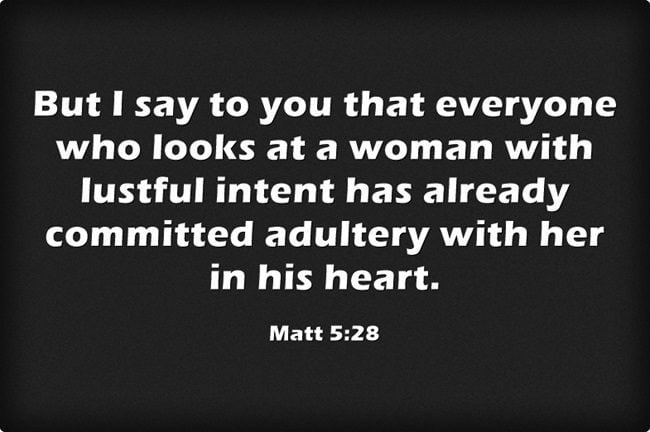
But-I-say-to-you-that

A Biblical Definition of Lust

I like what C.S. Lewis wrote many years ago. He wrote “If you look upon ham and eggs and lust, you have already committed breakfast in your heart.” This is a very good, biblical definition of lust in the heart. If you covet something or someone, that is lusting in the heart. Exodus 20:17 lists the tenth commandment as “You shall not covet your neighbor’s house. You shall not covet your neighbor’s wife, or his male or female servant, his ox or donkey, or anything that belongs to your neighbor” so lust is not just about looking at someone of the opposite sex, or for some, looking at someone with lust of the same sex, it is coveting what you don’t have. It is a passionate desire to have what someone else has.

What Lust Can Lead To

David let his lust carry him away as “One evening David got up from his bed and walked around on the roof of the palace. From the roof he saw a woman bathing. The woman was very beautiful” (2nd Sam 11:2) and so he lusted after her in his heart. This led to adultery and later, to the murder of Bathsheba’s husband, Uriah. This is why James wrote that “after desire (or lust) has conceived, it gives birth to sin; and sin, when it is full-grown, gives birth to death” (1:15). The proverbs say “Do not lust in your heart after her beauty or let her captivate you with her eyes” (6:25). Jesus said that it was “out of the heart come evil thoughts–murder, adultery, sexual immorality, theft, false testimony, slander” (Matt 15:19). Solomon understood this connection, writing that as a man “thinks within himself, so he is” (23:7a). You can commit adultery without ever committing the physical act. Jesus said that “that everyone who looks at a woman with lustful intent has already committed adultery with her in his heart” (Matt 5:28) and of course the same thing applies to women.

A Biblical Definition of Love

There are so many places that define love in the Bible that it will be hard to select only a few. Paul writes that “Love is patient and kind; love does not envy or boast; it is not arrogant or rude. It does not insist on its own way; it is not irritable or resentful; it does not rejoice at wrongdoing, but rejoices with the truth. Love bears all things, believes all things, hopes all things, endures all things” (1st Cor 13:4-7). The love of God is not about feelings or words but “God shows his love for us in that while we were still sinners, Christ died for us” (Rom 5:8). Love is a verb; it is what you do more than what you say or what you think. We know that Jesus did not feel like taking on all of the sins of humanity, but His great love for us on the cross proved what the love of God is like. He died for us while we were still wicked sinners and His enemies (Rom 5:8, 10).

Conclusion

The differences between love and lust are that we don’t covet what we don’t have. We shouldn’t covet (lust after) our neighbor’s spouse or their goods (Ex 20:17). Love, on the other hand, “does no wrong to a neighbor; therefore love is the fulfilling of the law” (Rom 13:10) and this means “You shall love your neighbor as yourself” (Matt 19:19) but above all “You shall love the Lord your God with all your heart and with all your soul and with all your mind” (Matt 22:37). The difference for believers is that we are told “Love your enemies and pray for those who persecute you” (Matt 5:44). The greatest display of love was not what Jesus felt or what God feels but it was revealed at Calvary. Jesus said “Greater love has no one than this, that someone lay down his life for his friends” (John 15:13) and that’s just what He did. Lust harms, love sacrifices.

—————-

**By Jack Wellman at what Christians wat to know / Photo by Mark Stebnicki at Pexels

Popular Articles

A Clear Gospel Message

The Abortion Debate

Human Trafficking / Child Abuse

The True Gift

True or False Conversion

Once Saved Always Saved?

The Judge – Upholding what is right comes at a cost

What is a True Christian or Believer

Prayer Speaking to God

Forgiving Others as God has Forgiving you

Prayer for forgiving others

Living Right Today

Shall We Sin So Grace May Abound?

Sin. It’s something most of us would rather not think about. For the unsaved person, sin is something that separates them from God, due to his perfect holiness. Yet for the Christian, their sin has been paid for. When God looks at them, he doesn’t see their sin, but instead righteousness.

How can that be? The answer is Jesus.

Jesus took the place of us on the cross. He paid the price of our sins with his very life and his holiness was accounted to us (2 Corinthians 5:21). God made it possible for us to be with him through the blood of his holy Son. Instead of condemnation, we receive grace. Instead of rightful punishment for our sins, God sees us as his sons and daughters. Indeed, this is the miracle of the Christian faith for all who believe.

But this brings up an important question. If our sin is already paid for, why should we stop sinning? In fact, doesn’t the vastness of our sin just make his grace more beautiful? Shall we sin that grace may abound?

Shall We Continue in Sin?

Paul demolished this dangerous line of thought in Romans 6. Christ died to free us from sin, not enable us to sin. When Jesus died, he was releasing us from our bondage to sin, because that is what sin is — slavery. Sin is what separates us from God. It’s damaging, and for the unredeemed, it is damning (Romans 6:23).


“For we know that our old self was crucified with him so that the body ruled by sin might be done away with, that we should no longer be slaves to sin — because anyone who has died has been set free from sin.” – Romans 6:6-7 

So, shall we then continue in sin that grace may abound? Paul replies with a resounding “God forbid” (Romans 6:2). To desire to continue in sin shows a misunderstanding of this abundant grace and a contempt for Jesus’ sacrifice. Either we believe what God says is true or we don’t. Either we take him at his word when he equates sin to death, or we do not believe him at all (Ephesians 2:1).

What is the point of the Christian faith if we get to pick and choose what we want to believe? Do we think God is that small, insignificant or somehow uninformed? Do we trifle with the very thing that God sent his Son to save us for? Do we misuse the grace that he gifted us with in his death and resurrection? Surely not.

Sin and Grace

Grace is a gift. Forgiveness of sins and his salvation are gifts. Grace is not, however, a license to sin. Throughout the Bible, fathers of our faith are seen distressed, tormented by their sin.

Consider David after his adultery with Bathsheba or Peter after denying Christ (Psalms 51:17 and Matthew 26:75). They did not discount their sin as simply something atoned for. Just because the Christian’s sin is paid for by Jesus, sin is still damaging to the believer and their relationship with God.

When David tried to ignore his sin, his “bones wasted away through my groaning all day long” (Psalms 32:3). He did, however, find freedom in confession.


“Then I acknowledged my sin to you and did not cover up my iniquity. I said, ‘I will confess my transgressions to the LORD’ – and you forgave the guilt of my sin.” – Psalms 32:5 

A Christian who pursues sin despite claiming Christ as their Savior is living outside the blessing and fullness of the relationship that comes with an obedient life. We cannot equate grace with freedom to sin. Instead, we should be thankful that grace provides freedom from sin and its eternal consequences.

Doesn’t that kind of grace make you want to obey the one who set you free?

What Is Sanctification?


“If you love me, you will obey my commandments. I will ask the Father, and he will give you another helper who will be with you forever. That helper is the Spirit of Truth. The world cannot accept him, because it doesn’t see or know him. You know him, because he lives with you and will be in you.” – John 14:5-17

The Christian’s spiritual journey doesn’t begin and end at a one-time prayer of confession. When we truly see our need for God, his grace and Christ’s sacrifice for us, we will want to obey him. Why? Because we will overflow with love and gratitude that the God of all creation cares enough to save us from ourselves. And if we love him, we trust him when he calls us to higher things. This pursuit toward Christ, and refining of our faith, is sanctification. Sanctification is progressing toward Christlikeness. A Christian cannot pursue both Christlikeness and sin.

So Christians, remember his abounding grace toward you. Turn from sin and embrace your new life as a vessel of light. You are dead to sin, alive in Christ.

Now go live it.

———

***By Lizzie Hoover at Grand Canyon University: gcu.edu / Photo by Mike Waters at Joyful Toons

God Does Not Want Our Offerings, But Our Body as a Living Sacrifice

“May we first learn to sit at His feet and listen, and nurture a pure and simple devotion unto Him… may He lead us in all our ways, never leaning on our own understand, but in all our ways acknowledging Him, so He can direct our paths…

In Hebrews 10:5, we read that “God doesn’t want our offerings.” I quote this verse to people who have suffered under preachers who have kept on telling them that God wants their offerings. What does it say here that God desires from us? – Our bodies. Under the old covenant, the emphasis was, “Pay your tithes to the Levites.” In the New Testament the emphasis is, “Give your bodies to God” (Rom.12:1). A church that is constantly asking its people to pay their tithes is an old-covenant church. A new-covenant church will emphasise presenting our bodies -our eyes, our hands, our tongues, etc.,- as a living sacrifice to God. It is not material offerings that God desires from us today, but our bodies.

Giving our bodies to God is the new-covenant equivalent of the old-covenant tithe – just like Christ dying on the cross is the equivalent of the old-covenant lamb sacrificed on the Passover day. Does this mean that we don’t have to give any money now for the work of God on earth? You may certainly give, but God wants only what you give cheerfully (2 Cor.9:7). In any case, He wants your body first of all. Those who give Him their bodies usually give Him everything else as well. But everything must be given cheerfully and joyfully.

When Jesus came into the world, He did not come to give tithes and material offerings to His Father (Hebrews 10:5). He came to give His body as a sacrifice. And He is the Mediator of the new covenant and taught us that what God wants from us, primarily, is our body.

Many give offerings of money and service to God. You may boast that you have distributed hundreds of tracts, or served as a missionary in some difficult area for many years, or prayed for a number of hours, or fasted for many days. These are all good offerings. But those offerings don’t have any value to God, if you still lust sexually with your eyes and still get angry. Then you haven’t given Him what He wants first of all – your body. Then God will say to you, “Forget about giving Me your sacrifices and your offerings. Give Me your eyes and your tongue first of all. I want your body.” Don’t substitute material offerings for your body. People who value the material offerings they have given to God are back in the old covenant. In the new covenant what God wants is your body. The book of Hebrews is one of the most important books in the Bible. If you want to live in the new covenant, study Hebrews.

Jesus never had a body when He was in heaven. When He came into this world the Father gave Him a body. What was He to do with that body? Was He to show His love for His Father by going to some difficult place like Africa as a missionary? Or was He to pray for 4 hours every day and fast twice a week? None of these. He says, “I have come (to earth), to do Your will O God – and not to make sacrifices” (Hebrews 10:7). This is what Jesus used His body for- and this is what we have to use our bodies for, as well. When we present our bodies to God, it is to do His will thereafter with every part of them- with our eyes, hands, tongues, passions, desires, etc., our only passion in life thereafter will be to do the will of God every day.


—————————————-

**Copyright – Zac Poonen. No changes whatsoever are to be made to the content of the article without written permission from the author: cfcindia.com / photo by Cottonbro at pixels

Don’t Despise Difficulty

One night, just before I went to bed, in my mind, I heard. “Don’t despise difficulty.”

In John 15:2 it says, “Every branch in Me that does NOT bear fruit, He takes away; and every branch that bears fruit, He prunes it…” Why does God do this? “… so that it (the branch-the Christian) may bear MORE fruit.
Vs.8 My Father is GLORIFIED by this, that you bear MUCH…fruit,.(not just a little, but MUCH fruit) and so prove to be My disciples.

To prune a tree, you must cut/remove specific branches or stems to BENEFIT the whole tree. The removal of dead, damaged diseased branches, HELP to PREVENT insect and decay organisms from entering the tree.

When God prunes me, ITS FOR MY BENEFIT! By the Holy Spirit He removes what is dead, damaged and diseased in my heart. When condescending words come from a co-worker, God can prune/cut off STEMS of pride, that are causing decay in your heart that says, how can you talk to me that way? I DESERVE RESPECT. IT’S FOR MY BENEFIT, when that big BILL comes. God can prune us to remove that disease of loving money, that UNREST you feel because your retirement fund has decreased.

God says, I’m pruning you, SO you CAN HAVE the BENEFIT of bearing MORE Fruit! Don’t despise the cuts, bear MUCH fruit! Fruit of the Holy Spirit (Gal. 5:22-23).

Much more love for one another (John 15:12) with people who are different than you, rejoicing ALWAYS, peace that surpasses understanding, an ABUNDANCE of patience DURING being tempted to be annoyed at someone, the law of kindness ALWAYS on your lips though you you’ve just been insulted, the goodness of God flowing out of your heart, faithfulness to God, the gentleness of Jesus to others, and dependence upon the Holy Spirit for self-control.

Do you want that? REALLY?

God is saying don’t despise the pruning, the cuts of difficulty. I’m doing great things in your life! And yes, you can enjoy a good meal, a nice trip and even good sleep, BUT that’s NOT the ABUNDANT life, God is calling us to! We SET ourselves up for discouragement, when we LIVE for ease, comfort and pleasure.
Jesus said, where your treasure is, there your heart will be also. Matt.6:19-21
We have to be careful NOT treasure our pleasure.

I also have to be careful what I call a BLESSING or a BENEFIT in my life.

I’m NOT COMPLETELY there yet, BUT I’m believing God WILL bring me to a place where I can ALWAYS see His pruning in my life, as an ABSOLUTE BENEFIT TO HIM! Not ONLY what benefits me. (2 Cor.5:9)

Just like we take our bags of fruit home from Safeway or farmers market. We enjoy eating the fruit. Can God do that too? When He walks out to the garden of my life, can HE partake of the Fruit of His Spirit? (Gal.5:22-23) Can He take each fruit, out of the bag and say Ah…humility? Another bite, Ah…love, ah…self-control? Another bite…ah patience, how good it is too eat of My children’s fruitful lives! If God does not prune me, I CANNOT give HIM that fruit! I cannot make Him go…Ah!

John 15:1 My Father is the vinedresser. He prunes, trains, and cultivates. If the fruit is NOT coming out of my branch, it’s possible I’m NOT abiding in the Vine, Jesus. Am I KEEPING His word? Am I dried up? Maybe you just got pruned. And you’re thinking, I got nothing man. PERFECT Vs. 5 Apart from Him, you CAN DO NOTHING! Realizing how INCAPABLE we are and how ABLE He is, will help us depend on Jesus, the Vine. His grace is sufficient (2 Cor.12: 9).

Before fruit appears/grows, it must go through a process of unseen nourishment from the vine.
So it is with fruit in my heart for God. Fruit will come as I get nourishment from the Vine/Jesus. That means I remain in His love and obey His word. Not copying and pasting on the fruit of the Spirit with some dead work, selfish motive. No, if I keep/obey His word, I can prove to God in MY HEART, I’m a DISCIPLE of Jesus. Not prove to others, BUT to God first, who sees and knows all, in the deep secrets of my thoughts and desires. To prove my devotion and allegiance to Him IN the difficulty. (John 15:8) Then the fruit can grow and be GENUINE.

If we look at Luke 14:25-33, we can see some ways our devotion and allegiances WILL be tested as a disciple of Jesus. My love for GOD should be MUCH greater in comparison to my love for others and for myself. So much so, that my love for others and for myself, LOOKS like hate. This is tested in the CLOSEST relationships. Father, mother, wife, children, siblings and even our own life (vs.26). All these relationships can have disagreements. And when you have a strong disagreement, you can have difficulty.

Jesus said in the very next verse, 27 “Whoever does not carry his own cross and come after Me cannot be My disciple.”
We face a choice to pick up our own INNER cross. We can decide to please others, please ourselves OR please Jesus. When we chose to please Jesus, it will cost us. It may cost us a “silent” treatment, disrespect, misunderstanding, others being angry with us and maybe even left alone or cut off. Yes, this can even happen in our OWN homes. (Luke 12:51-53).

In Phil. 2:1-11 We see the glory of Jesus, how He carried His cross. He humbled Himself His entire life, even to the point of death. Even in His own home, at least for a time, His brothers were not believing in Him ( John 7:5 ). They lived with Jesus and never saw Him sin even once! Yet they still mocked Him.
In Mark 3:21 says, “When His own people ( kinsmen-blood relatives ), heard of this, they went out to take custody of Him; for they were saying, “He has lost His senses.” In other words, Jesus’ own family called Him crazy! These are just a few examples of what we can face if we live by Jesus’ standards. Jesus Himself said in:
Matt.10: 34 “Do not think that I came to bring peace on the earth; I did not come to bring peace, but a sword. 35 For I came to set a man against his father, and a daughter against her mother, and a daughter-in-law against her mother-in-law; 36 and a man’s enemies will be the members of his household. 37 “He who loves father or mother more than Me is not worthy of Me; and he who loves son or daughter more than Me is not worthy of Me.38 And he who does not take his cross and follow after Me is not worthy of Me. 39 He who has found his life will lose it, and he who has lost his life for My sake will find it.

Maybe it’s Jesus’ standard against the finances between you and your spouse. Maybe it’s Jesus’ standard in your wedding plans against your family’s standards for your wedding plans. Maybe it’s deciding what church to go to or continue to go to. Or even different opinions and thoughts about ministry in the church. Yes, even there we can find Jesus’ dividing sword of discipleship. If I can’t have a humble attitude and pick up my INNER cross IN my home, I certainly won’t be able to do it in God’s church.

God knows in these relationships we WILL be tested. We CAN carry our own cross, when we love Jesus MORE than our own families and our own life. And in so doing, we actually love them better. Whether others say so or not. If that happens because we’ve chosen to obey God, not man, He will honor us ( 1 Sam.2:30 ). And that is greater than ANY honor we can receive!

Jesus sums it up in Vs.33 “So then, none of you can be My disciple who does not give up all his own possessions.”
If we are holding onto these relationships at the cost of lowering Jesus’ standards to follow what they say, we cannot be His disciple.
Being a follower of Jesus, is not a matter of how many times we’ve read, studied or memorized the Bible. Not a matter of how many times we went to church, shared the word, gave a testimony, prayed or helped people. Yes, amen, we should do these things BUT it’s NOT what qualifies me to be a disciple of Jesus.

Though God may prune me in these relationships, I don’t have to fear
God DOESN’T prune us to be mean. John 15:4-10 says, He does this so we can remain in His love. And when we keep His word, that’s what happens. We remain in His love. He stays close to us and we to Him. And I NEVER lose out, though the pruning HURT.
We see in verse 11 Jesus asked, why have I said these things to you? To discourage you? No. I HAVE SAID THIS TO YOU, SO I CAN…. GIVE you MY JOY TO THE FULLEST!!!!

So, I’m believing God, that when I face difficulty and I’m getting pruned, I can ACTUALLY look forward to some Promises!
John 15: 8 When I bear fruit of the Holy Spirit, I WILL give Him glory. Verse 10 If I obey His word, I WILL abide in His love like Jesus did. And verse 11 When I do these things, I WILL get Jesus’ JOY…. to the FULLEST!
The Lord is so generous, He gives us His joy too when we are faithful to Him in difficulty.

If you are IN a tough spot now, remain in His love. Obey His word and believe God WILL fulfill His promises, even IN your difficulty!

——————————————————

**By Paul Moore © Copyright – Paul Moore. No changes whatsoever are to be made to the content of the article without written permission from the author. https://nccf.com/ 

Picture by Pixabay at pexels

8 Reasons Why Obedience to God Is Important

8 Reasons Why Obedience to God Is Important

1. Jesus Calls Us to Obedience: If you love me, you will keep my commandments. (John 14:15, ESV)

2. Obedience Is an Act of Worship: And so, dear brothers and sisters, I plead with you to give your bodies to God because of all he has done for you. Let them be a living and holy sacrifice—the kind he will find acceptable. This is truly the way to worship him. (Romans 12:1, NLT)

3. God Rewards Obedience: Jesus replied, “But even more blessed are all who hear the word of God and put it into practice.” (Luke 11:28, NLT) But don’t just listen to God’s word. You must do what it says. Otherwise, you are only fooling yourselves. For if you listen to the word and don’t obey, it is like glancing at your face in a mirror. You see yourself, walk away, and forget what you look like. But if you look carefully into the perfect law that sets you free, and if you do what it says and don’t forget what you heard, then God will bless you for doing it. (James 1:22–25, NLT)

4. Obedience to God Proves Our Love: By this we know that we love the children of God, when we love God and obey his commandments. For this is the love of God, that we keep his commandments. (1 John 5:2–3, ESV) Love means doing what God has commanded us, and he has commanded us to love one another, just as you heard from the beginning. (2 John 6, NLT)

5. Obedience to God Demonstrates Our Faith: And we can be sure that we know him if we obey his commandments. If someone claims, “I know God,” but doesn’t obey God’s commandments, that person is a liar and is not living in the truth. But those who obey God’s word truly show how completely they love him. That is how we know we are living in him. Those who say they live in God should live their lives as Jesus did. (1 John 2:3–6, NLT)

6. Obedience Is Better Than Sacrifice: But Samuel replied, “What is more pleasing to the LORD: your burnt offerings and sacrifices or your obedience to his voice? Listen! Obedience is better than sacrifice, and submission is better than offering the fat of rams. Rebellion is as sinful as witchcraft, and stubbornness as bad as worshipping idols. So because you have rejected the command of the LORD, he has rejected you as king.” (1 Samuel 15:22–23, NLT)

7. Disobedience Leads to Sin and Death: For as by the one man’s [Adam’s] disobedience the many were made sinners, so by the one man’s [Christ’s] obedience the many will be made righteous. (Romans 5:19, ESV) For as in Adam all die, so also in Christ shall all be made alive. (1 Corinthians 15:22, ESV)

8. Through Obedience, We Experience the Blessings of Holy Living: Joyful are people of integrity, who follow the instructions of the LORD. Joyful are those who obey his laws and search for him with all their hearts. They do not compromise with evil, and they walk only in his paths. You have charged us to keep your commandments carefully. Oh, that my actions would consistently reflect your decrees! Then I will not be ashamed when I compare my life with your commands. As I learn your righteous regulations, I will thank you by living as I should! I will obey your decrees. Please don’t give up on me! (Psalm 119:1–8, NLT) This is what the LORD says—your Redeemer, the Holy One of Israel: “I am the LORD your God, who teaches you what is good for you and leads you along the paths you should follow. Oh, that you had listened to my commands! Then you would have had peace flowing like a gentle river and righteousness rolling over you like waves in the sea. Your descendants would have been like the sands along the seashore—too many to count! There would have been no need for your destruction, or for cutting off your family name.” (Isaiah 48:17–19, NLT)

Because we have these promises, dear friends, let us cleanse ourselves from everything that can defile our body or spirit. And let us work toward complete holiness because we fear God. (2 Corinthians 7:1, NLT)


**By Fairchild, Mary. “Why Is Obedience to God Important?” Learn Religions, Aug. 28, 2020, learnreligions.com/obedience-to-god-701962.