What He Must Be…

In pastor and author Voddie Baucham’s book, “What He Must Be,” he states that the man must lead in the Word.  To do so, he himself must be deeply rooted in the Word before he can lead his wife in this area.  I have outlined this book for single women to use as a reference guide for choosing a Godly mate and for men to strive for as God’s standard for them to follow.

The information detailed in this outline is not written by me, but was extracted from the book “What He Must Be,” written by Voddie Baucham Jr.  There are also additional notes I have added from his video series “Love and Marriage” on Youtube, the links are below. 

I am adding this to my blog to help raise my sisters’ standards in the men they consider as future husbands.  And to set the standard for brothers to live by and strive for as they prepare to be husbands to my sisters in Christ!

Ephesians 5:25-31 Husbands, love your wives, just as Christ loved the church and gave himself up for her to make her holy, cleansing her by the washing with water through the word,  and to present her to himself as a radiant church, without stain or wrinkle or any other blemish, but holy and blameless.  In this same way, husbands ought to love their wives as their own bodies. He who loves his wife loves himself.  After all, no one ever hated their own body, but they feed and care for their body, just as Christ does the church— for we are members of his body.  “For this reason a man will leave his father and mother and be united to his wife, and the two will become one flesh.”

Biblical Love

An act of the will, accompanied by emotion, that leads to action on behalf of its object; not led by emotion, nor is it void of emotion, that demonstrates itself by actions on behalf of its object

Marriage is a Ministry

  1 – It was God’s first command, “Be fruitful and multiply…”

  2 – A Training Ground for Church Leaders

  3 – An Illustration for a Lost World

  4 – The Preferred State

          a)  Be Prepared

          b)  Two States, One Standard

          c)  Jesus-Our Ultimate Guide

“Marriage is the God–appointed and legitimate union of man and woman in the hope of having children or at least for the purpose of avoiding fornication and sin and living to the glory of God.  The ultimate purpose is to obey God, to find aid and counsel against sin; to call upon God; to seek, love, and educate children for the glory of God; to live with one’s wife in the fear of God and to bear the cross.”  — Martin Luther

1 – He Must Be a Follower of Christ

a)  A True Believer is Regenerate

a.      He must be born again

b.     There is an infallible connection between regeneration and salvation

b)     A True Believer is Repentant

a.      Repentance is at the core of the gospel message.  A man cannot claim regeneration if he shows no evidence of repentance.

b.     True repentance is the result of an accurate understanding of the significance and gravity of sin, coupled with an overwhelming desire for the remission of that sin through the person and work of Christ.

c)      A True Believer is Reformed

a.      Consistent, perpetual, undeniable, evidence proceeding from his mouth and life on a daily basis.

b. No one who is born of God will continue to sin, because God’s seed remains in them; they cannot go on sinning, because they have been born of God. This is how we know who the children of God are and who the children of the devil are: Anyone who does not do what is right is not God’s child, nor is anyone who does not love their brother and sister. (1 John 3:9-10)

2 – He Must Be Prepared to Lead

a)  He must lead like Christ

a.  Lead in Love

A man who loves like Christ will protect his heart

A man who loves like Christ will protect her heart

b.  Lead in the Word

Leading in the word requires personal time in the word

Leading in the word requires a grasp of the word

Leading in the word requires a Plan for Growth

Leading in the word requires patient instruction

VIDEO: If he is not a man who can mentor you in the scriptures, he not worthy of being your husband. 

Can he disciple and mentor you in the Word of God?

He has to be equipped to mentor and disciple your children in The Word.

He MUST be this before you even think about him!!

c.  Lead in Righteousness

He must be marked with an upright life

He must nurture holiness in his bride

He must influence his family in righteousness

Video:  A man who ensures your purity.

What he’s saying if he wants to get physical: “I want to use you and I want to dishonor you.”

He must be a man who desires for me to be Pure.

A guy who wants you to move in with him is saying, “I want all the benefits with none of the responsibilities.”

“Sex is like Fire.  You put fire in a fireplace and it warms the whole room.  You let fire out of the fireplace, it will consume and destroy everything in its path. It must be in the proper context…and biblically, the only proper context is Marriage.” — Voddie Baucham Jr.

d.   Lead in Selflessness

He will show restraint and patience throughout the courtship process

He must show Christlike selflessness

He must demonstrate his willingness and desire to put her needs above his own

VIDEO: He must be a man who understands what it means to put others before himself.  If he’s more interested in what he can take from you than what he can give to you, then he’s not the kind of man who leads in selflessness.  If he doesn’t treat you like a delicate flower, keep stepping.  Cause what you’re looking for biblically is a man who nourishes you as he would his own flesh.

e.  Lead in Intimacy

External Intimacy

Internal Intimacy

VIDEO: Intimacy happens when I let someone into a part my life that is not readily available to everyone.

Creates a hedge of protection around the marriage relationship that says this relationship is prioritized above all others.

3 – He Must Be Committed to Children

a)  Committed to having children

b)  Committed to investing in children

c)  Committed to supporting children

4 – He Must Practice the 4 P’s

He must be a Protector

He must possess personal strength, wisdom, and courage

He must be a Provider (Dependence on others is a perversion of biblical manhood)

He must have a job

He must have a work ethic

He must have a plan

He must be a Prophet/Priest

A man must Pray for his family

A man must Preach to his family

A Priest is an intercessor who represents his people before God

A Prophet is one who instructs his people in God’s truth

God has given husbands the responsibility of washing their wives in the water of the Word; Diligently teaching the Law to their children; and bringing them up in the discipline and instruction in the Lord

Love and Marriage Video Series, Voddie Baucham

Love and Marriage, Part 1 (sermon starts at 32min:50sec)

http://www.youtube.com/watch?v=PnTCl6Dvr5U&feature=related

Love & Marriage (part 1 – In the Beginning).wmv – YouTube http://www.youtube.com* Sermon starts at – 32min:50sec A sermon series by Voddie Baucham spoken at the 7:22 service at the Northpoint Community Church in Atlanta in 2005

Love and Marriage, Part 2 (sermon starts at 29min)

http://www.youtube.com/watch?v=CKGyFyW3-D4&feature=relmfu

Love & Marriage (part 2 – True Love).wmv – YouTubehttp://www.youtube.com* Sermon starts at 29min * A sermon series by Voddie Baucham spoken at the 7:22 service at the Northpoint Community Church in Atlanta in 2005

Love and Marriage, Part 3 (sermon starts at 29min:15sec)

http://www.youtube.com/watch?v=7wAdURL_qdQ&feature=relmfu

Love & Marriage (part 3 – The Other Half).wmv – YouTubehttp://www.youtube.com* Sermon starts at 29min:15sec * A sermon series by Voddie Baucham spoken at the 7:22 service at the Northpoint Community Church in Atlanta in 2005

Love and Marriage, Part 4 (sermon starts at 17min:50sec)

http://www.youtube.com/watch?v=cybhnuvS1i0&feature=relmfu

——————————

***By Nina Andres author of the book, “God Ordained Relationship”

***More sermons to do with Christian relationships can be found HERE! Covering all stages of a Christian relationship for men and women: single, courting / dating, marriage, home, bringing up children and all the bits in-between.

Popular Articles

A Clear Gospel Message

The Abortion Debate

Human Trafficking / Child Abuse

Trusting God to Heal the Scars of Sexual Abuse

5 Ways Your Kids Are Under Attack and How to Take Action

The True Gift

True or False Conversion

Once Saved Always Saved?

The Judge – Upholding what is right comes at a cost

What is a True Christian or Believer

Prayer Speaking to God

Forgiving Others as God has Forgiving you

Prayer for forgiving others

Living Right Today

Lust Verses Love A Biblical Perspective

Most people know the difference between lust and love so what are they? What does the Bible define as love and as lust?

A Definition of Lust

Lust is an emotion or feeling of intense desire in the body and it can take nearly any form such as the lust for knowledge, the lust for sex or the lust for power. It is an overwhelming self-absorbed desire or craving for an object, person, or experience that might be good but in most cases, is not. For example, a man or a woman can lust after their spouse and since they are legally married, there is no sin in this, however lusting after someone else’s spouse or someone who’s not married is sin, so clearly, lust and love aren’t the same at all and in many ways, they are actually opposites of one another, for example we can lust after riches, for drugs, for alcohol, and for any number of things that are detrimental to our wellbeing.

A Definition of Love

The way the world defines love and the way that God defines love are not even close to the same thing. As far as the world sees, love is a strong and warm affection that someone has for another or others or for something. It could be like that of a parent for a child or a spouse for their mate or it could be a love for reading, eating, drugs, alcohol, or even shopping. Some of these are good and well, but others can lead to ruin. Love can certainly be a strong feeling of affection and concern toward another person, as that arising from a kinship or close friendship, which I have for my own spouse and children and grandchildren and even for my friends but from the biblical standpoint, love and lust are no co-equals since one can be good, while the other can lead to harm.

But-I-say-to-you-that

A Biblical Definition of Lust

I like what C.S. Lewis wrote many years ago. He wrote “If you look upon ham and eggs and lust, you have already committed breakfast in your heart.” This is a very good, biblical definition of lust in the heart. If you covet something or someone, that is lusting in the heart. Exodus 20:17 lists the tenth commandment as “You shall not covet your neighbor’s house. You shall not covet your neighbor’s wife, or his male or female servant, his ox or donkey, or anything that belongs to your neighbor” so lust is not just about looking at someone of the opposite sex, or for some, looking at someone with lust of the same sex, it is coveting what you don’t have. It is a passionate desire to have what someone else has.

What Lust Can Lead To

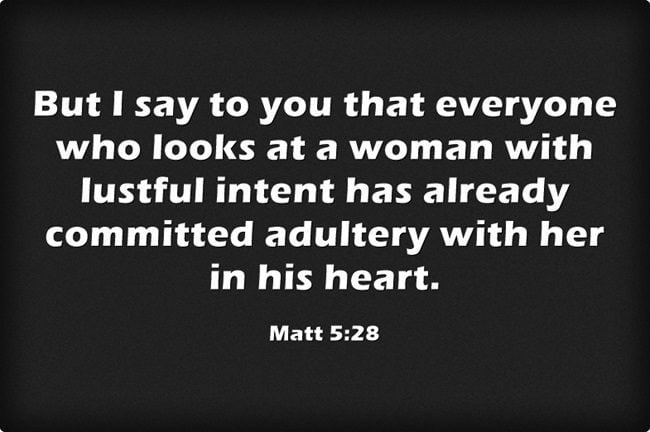
David let his lust carry him away as “One evening David got up from his bed and walked around on the roof of the palace. From the roof he saw a woman bathing. The woman was very beautiful” (2nd Sam 11:2) and so he lusted after her in his heart. This led to adultery and later, to the murder of Bathsheba’s husband, Uriah. This is why James wrote that “after desire (or lust) has conceived, it gives birth to sin; and sin, when it is full-grown, gives birth to death” (1:15). The proverbs say “Do not lust in your heart after her beauty or let her captivate you with her eyes” (6:25). Jesus said that it was “out of the heart come evil thoughts–murder, adultery, sexual immorality, theft, false testimony, slander” (Matt 15:19). Solomon understood this connection, writing that as a man “thinks within himself, so he is” (23:7a). You can commit adultery without ever committing the physical act. Jesus said that “that everyone who looks at a woman with lustful intent has already committed adultery with her in his heart” (Matt 5:28) and of course the same thing applies to women.

A Biblical Definition of Love

There are so many places that define love in the Bible that it will be hard to select only a few. Paul writes that “Love is patient and kind; love does not envy or boast; it is not arrogant or rude. It does not insist on its own way; it is not irritable or resentful; it does not rejoice at wrongdoing, but rejoices with the truth. Love bears all things, believes all things, hopes all things, endures all things” (1st Cor 13:4-7). The love of God is not about feelings or words but “God shows his love for us in that while we were still sinners, Christ died for us” (Rom 5:8). Love is a verb; it is what you do more than what you say or what you think. We know that Jesus did not feel like taking on all of the sins of humanity, but His great love for us on the cross proved what the love of God is like. He died for us while we were still wicked sinners and His enemies (Rom 5:8, 10).

Conclusion

The differences between love and lust are that we don’t covet what we don’t have. We shouldn’t covet (lust after) our neighbor’s spouse or their goods (Ex 20:17). Love, on the other hand, “does no wrong to a neighbor; therefore love is the fulfilling of the law” (Rom 13:10) and this means “You shall love your neighbor as yourself” (Matt 19:19) but above all “You shall love the Lord your God with all your heart and with all your soul and with all your mind” (Matt 22:37). The difference for believers is that we are told “Love your enemies and pray for those who persecute you” (Matt 5:44). The greatest display of love was not what Jesus felt or what God feels but it was revealed at Calvary. Jesus said “Greater love has no one than this, that someone lay down his life for his friends” (John 15:13) and that’s just what He did. Lust harms, love sacrifices.

—————-

**By Jack Wellman at what Christians wat to know / Photo by Mark Stebnicki at Pexels

Popular Articles

A Clear Gospel Message

The Abortion Debate

Human Trafficking / Child Abuse

The True Gift

True or False Conversion

Once Saved Always Saved?

The Judge – Upholding what is right comes at a cost

What is a True Christian or Believer

Prayer Speaking to God

Forgiving Others as God has Forgiving you

Prayer for forgiving others

Living Right Today

How to Start a House Group Fellowship

The really good news is that, to start a house church, you can lay down the burdens of planning how to cope with buildings, programs, and outreach strategies. You don’t have to be an impressive leader (though you probably will have some leadership gifts). To start a house church, you simply need to open your home to friends and neighbours and take things one step at a time.

Pray First!

The first step to starting a house church is to pray. House-church ministry must be birthed in prayer. Though it is a simple step, without prayer and God’s leading, we invite trouble. Starting a house church cannot be just a good idea; it must be a God idea. If you feel that you are called to start a house church, gather a few like-minded people together and begin to pray so that you can receive a strategy from God. Many house churches have false starts that are directly linked to a lack of prayer.

Taking time to pray gives God the opportunity to work in our hearts and purify our motives. When house churches start up because of a reaction to something we don’t like about the established church, the house church’s identity is built from rebellion and discord. Healthy house churches, on the contrary, must begin with God’s leading and a desire to reach those who don’t know Jesus. What a person sows, the Bible teaches us, he also reaps. Therefore, if you begin a house church because of an offense toward an existing church or leader, you will sow the seeds of fault-finding and pride in the church you are creating.

Along with prayer, it is also important to look to the local Christian community’s leaders for spiritual guidance and advice as you launch a new church. From day one of the Lancaster Micro-Church Network, we have cultivated relationships with established believers in our local community and beyond to answer questions and explain to them the concept of micro-church. A wise Bible teacher once said, “Lone rangers get shot out of the saddle.” We agree. Healthy house-church movements are not exclusive groups who refuse to be accountable. Vibrant micro-church networks are spiritually connected to leadership in the Body of Christ.

Know Whom You Are Called to Reach

Every micro-church should know whom they are called to reach. Here’s a great suggestion from Tony and Felicity Dale, who together started a successful network of house churches in Texas:

Draw together people from your circle of influence. We had a number of business associates who were not Christian, but whom we had come to know pretty well over a period of months or years. We asked a dozen of them to join us in a study of business principles while enjoying pizza in our home, using the book of proverbs as our textbook.
There were no rules to our discussion; everybody’s opinion was valid and there was no such thing as a wrong answer. Gradually we introduced prayer and worship and over the course of a year, every one of them became a Christian. They formed the nucleus of our original house church.

When the first micro-church in the Lancaster Micro-Church Network started in our (Larry’s) home a few years ago, we asked God for pre-Christians or new believers to join us—we also asked for labourers to help in the endeavour. However, we ran into some immediate problems. First of all, lots of believers wanted to come and check it out. Some of these Christians were looking for the latest Christian fad. They liked the idea that the micro-church met on a Wednesday, not a Sunday, and that it met in a living room, not a sanctuary.

But we were not starting something new for the sake of starting something new! Since we had a mandate from the Lord to reach new believers, we asked inquiring Christians not to come to our meetings. Having too many older Christians in the group would make the pre-Christians feel uncomfortable.

Jim Petersen, in his book Church Without Walls, clearly describes what can happen if a “migratory flock from neighbouring churches” invades a new church simply because they are curious:

I have a friend who was a part of a team that set out to start a church. The congregation was divided into house churches, each of which was assigned an elder who helped shepherd the members of that house church. Centralised activities were kept at a minimum for the sake of keeping people free to minister to their families and unbelieving friends.

The weekly meetings were dynamic. I will never forget the first one I visited. People of all sorts were there, from men in business suits to ponytails. Many were new believers. The Bible teaching was down to earth, aimed at people’s needs. I loved it.

So did most everyone else who visited. The word got around and soon the migratory flock from neighbouring churches came pouring in. Their needs consumed the energies of the leaders of this young church. Their wants gradually set the agenda. The inertia of the traditions of these migrants engulfed this very creative effort and shaped it accordingly.

So what’s the problem, we ask? The problem is that the vision that original team had for taking the church into society through the efforts of every believer was frustrated.

My wife and I knew that the vision the Lord had given to us to reach a new generation had to be safeguarded in the early days of our new micro-church network, and the young leaders of our network wisely set clear perimeters. They asked God to bring pre-Christians, new believers, and labourers—and the Lord honoured their request.

The Size of the House Church Matters

Quite soon, my wife and I had a second problem in our home-based micro-church. The pre-Christians attending invited their friends, and within 6 months of starting, we had 50 people in our living room on a given night. It was way too large!

It is wise to keep the number of people to between 6 and 12. From my experience, groups less than 6 strong tend to dwindle and be lacklustre because of the decreased number of relationships and interactions possible. However, groups over 12 tend to lose intimacy and every-member participation. It is perhaps not surprising, then, that rapid church planting movements today reproduce small house churches numbering between 10 and 30 people.

Frequency of Meeting

House churches should meet at least once a week to maintain a sense of connectedness. Again, though, we must emphasise the importance of flexibility. Some micro-churches meet at the same location every week, while others move the meeting place by rotating turns in members’ houses. Some groups meet more frequently, others less often. Some house churches meet during the week, others on weekends.

It is crucial that meeting together is an expression of the members’ desire to build community together—not just a religious duty to add more meetings to their already busy lives. If gathering together is done around food and for the purpose of fellow-shipping, it is more natural. Choose times that are convenient for everyone involved and then make an effort to connect with the other members (even just by phone or e-mail) outside of official meeting times. Building a spiritual family takes more than an hour or two one night a week!

Meeting Components

One thing is certain about house-church meetings: they should not be a smaller scale duplicate of a typical Sunday morning meeting. A house-church gathering should not look like an “escaped meeting captured by a living-room,” as one young man described house churches that do little more than replicate and repeat the traditional church service format: worship, teaching, prayer.

Instead, we have learned that there are often four basic components to a micro-church gathering: eating, meeting, small groups, and “the meeting after the meeting.

Although eating (usually a meal) is one of the elements of a house-church gathering, sometimes there may not be food. One week the house church may help someone trim their shrubs and have a time of prayer afterwards, and the next week they may come together for a whole smorgasbord of worship, prayer, teaching, and fellowship. Every week should be fresh and informal as people meet to discuss the life of Jesus and life with Jesus.

—Larry Kreider and Floyd McClung; excerpted from their book Starting a House Church (Regal Publishers, 2007) / Picture by Fauxes at pexels / By Small Groups

Signs You May Be Losing Your Identity in Christ

2 Corinthians 5:17~ “Therefore, if anyone is in Christ, he is a new creation; old things have passed away; behold, all things have become new.”

Our identity is our sense of self and our knowledge of who we are. When we are confident in our identity, we know who we are, what we believe, and why. We make decisions based on our personal values and belief system and surround ourselves with people who reinforce what we believe about ourselves.

As believers, our identity is found in Christ. We have value because He created us. We have purpose because we were created on purpose for a purpose. Our decisions are based on the Bible and the teachings of Jesus Christ.

The Link between Identity and Relationship

I have always maintained that true knowledge of God can only be accomplished when we know who God is. We are created in God’s image and were made to remain in a relationship with Him.

Before His crucifixion, Jesus told His followers: Abide in Me, and I in you. As the branch cannot bear fruit of itself, unless it abides in the vine, neither can you, unless you abide in Me (John 15:4 NKJV).

Jesus wanted His followers to make a deliberate choice to be present with Him. If you are choosing to remain in someone’s presence it means you desire to be in a relationship with them.

Your identity is impacted by the people you spend time with just as your identity influences the people you choose to spend time with.

7 Signs You May Be Losing Your Identity in Christ

  1. Your personal devotion time has dwindled. As Christians, we need to spend time in the presence of our Heavenly Father. This is where we learn about who God is and build the foundation for our identity. When we sacrifice our alone time with God (for whatever reason), we put at risk the foundation on which we build our identity.
  2. Your beliefs keep shifting. The world we live in is filled with many people who believe in many things. If we base our beliefs on what the world says, we will constantly be changing what we believe and how we feel about things. Our beliefs should be based on the Bible which is the infallible Word of God. God’s Word is true and it never changes. When you feel as though you are losing your identity in Christ, reach for God’s Word and find the truth you need.
  3. You’ve lost your passion for Christ. When we first become believers, we are passionate about the Word, and work, of God. Unfortunately, this fervor doesn’t always last. This is why Jesus told the church of Ephesus: But I have this against you, that you have abandoned the love you had at first (Revelation 2:5 ESV).
    If we lose our love for God, what are we going to base our identity on?
  4. You are constantly seeking approval and validation from the world or man. If you’re waiting for the world to approve you will wait for a very long time. Or if you do get the world’s approval, you will always be struggling to keep it. Let’s face it, the world’s standards change all the time. Do not base your self worth on what man thinks of you (the shallow emptiness of another mere mortal’s opinion) the only opinion that counts is God’s, He made you and didn’t make a mistake. You’re wonderfully made and one of a kind.
  5. You talk mostly negative things to yourself. You know no one can criticize you the way you can. But if all you’re doing is talking down to yourself and saying negative things about you to you, you’re doing the devil’s work for him, and he too will be whispering negative things to you. Don’t be Satan’s handmaiden. You were bought with a price and you are special to God. He’s the one who gives you value and determines your worth.
  6. You’ve lost your joy. In John 15:11, Jesus told His disciples: I have told you these things, that My joy and delight may be in you, and that your joy and gladness may be of full measure and complete and overflowing (AMP).
    When you can no longer find joy, especially in the things of God, you may be losing your identity in Christ.
  7. You don’t have a sense of peace. One of the gifts of the Holy Spirit is a peace that surpasseth all understanding… the kind of peace that doesn’t make any sense because everything in your life is upside down, but you’re experiencing it anyway.

If you no longer feel this inner peace you may be losing your identity in Christ.

How to Regain Your Identity in Christ

When you realize you’ve lost, or are on the verge of, losing your identity in Christ, the devil will attack. He will tempt you to walk away from the faith or just give up. Here are some things you can do instead.

  1. Do not give in to the enemy. Hell was never meant for God’s children. The everlasting fire was prepared specifically for the devil and his angels (Matthew 25:41). But Satan knows his time is short and he’s trying to get as many people in hell with him as he can. Refuse to be one of them.

Therefore submit to God. Resist the devil and he will flee from you (James 4:7 NKJV).

  1. Read the Scriptures. The best way to remember who you are in Christ is to spend time reading and studying God’s Word. Maybe you won’t feel like doing an in-depth study, but you can read your favorites verses.
  2. Listen to Scripture songs. Listening to scripturally-sound songs can encourage your heart when you feel like you’re losing your spiritual identity.
  3. Spend time in nature. God is the Creator of everything on earth. Spend time appreciating what He has made and find connection with the sustainer of all life.
  4. Serve in your community or local church. Service takes the focus off ourselves and puts it on others. When we serve others, we remember that Jesus was sent on earth to serve us and gave His life for us in the process.
  5. Pray. Ask God to allow you to see His hand in your life. God is always working but we can’t always see Him because we’re not really paying attention. Ask Him to open your eyes so you can see the wonderful things He’s doing.
  6. Listen to sermons. Sometimes, you just need someone to remind you who you are in Christ. Listen to your favorite pastor or search YouTube for videos on identity.
  7. Reminisce. What was your life like before you were saved? If you grew up in the church, think about the person you were five years ago–how has God changed you?

Bible Verses on Identity and Purpose

Our purpose is intricately woven with our identity in Christ. Only when we know who we are will we begin to understand what God expects from us. Only then can we begin to think about and live our purpose.

As you ponder your identity in Christ, here are a few passages of Scripture to remind you of your identity and purpose.

In him we have obtained an inheritance, having been predestined according to the purpose of him who works all things according to the counsel of his will, (Ephesians 1:11 ESV).

For I know the plans I have for you, declares the Lord, plans for welfare and not for evil, to give you a future and a hope (Jeremiah 29:11 ESV).

But you are a chosen race, a royal priesthood, a holy nation, a people for his own possession, that you may proclaim the excellencies of him who called you out of darkness into his marvelous light (1 Peter 2:9 ESV).

Therefore, if anyone is in Christ, he is a new creation. The old has passed away; behold, the new has come (2 Corinthians 5:17 ESV).

I have been crucified with Christ. It is no longer I who live, but Christ who lives in me. And the life I now live in the flesh I live by faith in the Son of God, who loved me and gave himself for me (Galatians 2:20 ESV).

For we are his workmanship, created in Christ Jesus for good works, which God prepared beforehand, that we should walk in them (Ephesians 2:10 ESV).

I am the vine; you are the branches. Whoever abides in me and I in him, he it is that bears much fruit, for apart from me you can do nothing (John 15:5 ESV).

Therefore, we are ambassadors for Christ, God making his appeal through us. We implore you on behalf of Christ, be reconciled to God (2 Corinthians 5:20 ESV).

Oh come, let us worship and bow down; let us kneel before the Lord, our Maker! For he is our God, and we are the people of his pasture, and the sheep of his hand (Psalm 95:6-7 ESV).

Whatever you do, work heartily, as for the Lord and not for men, knowing that from the Lord you will receive the inheritance as your reward. You are serving the Lord Christ (Colossians 3:23-24 ESV).

When you feel as though you’re losing your identity in Christ it can be a scary thing. The key to not fully losing your identity is to remind yourself what God says about you and to take steps to stop the drift.

Jesus is and what He did. Studying His life in the Scriptures is a great place to start. Also there’s free study exposition called, “All Jesus taught” by Brother Zac Poonen that’s been a great blessing to many:

————

**By Aminata Coote -Hebrews12Endurance.com / Photo by pixabay

Learn to Desire the Best for Others

Our passion should be to know God better and better, because this is eternal life. We are going to spend all eternity getting to know God more and more. This is why eternity will not be boring for anyone whose passion is to know God. Our earthly life too will then not be boring any more. Let us learn something of God’s life and of His ways from Genesis 2, in the way He dealt with Adam. There we see that it was God Who saw Adam’s need for a wife and Who met that need and made a wife for him. There we see what God’s nature is like. God is always alert to the needs of people and does all that He can to meet those needs. When we partake of this Divine nature, we too will become like that – always alert to the needs and problems of those around us and doing everything we can in order to meet those needs! This will involve a great deal of sacrifice on our part often. We need therefore to ask ourselves whether we are willing to pay this price for partaking of the Divine nature.

Our Adamic nature is the exact opposite of this Divine nature. The life of Adam is thoroughly selfish and makes us alert only to our own needs and to the needs of our own family members. In fact it is so full of selfishness and jealousy that it does not want the needs of others to be met even by another. On the contrary. it enjoys seeing people suffer.

When man sinned, God placed cherubs in front of the tree of life with a sword that turned in every direction to guard the way to that tree. The tree of life symbolises eternal life – knowing God. Through this sword placed in front of the tree of life, God was symbolically showing Adam that if anyone now wanted to partake of the tree of life, he had to first experience the sword falling on his own selfish life. We read in Genesis 3:21 that as soon as Adam and Eve sinned, God killed an animal in Eden and clothed them with coats of the skin of that animal. There too God was teaching them the same lesson – that the only way for them to be clothed now was through the way of sacrifice and death. Adam and Eve had tried to clothe themselves at first without any “death” – with just fig leaves. But God threw those leaves away and showed them the right way to be clothed. So we see right from the beginning God emphasising sacrifice as the way for man to fellowship with Him and to be clothed with His nature.

God told Cain that his fundamental problem was that he “did not intend well” towards his brother Abel (Genesis 4:7). Jude speaks of those who walk in “the way of Cain” (Jude 11). Who are they? They are those who do not intend well towards their brothers. It is good for all of us to have a spiritual check-up in this matter. Can you honestly say that you desire the very best for all the brothers and sisters in your local church and for their families? Can you also say that you desire the very best for other believers whom you know in other denominations? Then widen the circle still further and ask yourself if you desire the very best for all the people whom you know, including your relatives, your enemies and those who have harmed you in any way. If you find a disturbance in your heart (instead of a rejoicing) when something good happens to another person or to his children, or if you sense a rejoicing in your heart (instead of a grief) when something evil happens to him or his family, what do such attitudes indicate? Just this that the life of Adam is alive and active in you.

If you are honest with yourself, you will soon discover whether you are walking the way of Cain or not. You must be quick when you see that evil Adamic life within you to put it to death, if you want the fire and the anointing of God to rest upon you constantly.

It is when the grain of wheat falls into the ground and dies TOTALLY, that there will be much fruit. One who dies totally to himself will never get offended, no matter what others do or don’t do. He will always intend well towards all. He will never get angry in any matter that concerns himself and he will never quarrel with anyone. He will never shed a single tear for himself in self-pity – for, surely, dead people don’t weep in their graves!!

Cain’s face was sullen and dark when he did not intend well towards his brother (Gen.4:6). We may not realise it, but the attitude we have in our hearts is often reflected on our faces. If you intend well towards all, your face will always beam with the joy of the Lord. Many believers are walking in the way of Cain. Beneath their weak smiles and the “Praise the Lord”s that come from their lips, are found wrong attitudes towards their fellow-believers. When people turn against you and do evil to you, God uses them to give you a scan of your real heart condition. If you cannot love them, your heart-scan will show that you have NOT partaken of God’s nature, for God’s nature is one that loves even His enemies. Jesus intended well even towards Judas Iscariot.

God desires the very best for all people. The gospel message is that we too can partake of this nature. Those who haven’t understood the gospel thus haven’t understood the gospel at all.

————

**Copyright – Zac Poonen. No changes whatsoever are to be made to the content of the article without written permission from the author.