Video – Victor Mark’s testimony is one of the redemptive power of God
Nothing is impossible for God! He is the restorer and healer of all things, if you give it to Him.
Victor Marx is a remarkable figure who has dedicated his life to humanitarian efforts and helping those trapped in devastating circumstances, including victims of human trafficking. Overcoming his own traumatic childhood of serious abuse and neglect, he transformed his pain into a mission to bring hope and restoration to others.
Through his organisation, All Things Possible Ministries, Victor works in high-risk areas, including war zones and regions plagued by human trafficking, to rescue and rehabilitate those in need. His ministry has impacted tens of thousands of lives, including children and survivors of abuse, as well as prisoners through his outreach programmes. His work exemplifies courage, faith, and perseverance.
Victor Marx is also a devoted family man with over 34 years of marriage, five children, and five grandchildren. He shares his wisdom and experiences to inspire others, blending his military discipline, faith, and compassionate outlook to build successful relationships and empower individuals to thrive despite life’s challenges.
Notable Quotes by Victor Marx:
“Kids who are born in the fire , will not be burned by the heat of life”
“Forgiveness is giving up your right to hurt someone back for hurting you.”
“Forgiving: gaining real estate in your heart to both give and receive love”
Support
To support Victor Marx’s ministry and his mission to bring hope, freedom, and restoration to those in desperate need, consider contributing to All Things Possible Ministries: Support
Outstanding interviews with Victor Marx at the Shaun Ryan show
Part 1 – How Victor became the Guinness book of records fastest gun disarmer in the world
“Please help me! Please don’t send me back!” screamed 7-year-old Preena as she jumped into Amy Carmichael’s lap, clinging to her neck. The little girl had just escaped from a Hindu temple in the middle of the night while her guardians were sleeping. She tiptoed quietly through an unlocked door and pushed open the heavy gate running as fast as she could.
Preena’s mother had given her to the temple priests in hopes of winning the favor of the gods. Amy did not know what was going on, but she knew this little-frightened girl needed her love and protection.
The Missionary: Amy Carmichael
Amy Carmichael had come to India as a missionary to reach those who did not know Jesus. Amy was sure that God did not want her to marry and have children of her own. That decision had been settled many years before. But was He now asking her to settle down and become a mother to an unwanted Indian child?
Life in Ireland
Amy Carmichael grew up in a wealthy family in Ireland. Her father owned a flour mill business. She went to the best boarding schools and had many fine things.
But one day Amy’s life changed without warning. Her father’s business began to lose money and it closed. Mr. Carmichael worried so much about his business that he became ill and died.
The family could no longer afford expensive things. Amy had to drop out of school. She spent the next ten years helping her mother take care of her younger sisters and brothers.
Life-Changing Events
One cold, dreary day as the young Amy, her mother and brothers left the church, Amy saw something that changed her life. An old beggar woman came staggering out of the alley. Her clothes were torn and mud-soaked rags covered her feet. Amy felt sorry for the woman. She and her brother helped the old woman down the alley. When she saw other people from church pass by them, she was embarrassed to be seen with the woman and hid her face. As she continued to walk with the beggar, Amy noticed a fountain in the center of the road. She studied it closely. Then she heard a voice say, “Gold, silver, precious stones, wood, hay, and straw — the fire will test what sort of work each has done. If the foundation survives, he will receive the reward.” She turned to see who was speaking but saw no one. Amy knew that she appeared kind by helping the old woman, but she knew her heart was wrong. From that moment on, she decided to hold her head high. She was no longer embarrassed. When she got home, she searched the bible and found the words she had heard. Amy knelt by her bed and promised God that in the future she would only do things to please him.
Another time she and her mother stopped to have tea and biscuits in a restaurant. As they ate, Amy saw a dirty little beggar girl with her nose pressed against the window. The poor little girl, with no food, touched Amy so much that she made another promise. She promised that when she grew up she would give her money to the poor.
The Shawlies
Amy Carmichael became very excited about doing what God wanted her to do. On Saturday evenings, she would go with her pastor to the poor neighborhoods to hand out tracts and food to the poor people known as Shawlies. The Shawlies made so little money that they could not afford hats so they used their shawls to protect their heads from the cold. They were eager to learn about God. Amy’s heart went out to them. She moved into their neighborhood and slept in bug-infested beds to be closer to the people. She prayed about building a church for them to attend but didn’t know where she would get money for such a large job. She did not want to ask the rich people in her old church who didn’t seem to care about the Shawlies. Instead, she and the Shawlies asked God to provide it. God answered their prayers and a new church was built.
Time to Move On
Amy began to sense that God wanted her to tell people in other countries about him. There was one problem though. Amy had an illness that made her so sick she had to stay in bed days at a time. Despite her health, she knew she must obey God.
Life In India
Amy traveled the India countryside telling anyone who would listen about Christ.
One day Preena, a little Indian girl, was collecting water for the temple near where Amy was speaking. Preena stopped to listen as Amy told the ladies about her God who loved everybody the same. He did not put people in different classes as the Indian caste system did. Preena was very interested in what Amy was saying but knew she must not be seen listening to the stranger. She tucked Amy’s words into her memory and hurried back to the temple.
Indian girls were often unwanted and were given to the temple to serve as prostitutes. Because of this, when Preena arrived at Amy’s door, Amy knew she could not send her back. The little girl would be beaten, even killed, if she were returned. Amy could have been charged with kidnapping and thrown into prison. But it was a chance she was willing to take.
Over the 50 years she spent in India, Amy Carmichael took in hundreds of unwanted children. She became known as “Amma” or mother to them.
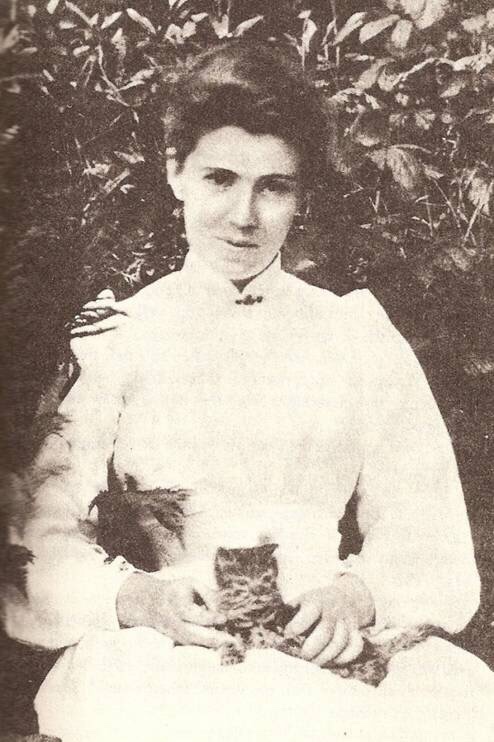
She was born Elisabeth Howard in 1926 – one of six children – to missionary parents in Brussels, Belgium. Her parents moved to Philadelphia, USA, a few months after Elisabeth was born. She later described them as devout, disciplined Christians who built their family life around the Bible.
‘We grew up with the understanding that the scriptures were top priority… we had bible reading and prayer at the end of dinner every night as we sat around the table, and up until the age of, I suppose, seven or eight, each of us children was put to bed by one of our parents and prayed with, and sometimes we had the bible read to us again. so we heard the bible read aloud at least twice a day, sometimes three times a day.
‘And the other very very powerful influence in our lives, I’m sure was the fact that my father got up himself between 4:30 and 5:00 in the morning in order to have time alone with the Lord.
And when we came to breakfast, we knew that we had been prayed for… meaning my father was in his study for those hours before breakfast with his prayer lists and his notebooks and his bible and down on his knees praying for us.’
Elisabeth reckoned she herself came to faith at around the age of five. This was followed by a definite commitment to Christ when she was twelve: “I think I realised that if Jesus was my saviour, he also had to be my Lord, so I then committed my life and said, ‘Lord, I want you to do anything you want with me.’”
We can surmise from this that even at this tender age Elisabeth realised she had a calling to the mission field. She studied classical Greek at Wheaton college, Illinois, believing that it was the best tool to help her with her desire to translate the New Testament into a yet-unreached language.
It was at Wheaton where she met Jim Elliot. Before their marriage they both went individually to Ecuador to work with the Quechua Indians; the two married in 1953 in the city of Quito, Ecuador.
Before Elisabeth started her work, she listened to the words of Maruja, a woman of a neighbouring tribe who had been held captive for a year by the Huaorani, sometimes called the Aucas, or ‘savages’. She told Elisabeth that the tribe was fierce and they acted like savages, but that the women were likeable and kind. In 1955, only ten months before Jim was killed, Elisabeth gave birth to a daughter, Valerie.
Elisabeth said that she had a premonition that Jim’s mission might end in his death, explaining, “I often thought I was going to lose my husband.” In fact, just before he left for his fateful mission to the Aucas they had talked about what she would do if Jim should not return.
So as they said what turned out to be their last goodbyes in January 1956, her mind was a filled with thoughts as to whether that would be the last time she saw him alive.
Jim and four other Christian missionaries Nate Saint, Roger Youderian, Ed Mccully and Peter Fleming – were speared to death in the jungles of Ecuador. Their killers were Huaorani Indians, the same group that Elisabeth had been warned about earlier.
After Jim’s death, Elisabeth, together with Rachel saint, the sister of another of those killed, continued her work among the Quechua at a site which was several days by trail from Auca territory.
Despite what had happened to their men, Elisabeth and Rachel were still determined to reach the killers with the gospel. At the time, their only link with Auca culture came when they met Dayuma, a young woman who had fled the tribe some years before to live with white missionaries. Dayuma, who was by then a believing Christian, helped them with the Auca language.
In November 1957 came a breakthrough. Elisabeth heard that two more Auca women had left their tribe. She hurried to the neighbouring settlement where the women – Mintaka and Minkamu – were, and spent the next ten months with them, seeking to learn more of the Auca language and culture.
Eventually the two Auca women – together with Dayuma – decided to return to their native tribe, leaving Elisabeth and Rachel wondering what the fate of the three women might be when they arrived home.
However, after three weeks the women returned to the mission compound bringing along seven other Aucas, plus a invitation to the missionaries to visit the tribe!
‘As long as this is what the Lord requires of me, then all else is irrelevant’ Elisabeth Elliot
Elisabeth and Rachel lost no time in taking up this unprecedented offer. However, Elisabeth admitted that taking her three-year-old daughter, Valerie, along strapped to her back was ‘the biggest test of faith ever’.
As well as the usual dangers found in jungle terrain, she had to face the possibility that the Aucas might choose to kill her and carry off the youngster.
In a later interview she said that, although she appreciated the kind warnings of fellow Christians, she felt that ‘as long as this is what the Lord requires of me, then all else is irrelevant’.
The journey to the Auca village took two-and-a-half days by canoe and trail paths. Ironically, the party arrived on the afternoon of 8 October 1958, Jim’s birthday and the day which would have been the couple’s fifth wedding anniversary.
When the missionaries reached a clearing in the jungle, there stood a welcoming party of three Aucas.
Elisabeth described the reception as ‘friendly… it seemed like the most natural thing in the world’. For the next year the missionaries enjoyed a good relationship with the tribe as they ministered to them. the Aucas gave Elisabeth the tribal name ‘Gikari’, Huao for ‘Woodpecker.’
She later returned to the Quichua and worked with them until 1963, when she and Valerie returned to the USA. Rachel saint continued the work with the Aucas under the auspices of their sponsoring missionary society, the summer Institute of linguistics (sIl).
Over the years some anthropologists have criticised the missionaries’ work, viewing their intervention as the cause for the widely-recognised decline of Huaorani culture. In response Elisabeth Elliot said in an interview that there is absolutely no point in trying to reach tribes like the Huaorani unless you believe the New Testament message that people – however few and remote – are lost without the gospel of Jesus Christ.
And while no-one would claim the missionaries didn’t make mistakes along the way, the gospel they preached resulted in a marked decline in violence among tribe members, together with numerous conversions to Christianity and the growth of the local church.
Indeed, it has been argued by others that the effects of Christianity were very positive, as it served as a way for the Huaorani to escape the cycle of violence in their community, providing them with a motivation to abstain from killing. Ironically it was probably exposure to Western ‘civilisation’ – not the gospel – that had the most detrimental effect on the Huaorani people.
On her return to America, Elisabeth became a noted speaker and writer. Her book, ‘through gates of splendour’ is ranked among the most influential books that have shaped the thinking of evangelicals. The book became a bestseller, as did ‘shadow of the Almighty: the life and testimony of Jim Elliot.’
According to Kathryn long, professor of history at Wheaton college, ‘those books became the definitive inspirational mission stories for the second half of the 20th century. [Elisabeth Elliot] really had a sense of her audience as evangelicals, and she could tell this story in a way that keyed into [their] values.’
Elisabeth went on to write more than a dozen additional books and launched a raddio show, ‘gateway to Joy’, which ran until 2001. She almost always opened the programme with the phrase, “‘You are loved with an everlasting love,’ – that’s what the Bible says – ‘and underneath are the everlasting arms.’ this is your friend, Elisabeth Elliot…”
Two later books on missions, ‘no graven Image’ and ‘the savage my Kingsman’, raise important questions about mission work and reveal Elliot as a extraordinarily perceptive thinker and writer.
In 1969, Elisabeth married Addison Leitch, professor of theology at Gordon-Conwell theological seminary in south Hamilton, Massachusetts.
They were together until Leitch’s death in 1973. In 1974, Elliot became an adjunct professor on the faculty of Gordon Conwell theological seminary and for several years taught a popular course entitled ‘christian expression’.
Her third marriage to Lars Gren, a hospital chaplain, took place in 1977.
After their marriage the couple worked and travelled together.
‘Nothing can separate us from the love of Christ’ – Elisabeth Eliott
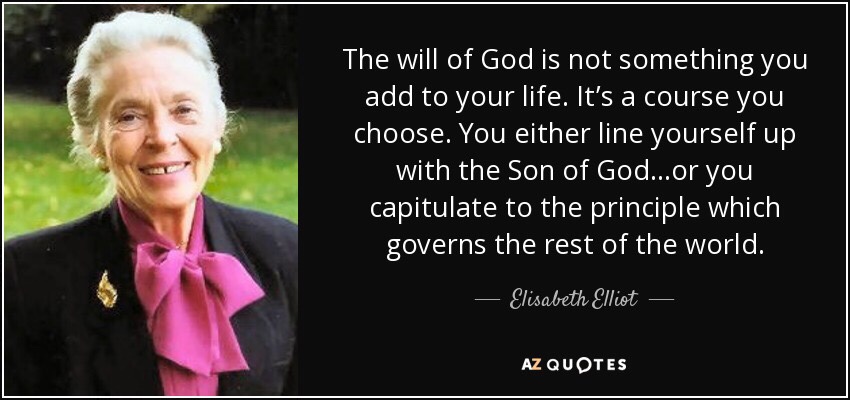
Elisabeth Elliot died in Magnolia, Massachusetts, on 15 June 2015, at the age of 88. Sadly in her last years she suffered from dementia. Her husband, Lars, said: “She accepted those things, [knowing] they were no surprise to god.
”It was something she would rather not have experienced, but she received it.”
Elisabeth’s only daughter, Valerie, who spent part of her childhood among the Aucas, married a pastor, Walter Shepard, in 1976. Since then Valerie has spent her time being a pastor’s wife, raising eight children, teaching the bible and speaking at conferences.
She described her mother as: “A speaker of the truth, a teacher of obedience, a woman of strength and dignity. She always loved and encouraged me. she was a woman of prayer.”
Perhaps Elisabeth Elliot’s whole philosophy of life and ministry can be summed up in the words she once wrote: “We have proved beyond any doubt that he [God] means what he says – his grace is sufficient – nothing can separate us from the love of Christ. We pray that if any, anywhere, are fearing that the cost of discipleship is too great, they may be given a glimpse of that treasure in heaven promised to all who forsake.”
———
** This article was taken from the October 2016 issue of Heroes Of The Faith by Dave Littlewood / Photos Elisabeth Elliot Foundation
This inspiring documentary presents the events of Gladys Aylward’s life. Gladys was a commoner from a poor family in London, barely five feet tall, who worked as a maid, in a kitchen and other odd jobs to make ends meet. She was considered ordinary in every way, as there was nothing to distinguish her amongst her peers, but it was this very woman the Lord picked up, this empty and open vessel, God filled and used for His honour and glory, to be a blessing to the Chinese people and spread the good news of the gospel, as it’s not our ability the Lord wants, but our willingness and AVAILabilty, “use me Lord, send me!”
Gladys was rejected from the CIM (Chinese Inland Missions) because she couldn’t keep up with the academic studies. The CIM was set up by none other than Hudson Taylor to train new missionaries. Gladys was sure the Lord had called her and was not deterred. She needn’t have worried for she was in good company with others that had gone before her; people like Peter, Andrew, James and John lowly fishermen whom Jesus chose to be His disciples, who also in their day would’ve been rejected from the Bible colleges! But it’s these unlearned people that the Lord picked up and used. People wondered how these so called simpletons, knew and did the things they did. It was obviously all God’s doing, He had quickened their spirits, given them wisdom, guidance and much grace. He opened the doors He wanted opened, and closed the doors He wanted shut, and showed them favour. He doesn’t call the qualified, He qualifies the called! So not one could ever touch His glory.
God’s ways are not our ways, and His thoughts are not our thoughts, as stated in 1 Corinthians 1:27-29, ‘But God chose the foolish things of this world to put the wise to shame. He chose the weak things of this world to put the powerful to shame. What the world thinks is worthless, useless, and nothing at all is what God has used to destroy what the world considers important. God did all this to keep anyone from bragging to Him.’ To help us remain humble in our endeavours may we never forget that, all good gifts are from above, given to us by our loving Father. What is it we have that the Lord didn’t give us? Let us pray that the Lord will keep us humble like the examples of Godly men and women who have gone before us, such as Gladys.
Gladys Aylward’s biography can be found on Amazon:
E.H. Hamilton, a Presbyterian missionary to China, wrote the poem below to reflect upon and commemorate the martyrdom of his fellow missionary J.W. Vinson (1880-1931). In October 1931, as Vinson visited some believers 18 miles from his mission station, the area was overwhelmed by a group of 600 bandits. Vinson was taken hostage along with around 150 others. Offered freedom if he would write a letter to the commanding officer of government troops telling them to withdraw, Vinson declined “unless all the hostages are released”. The bandit chief refused and Vinson was shot and killed. His decapitated body was later found by Edward Currie, and he was buried in the small missionary cemetery in Haichow.
As his captors prepared to execute Vinson, waving a gun in his face they asked him, “Are you afraid?”. A girl who witnessed the event later testified that Vison replied, “No. If you shoot, I go straight to heaven.” This incident inspired E.H. Hamilton to write his poem.
Afraid? Of what? To feel the spirit’s glad release? To pass from pain to perfect peace, The strife and strain of life to cease? Afraid? Of that?
Afraid? Of what? Afraid to see the Saviour’s face, To hear His welcome, and to trace, The glory gleam from wounds of grace, Afraid? Of that?
Afraid? Of what? A flash – a crash – a pierced heart; Brief darkness – Light – O Heaven’s art! A wound of His a counterpart! Afraid? Of that?
Afraid? Of what? To enter into Heaven’s rest, And yet to serve the Master blessed? From service good to service best? Afraid? Of that?
Afraid? Of what? To do by death what life could not – Baptise with blood a stony plot, Till souls shall blossom from that spot? Afraid? Of that?
Poem by E.H. Hamilton
————————————
By webtruth.org / Photo Great wall of China by Tom Fisk at pexels









 The Sisterhood Hub