What Is the Love Language of Physical Touch?

Physical touch is more than sex. People who have this as their primary love language express and receive love through hugging, cuddling, holding hands, a back rub, or any other kind of touch that is appropriate in the moment.

Anytime I mention that my love Language is physical touch — it’s assumed that I feel loved through sex. But the love language of physical touch is more than that.

While sex is an important aspect of marriage, physical touch communicates meaningful expressions of love.

In fact, two of my three kids have the same love language I do. Our primary love language is physical touch and quality time together.

What Are Love Languages?

The 5 Love Languages: The Secret to Love that Lasts by Gary Chapman became a New York Times #1 bestseller in the early 1990s and has remained popular for its timeless wisdom, practical help, and how it helps us become better at loving those in our family.

Written for married couples, the book and its tips have expanded to help parents understand their children as well.

This book explores the ways people give and receive love. He explains how many of the misunderstandings and problems that arise in marriage is because we don’t know how to communicate love to our spouse.

While words of affirmation may make one spouse feel good, quality time might be the other’s love language. Through his book, individuals in relationships learn to communicate in their partner’s love language, they can strengthen their bond by keeping each other’s “love tank” full of fuel.

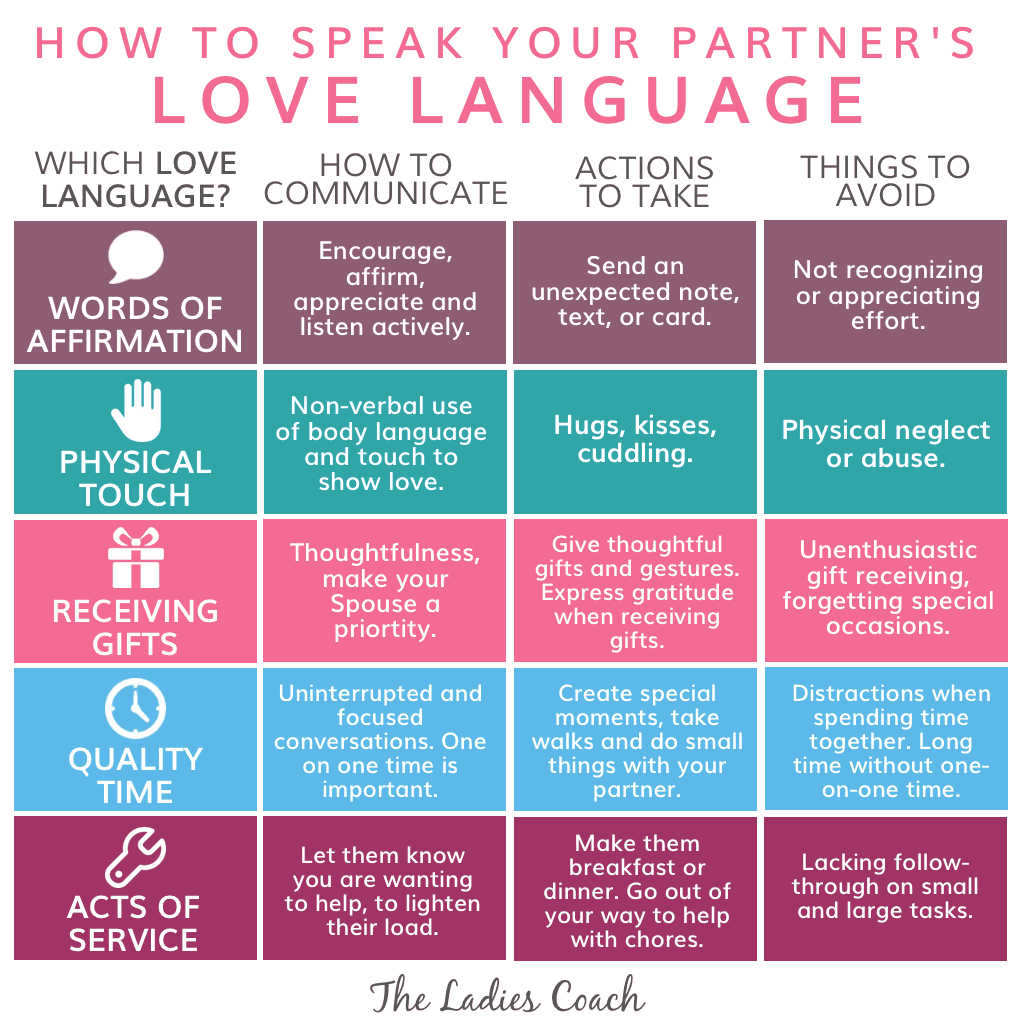
These five categories are how we all express our love for another and how we need to receive love. In the book, Chapman suggests that everyone receives love in at least one of five ways:

1. Quality time: Giving your partner your undivided attention like going on a date or going for walks. It’s all about giving the other person your attention.

2. Physical touch: People who have physical touch as their primary love language have a deep-felt need for appropriate touch.

3. Words of affirmation: This love language means these people need to hear how much they are loved, cherished, and appreciated.

4. Acts of service: For these people, the phrase, “Actions speak louder than words,” equals love.

5. Gifts: For some people, what makes them feel loved and cherished is to receive a gift.

The Gift of Physical Touch

Physical touch is more than sex. People who have this as their primary love language express and receive love through hugging, cuddling, holding hands, a back rub, or any other kind of touch that is appropriate in the moment.

Physical touch is the most direct way to communicate love. It is essential for the health and well-being of every human being.

Experts say the first hour of a child’s life is crucial to have skin-to-skin contact. This helps regulate their heart rate, temperature, and breathing. At the same time, a mother’s hormones are regulated as well. As the infant grows, physical touch boosts early child development.

Other studies have proven how detrimental physical touch is through intuitional isolation that is prevalent in orphanages around the world. These children often grow up in environments where touch and emotional engagement are lacking.

Many children who have not had ample physical and emotional attention are at higher risk for behavioral, emotional, and social problems. It’s clear, God created physical touch to be a powerful force of love.

What Is the Love Language of Physical Touch?

Jesus used physical touch often and made it a point even though He could heal people with just His Words. When the children came to Jesus, we see that “he took them in his arms and blessed them, laying hands on them” (Mark 10:15-16).

In Matthew 18:14-15, we read, “He touched her hand and the fever left her.”

When Jesus saw Simon’s mother-in-law lying ill, he “took her by the hand and lifted her up, and the fever left her” (Mark 1:31).

Then he poured water into a basin and began to wash the disciples’ feet and to wipe them with the towel that was wrapped around him (John 13:5).

In Matthew 17:7, we read, “Jesus came and touched them, saying, “Rise, and have no fear.”

These are just a few passages of Jesus’ time on earth when He chose to use His hands to show His love for the world.

God created us to enjoy skin-to-skin contact because it triggers the release of certain hormones associated with pleasure and bonding as a couple.

Oxytocin is the bonding hormone, and it is released along with the rest of the feel-good hormones like serotonin and dopamine.

To some degree, we all need physical touch in our marriages but for those whose love language is physical touch — it’s critical.

But this type of love comes down to timing because it is primarily made up of small gestures like having your spouse put his arm around in public. It could be a hug before leaving for work, a kiss when you get home.

How to Love Someone Whose Love Language Is Physical Touch

When you hug, use both arms and your whole body, and linger for a moment in the embrace. A rule of thumb is 30 seconds, 60 is heavenly!

Give them kisses often. Whenever your spouse is feeling blue, holding them closely can make tears disappear. Cuddle in bed together. Snuggle on the couch or hold their hand. Take them dancing for date night.

Make a point of maintaining physical contact when you’re both out for events. Kiss them hello and goodbye. Kiss them in places besides the lips, like her forehead, collarbone, the back of her neck or hand. Rub her shoulders when she is stressed out.

When you hug, use both arms and your whole body, and linger for an extra moment in the embrace. Spontaneously give them a little back rub or back scratch. Always hold hands when you’re out and about. Enjoy the public displays of affection, holding hands, cuddling, and kissing!

If you’re in a marriage or dating someone who has physical touch as their love language, be sure to ask what touch makes them feel most loved and what annoys them.

These physical displays of affection are a gift and matter more than words of affirmation, acts of service, quality time, and gifts.

Remember Jesus modeled physical touch and used His hands to heal. In the same way, this is an immense gift to give to your spouse.

————

**By Heather Riggleman at Christianity.com

Everyone Is A Christian Until It Gets Biblical!

Everyone is a Christian until it gets Biblical.

What do I mean?

Everyone claims to be a Christian until you start preaching the Biblical teachings from the word of God that shakes you to the core. The real substance, the real stuff. The things that Jesus said and showed his disciples that was scary. People get mad when you present their God as powerful and someone to fear when that’s who he is!

We are supposed to love God and fear God, but all we want to do is love God and believe some of the washed up teachings of some of today’s church, who teach you that, the God that destroys cities for sinning and who is coming back to destroy the world, is not the god you serve because He loves, and is too merciful to do that.

Our God is righteous and doesn’t change! Some churches teaches you its okay to sin, just repent when you do. My Saviour said my people take my grace as a license to sin and will perish for a lack of knowledge! Be sure you serve the GOD of Abraham, Isaac and Jacob! That you serve the GOD of the Bible! NOT another god that grants your every wish and desire like a genie in a bottle, or some celestial santa clause, who you rub the right way and he will grant you your every desire, that is a deception! You cannot trust ANY other man to teach you the true Word! You must read it for yourself and ask the Lord for understanding, if you’re born again you have the Holy Spirit as your teacher! He will always teach you the RIGHT word! The RIGHT understanding! The RIGHT interpretation! Put all your faith in the Lord and put on the FULL ARMOUR of God for the enemies fiery darts are flying fast and hit hard.

The Bible verses:

Titus 1:16 ~ “They profess to know God, but by their works they deny him, being detestable, disobedient, and worthless for any good work.”

Matthew 7:21 ~ “Not everyone who says to me, ‘Lord, Lord,’ will enter into the kingdom of heaven, but he who does the will of my Father who is in heaven will enter.”

Matthew 15:8 ~ “This people honor me with their lips, but their heart is far from me.”

2 Timothy 3:5 ~ “…having a form of godliness, but denying its power. Keep away from such people.”

1 John 2:3–6 ~ “Now by this we know that we have come to know him, if we keep his commandments. The one who says, ‘I know him,’ and doesn’t keep his commandments is a liar, and the truth is not in him. But whoever keeps his word, the love of God is truly perfected in him. By this we know we are in him: whoever says he abides in him ought himself to walk even as he walked.”

Romans 6:13 ~ “Don’t let sin reign in your mortal body, that you should obey it in its lusts. Neither yield your members to sin as instruments of unrighteousness, but yield yourselves to God as those alive from the dead, and your members as instruments of righteousness to God.”

Acts 3:19 ~ “Repent therefore, and turn back, that your sins may be wiped out, that times of refreshing may come from the presence of the Lord.”

Romans 10:9 ~ “If you confess with your mouth the Lord Jesus, and believe in your heart that God has raised him from the dead, you will be saved.”

Titus 2:11–12 ~ “For the grace of God has appeared, bringing salvation for all people, teaching us to deny ungodliness and worldly desires, and to live sensibly, righteously, and godly in this present age.”

——-

** By Random Christian at Reddit / Picture by Wendy V Zyl at Pexels

Popular Articles

A Clear Gospel Message

The Abortion Debate

Human Trafficking / Child Abuse

Trusting God to Heal the Scars of Sexual Abuse

The True Gift

True or False Conversion

Once Saved Always Saved?

The Judge – Upholding what is right comes at a cost

What is a True Christian or Believer

Prayer Speaking to God

Forgiving Others as God has Forgiving you

Prayer for forgiving others

Living Right Today

Are the 5 Love Languages in a Marriage Biblical?

These five categories are how we all give and receive love, which can greatly affect relationships. When we understand the love language of another person, we can more effectively communicate our respect and affection.

A year into joining a church, my husband and I were sitting in a small couple’s group when the leader asked what our love languages were. Perplexed, we had no idea. The leader went on to explain the book, The 5 Love Languages: The Secret to Love That Lasts by Gary Chapman.

The 5 Love Languages became a New York Times #1 bestseller in the early 1990s and has remained popular for its timeless wisdom and practical help.

This book explores the ways people give and receive love. In the book, Chapman suggests that everyone receives love in at least one of five ways: Quality time, physical touch, words of affirmation, acts of service, and gifts.

The way we love our spouse is how we naturally express it but if our loved one does not receive love in the same way we do, he or she can feel unloved.

These five categories are how we all give and receive love, which can greatly affect relationships. When we understand the love language of another person, we can more effectively communicate our respect and affection to our spouse.

What Are the 5 Love Languages?

1. Words of affirmation. Some people are more attuned than others to hear both positive and negative words from those whose opinions they cherish.

While negative, critical words can tear them down, positive, encouraging words make them flourish. According to Chapman, people with this love language need to hear their partner say, “I love you.”

Even better is including the reasons behind the love through leaving them a voice message or a written note or talking to them directly with sincere words of kindness and affirmation.

2. Quality time. This language, says Chapman, is all about giving your partner your undivided attention. That means dropping everything to give them your full attention, in other words, no chores, no TV, no cell phone, etc.

Other ways to spend time together could include, going for a walk, preparing dinner together and talking while preparing and eating it, sharing plans for the future, making love, and/or creating something together.

Take time every day to do this to fill up their love tank.

3. Acts of service. When acts of service is a person’s primary language, he or she interprets help as a sign of someone’s love.

This language includes anything you do to ease the burden of responsibility, like picking kids up from school, vacuuming, running errands, going grocery shopping, or filling up the car with gas.

4. Receiving gifts. The person who loves this language thrives on the love, thoughtfulness, and effort behind the gift. In short, actions speak louder than words.

These people thrive on gift-giving, and when they are given a gift, it fills their love tank. A single rosebud, a candle, or a note can go a long way toward filling the love tank of someone who understands love as giving gifts.

The act of giving a gift tells your spouse you cared enough to think about him or her in advance and go out of your way to get something to make your partner smile

5. Physical touch. People who speak this love language thrive on any type of physical touch: Handholding, hugs, and snuggling. It is not about sex.

Those actions spell love to those with this primary language. Physical touch is the most direct way to communicate love. It is crucial for the health and well-being of every human being.

Are Love Languages Biblical?

What makes the love languages unique is that they are one of the few methods of extending love that is not self-serving because the giver isn’t looking for anything in return.

It simply means they’ve studied their partner and they want them to feel loved, but if you’re looking for the term love languages in the Bible, you’re not going to find it.

But the concepts are there, and Jesus did an incredible job demonstrating how we are to use them.

1. Acts of service: Jesus’ first love language. “Do you understand what I have done to you? You call me ‘Teacher’ and ‘Lord,’ and rightly so, because I am. So if I then, your Lord and Teacher, have washed your feet, you also ought to wash one another’s feet. For I’ve given you an example, that you should do just as I have done to you. . . If you know these things, blessed are you if you do them” (John 13:12-15,17).

2. Quality time. Jesus lived with his disciples for three years when he began his ministry. They traveled together, ate together, worshiped together. Do you get the picture?

They were together for daily life. Not only did he spend time with the 12 disciples, but he also often spent even more quality time with Peter, James, and John (Matthew 17:1-9).

The quality time was even broken down to one on one quality time with Peter. A look at Mark 9:30-31 shows that Jesus carefully guarded his time.

3. Words of affirmation. Jesus often spoke words of affirmation over individuals. We first see this when he spoke about his cousin, John the Baptist when he said that John was “more than a prophet,” and “among those born of women there has arisen no one greater.” These words are powerful because they are indirect words of affirmation.

Other examples of this love language happen in Matthew 12:49 when Jesus outstretches his hand toward his disciples and tells the crowd they are his family or in the book of Mark when Jesus tells a dinner party that the questionable woman “has done a beautiful thing” when she anointed his feet with her tears and expensive perfume.

He also said, “Wherever the gospel is proclaimed in the whole world, what she has done will be told in memory of her” (Mark 14:6-9).

4. Giving gifts. Perhaps this one was one of Jesus’ favorites. We see throughout the New Testament Jesus loved to give good things to his people.

  • Jesus gave the 4,000 the gift of food to eat in Matthew 15.
  • Jesus gave the 5,000 the gift of bread and fish in Luke 9.
  • Jesus gives sight to a blind man in John 9
  • Jesus gave the gift of healing and a new name to the woman who bled for years in Mark 5
  • He gave children to women who suffered from infertility like Hannah, Sarah, and even Samson’s mother. 

This list could go on and on. Jesus was a giver of gifts but the biggest gift he gave us was our salvation through his death on the cross. This was his ultimate love language and gift.

5. Physical touch. Jesus touched often and he made it a point, even though he never needed to touch anyone, to heal them or offer comfort as we see in Luke 7 when the centurion asked for healing for one of his servants.

We see in Mark 1:31, Jesus took Simon’s mother-in-law by the hand “and lifted her up and the fever left her.”

When the children came to Jesus, we see that “he took them in his arms and blessed them, laying hands on them.” (Mark 10:15-16).

What Does This Mean?

Jesus used all five love languages and undoubtedly, he was a master at matching them with people appropriately.

He is the creator of all things and he teaches us how to love well by example throughout the Old and New Testaments.

Most of us pick up Chapman’s book and think, “If I get this right for my spouse, maybe he will love me how I want to be loved.” But a word of caution, learning someone’s love language is sacrificial like Christ.

He never asked for anything in return, even as he poured out his life. He gave freely with no strings attached. We are to follow his example and love well.

————-

** By Heather Riggleman at Christianity Today / Website: http://www.heatherriggleman.com/

Popular Articles

A Clear Gospel Message

The Abortion Debate

Human Trafficking / Child Abuse

The True Gift

True or False Conversion

Once Saved Always Saved?

The Judge – Upholding what is right comes at a cost

What is a True Christian or Believer

Prayer Speaking to God

Forgiving Others as God has Forgiving you

Prayer for forgiving others

Living Right Today

What Does it Mean to be a Proverbs 31 Woman?

The older women in the church are charged with teaching the younger women and girls the skills and character traits necessary to take care of their homes and families.

A woman that yearns to please God strives to be like this ideal example, but with the understanding that every Christian is a work in progress, brought “to completion in the day of Jesus Christ” (Philippians 1:6).

Proverbs 31 paints the picture of an ideal woman, the best example of a virtuous wife and mother. This final Proverb echoes Proverbs 1:7 — “fear of the Lord is the beginning of knowledge.”

What sort of woman is the wisdom literature talking about, what are her qualities, and do they exclusively apply to wives and mothers?

What Is the Meaning of a Proverbs 31 Woman?

Commentary from the ESV Study Bible regarding Proverbs 31 tells us that the ideal woman is virtuous, strong, and selfless. She does not wait to be served but rises early, even before sunrise, to delegate tasks and engage in business.

She possesses “a range of manual, commercial, administrative, and interpersonal skills.” This woman “opens her hand to the poor and reaches out her hands to the needy” (v.20). She is loving, dignified, and her virtues increase her husband’s reputation: “Her husband is known in the gates when he sits among the elders of the land” (v.23).

She is sharp but honest, engaged in business for the benefit of her household. Above all, she fears the Lord for “a woman who fears the Lord is to be praised.”

Characteristics of a Proverbs 31 Woman

What woman can live up to the example given in this Proverb? Every wife and mother looks back at certain events in her life and cringes with painful regret. “But what if I told you that the heart behind Proverbs 31:10-31 is one of celebration, not condemnation?” asks Lysa Terkeurst.

She argues that these words of wisdom, which were read aloud at the Sabbath, are not “meant to tell a woman she is supposed to be more. They are a celebration of who she is.” The Proverb does not describe “a woman with a spotless house” or “with perfectly behaved children wearing matching, designer outfits. Honestly, it’s not even the woman who’s married and has children.”

These words describe “a woman who honors God by seeking Him in everything she does and trusting Him wholeheartedly with her life. She has a heart of reverence that overflows into a life of spiritual maturity and wisdom.”

She is not born this way; she gets there by a process of refinement, which is a work of the Holy Spirit. A woman that yearns to please God strives to be like this ideal example, but with the understanding that every Christian is a work in progress, brought “to completion in the day of Jesus Christ” (Philippians 1:6).

Just a Wife, or All Women?

One reason a woman might skip past Proverbs 31 is that not all women marry, and not all who marry become parents. Should an unmarried woman, or a wife with no children, still aspire to the qualities of a Proverbs 31 woman?

Marriage is an especially intimate relationship, yet aspects of an intimate relationship are not mentioned by the writer in this piece of wisdom literature. His greatest concern has to do with the woman’s character and how she interacts with people.

The writer is hopeful that the young men of his community will seek out this sort of wife, and that the young girls will aspire to her ideal. But even if they never marry, every female who sincerely loves the Lord is developing the characteristics of a Proverbs 31 woman.

At many times and in many locations around the world (even now), professing faith in Christ has been risky for women. They have had to truly love the Lord in order to endure the ridicule and isolation they sometimes face(d).

One historian wrote that, in his opinion, the church was attended by the “silly and mean and stupid,” and “disproportionately populated by women.” Certainly, the church attracted individuals who needed to be cared for — sheltering vulnerable people has always been a function of the church.

But it took great courage to be a Christian woman. For one thing, many of them attended Christian fellowship without their husbands; they “often converted to Christianity while their male relatives remained pagans, lest they lose their senatorial status.”

One might argue that any woman with a sincere Christian faith is well on her way to becoming the ideal example of Proverbs 31.

The Christ and the Church as the Proverbs 31 Wife

Proverbs 31 describes an ideal woman, but also the ideal bride: The church. “God created marriage to be a metaphor of Christ’s relationship to the church,” wrote John Piper.

As such, the selfless, hard-working, considerate, pleasing woman of this Old Testament passage represents everyone who makes up the body of the Christian church. “The union of man and woman in marriage” contains “a truth about Christ and the church,” which is that “God ordained a permanent union between His Son and the church.”

Marriage between a man and a woman should reflect this: The man is the head, giving his life for the woman; the woman submits to the man who lays his life down for her. “Human marriage is the copy, not the original” (Piper).

Taken as a metaphor, Proverbs 31 is not simply describing wives and mothers, but also husbands and fathers; unmarried men and women; couples without children; and those who have survived their spouses.

Anyone who calls himself or herself a Christian is a bride of Christ through the Spirit, which unites the global church. Each person and each fellowship have responsibilities such as spreading the good reputation of the bridegroom (v.23) and caring for the poor (v.20).

Chad Ashby comments: “The church ought to be characterized by […] single-hearted devotion to her Bridegroom,” which is embodied by the Proverbs 31woman. “After all, John Gill reiterates, she is ‘a woman actually married to Christ.’”

Final Words from the New Testament

“Let your adorning be the hidden person of the heart with the imperishable beauty of a gentle and quiet spirit, which in God’s sight is very precious. For this is how the holy women who hoped in God used to adorn themselves” (1 Peter 3:4-5).

God wants his bride to love him, to submit to him, and then he will give his bride discernment. He will increase her courage and soften her heart, so she is disposed to give generously; to act charitably.

He will ensure that when “she opens her mouth with wisdom, […] the teaching of kindness is on her tongue” (v.26). His bride is his treasure. We, the church, are his bride.

———

** By Candice Lacey at Christianity.com / Picture created by Mike Waters at Joyful Toons

5 Ways To Be A Godly Woman

Being a woman of bold faith is what we have been called to. Boldness is not a personality trait. Boldness is acting by the power of the Holy Spirit. Let’s take risks for the sake of the gospel to the glory of God. ~ Heather Riggleman

“You will be a woman of bold faith who empowers and encourages those around you.”

This was declared over me after I handed my life over to Jesus. I was barely toddling in my walk with God, yet others could see the calling and purpose He already had for me.

What Does it Mean to Be a Godly Woman?

But what does it mean to be a godly woman? Becoming a woman of faith is not about perfectly checked church attendance, being the most modestly dress, how much you volunteer, having the best snacks for life groups, or having all the answers in Bible study.

A bold woman of faith has real, bold, Jesus-glorifying, heart-wrenching, deep-in-the-trenches, and fight for God’s truths in the midst of the lies, kind of belief.

John Piper says it best, “The deepest root of Christian womanhood is hope in God,” and “this hope in God yields fearlessness.”

However, becoming her means embodying a warrior willing to bleed for her cause. Becoming a godly woman is digging-your-heels in the dirt when your marriage falls apart, when your child rebels, when your career gets decimated, or when everyone follows tradition without question or when your health fails.

Why? Because we have a very real enemy whose goal is to destroy us. Why was Satan so anxious to have access to us?

Because clearly, Satan was listening when Jesus declared: “And I tell you that you are Peter, and on this rock I will build my church, and the gates of Hades will not overcome it” (Matthew 16:18).

We are the keys to God’s kingdom! We are the keys to help others unlock their faith. We are the keys to our home and our community.

Our enemy wants to knock us down — blow by blow until we are so bloodied and wounded in our hearts and minds that we lose sight of Jesus.

He wants us so focused on the mess, the hurt, and pain that we forget God’s promises of who we really are: Heiresses to His Kingdom. And the “brutiful” (beautiful and brutal) truth behind this: you will then help others through the sifting.

A godly woman isn’t something that just happens without the “becoming.” Look at our savior:

  • It’s what Jesus did
  • He helped others through the sifting
  • He demonstrated the process of becoming
  • He was the light of God in a world that didn’t even want Him
  • Like Jesus — bold women of faith lead others to God 

The word “godly” in the Bible means pious or holy. This means we are set apart from all others. Holiness is achieved when we are made new creations in Christ.

2 Corinthians 5:17 says, “Therefore, if anyone is in Christ, he is a new creation. The old has passed away; behold, the new has come.” Born again Christian women are indwelled with the Holy Spirit.

In Him, we produce godliness that molds and shapes us into the image of Christ. A godly woman controls her thoughts and takes them captive, making them obedient to Christ (2 Corinthians 10:5). She also controls her tongue and uses her words to encourage and build up others.

Godly women inspire change. They question tradition for tradition’s sake. They lift up other women gunned down in the trenches.

They impact their community. Their table always has room for one more. They friend the unwanted. They love the rejected.

They speak for those who do not have a voice. They change the world right where they are at all the while keeping their hearts and minds focused on Christ.

Becoming a godly woman means stepping into your God-given leadership. Let God’s voice speak louder than all the others. Here are a few ways to be a godly woman within God’s parameters for us.

Five Ways to be a Godly Woman

1. Always stay in God’s Word. Know what the Bible says. Study it. Read it every day. Understand what scriptures say within context. God’s Word is our go-to source for wisdom, encouragement, and nourishment.

All Scripture is breathed out by God and profitable for teaching, for reproof, for correction, and for training in righteousness (2 Timothy 3:16).

Do not be conformed to this world, but be transformed by the renewal of your mind, that by testing you may discern what is the will of God, what is good and acceptable and perfect (Romans 12:2).

2. Pray. Ask God to use your gifts, your personality, and your community to further his kingdom. Ask God to reveal to you the things that matter to Him.

Take all of your hurts, worries, dreams, and petitions to God! Ephesians 6:18 is our battle call, “Praying at all times in the Spirit, with all prayer and supplication. To that end keep alert with all perseverance, making supplication for all the saints.”

“Truly, truly, I say to you, whoever hears my word and believes him who sent me has eternal life. He does not come into judgment, but has passed from death to life” (John 5:24).

“Call to me and I will answer you, and will tell you great and hidden things that you have not known”(Jeremiah 33:3).

3. Know the things that matter. Hold firm to the beliefs that God has placed heavily on your heart. When you make a stand for these issues, make sure you know why God stands for them too.

Finally, brothers, whatever is true, whatever is honorable, whatever is just, whatever is pure, whatever is lovely, whatever is commendable, if there is any excellence, if there is anything worthy of praise, think about these things (Philippians 4:8).

4. Speak with gentleness. Always remember who you represent every time you open your mouth to voice an opinion or idea. And always, always speak with love. Proverbs 15:1 reminds us, “A soft answer turns away wrath, but a harsh word stirs up anger.”

But in your hearts honor Christ the Lord as holy, always being prepared to make a defense to anyone who asks you for a reason for the hope that is in you; yet do it with gentleness and respect (1 Peter 3:15).

5. Respect authority. All authority comes from God and He calls us to respect those He places in authority over us. This includes husbands, fathers, pastors, elders, and other leaders.

Wives, submit to your own husbands, as to the Lord. For the husband is head of the wife, as also Christ is head of the church; and He is the Savior of the body. Therefore, just as the church is subject to Christ, so let the wives be to their own husbands in everything(Ephesians 5:22-24).

Let every person be subject to the governing authorities. For there is no authority except from God, and those that exist have been instituted by God (Romans 13:1).

Yet, John Piper once said, “The deepest root of Christian womanhood is hope in God,” and “this hope in God yields fearlessness.”

Becoming a fearless, bold woman of God didn’t happen overnight. Those two years of lost time were spent on my knees in prayer for our hearts and health.

What seemed like wasted time was actually the refining fires that created a boldness for believing God’s truth and promises for my family.

And the more I spent time with him, the more he began to send others in need of a good dose of Jesus’ strong courage my way.

Each of us has causes that make us come alive, things that move us and make us eager to share our vision.

Each woman has a chance to embody what it means to be bold, brave, and fierce for the life she has given. Even though you are not Maya Angelou, Malala, Mother Teresa, or Mary — mother of Jesus, you are still changing the world one breath at a time.

Why? Because being a woman of bold faith is what we have been called to.

Boldness is not a personality trait. Boldness is acting by the power of the Holy Spirit, on an urgent conviction in the face of some threat.

A shy, soft-spoken, introverted, calm person can be bold at a time when a typically driven, outspoken, brash person shrinks back. A Bold Woman for God contains these ingredients.

Spirit-Empowered Courage, Conviction, and Urgency

Meaning — every woman must get uncomfortable for the sake of the gospel. A bold woman:

Seeks God every morning (Psalm 5:3).

Looks for one person to share the gospel at the grocery store, meetings, appointments, or the park (2 Corinthians 5:20).

Hosts without grumbling. Open your front door and add one more spot at the table (1 Peter 4:9).

Welcomes fellowship in difficult seasons — all seasons (Hebrews 10:24–25).

Adorns herself in His word through good works — not the latest trends (1 Timothy 2:9–10,4:7–8).

Takes time to disciple and discipline your children with grace and love (Titus 2:3–5; Hebrews 12:5–11).

Christian women, we have nothing to fear and nothing to lose. Let’s live like we have the greatest hope to offer the world.

Let’s get uncomfortable by hoping in God and not in what the world offers. Let’s not be conformed to the world in its apathy toward the things of God.

Let’s take risks for the sake of the gospel to the glory of God.

————

** By Heather Riggleman at Christianity.com / Photo by Ellagrin at Shuttershock