What Is the Love Language of Physical Touch?

Physical touch is more than sex. People who have this as their primary love language express and receive love through hugging, cuddling, holding hands, a back rub, or any other kind of touch that is appropriate in the moment.

Anytime I mention that my love Language is physical touch — it’s assumed that I feel loved through sex. But the love language of physical touch is more than that.

While sex is an important aspect of marriage, physical touch communicates meaningful expressions of love.

In fact, two of my three kids have the same love language I do. Our primary love language is physical touch and quality time together.

What Are Love Languages?

The 5 Love Languages: The Secret to Love that Lasts by Gary Chapman became a New York Times #1 bestseller in the early 1990s and has remained popular for its timeless wisdom, practical help, and how it helps us become better at loving those in our family.

Written for married couples, the book and its tips have expanded to help parents understand their children as well.

This book explores the ways people give and receive love. He explains how many of the misunderstandings and problems that arise in marriage is because we don’t know how to communicate love to our spouse.

While words of affirmation may make one spouse feel good, quality time might be the other’s love language. Through his book, individuals in relationships learn to communicate in their partner’s love language, they can strengthen their bond by keeping each other’s “love tank” full of fuel.

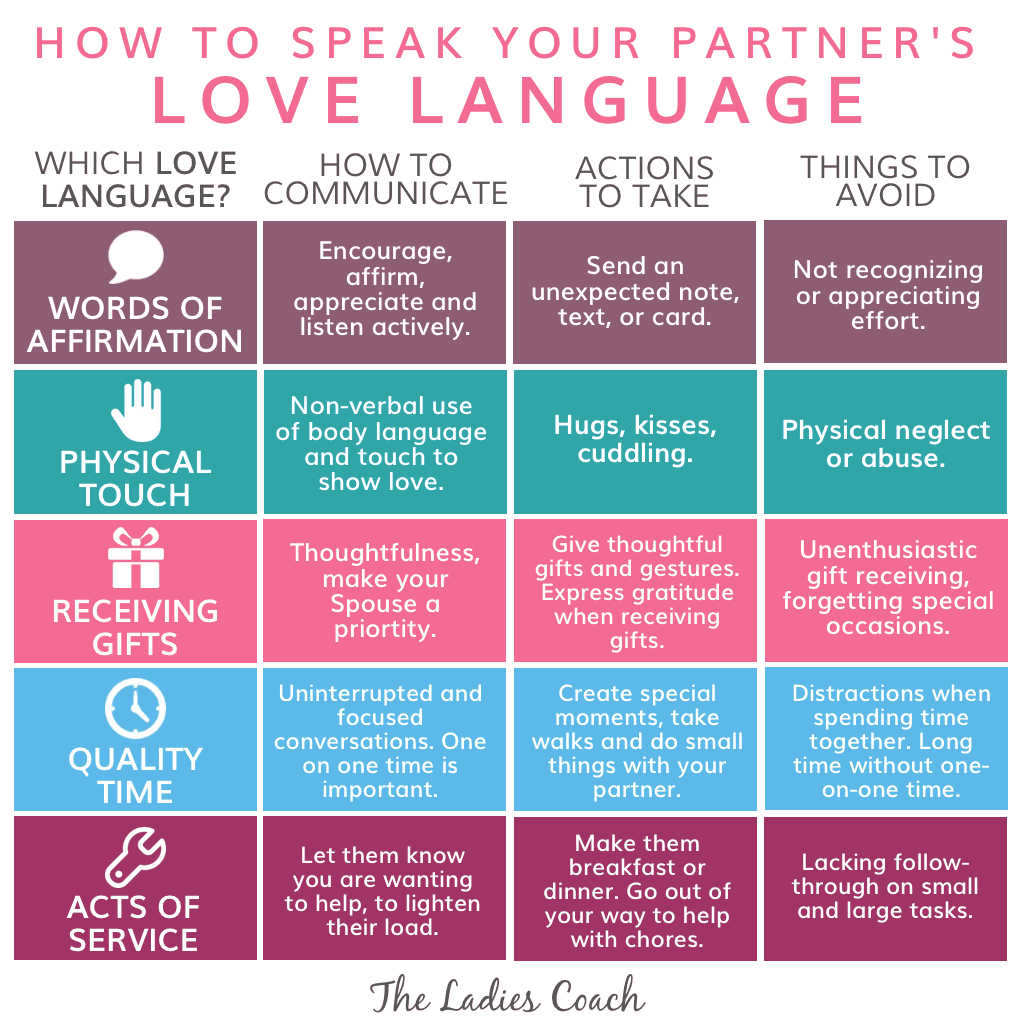
These five categories are how we all express our love for another and how we need to receive love. In the book, Chapman suggests that everyone receives love in at least one of five ways:

1. Quality time: Giving your partner your undivided attention like going on a date or going for walks. It’s all about giving the other person your attention.

2. Physical touch: People who have physical touch as their primary love language have a deep-felt need for appropriate touch.

3. Words of affirmation: This love language means these people need to hear how much they are loved, cherished, and appreciated.

4. Acts of service: For these people, the phrase, “Actions speak louder than words,” equals love.

5. Gifts: For some people, what makes them feel loved and cherished is to receive a gift.

The Gift of Physical Touch

Physical touch is more than sex. People who have this as their primary love language express and receive love through hugging, cuddling, holding hands, a back rub, or any other kind of touch that is appropriate in the moment.

Physical touch is the most direct way to communicate love. It is essential for the health and well-being of every human being.

Experts say the first hour of a child’s life is crucial to have skin-to-skin contact. This helps regulate their heart rate, temperature, and breathing. At the same time, a mother’s hormones are regulated as well. As the infant grows, physical touch boosts early child development.

Other studies have proven how detrimental physical touch is through intuitional isolation that is prevalent in orphanages around the world. These children often grow up in environments where touch and emotional engagement are lacking.

Many children who have not had ample physical and emotional attention are at higher risk for behavioral, emotional, and social problems. It’s clear, God created physical touch to be a powerful force of love.

What Is the Love Language of Physical Touch?

Jesus used physical touch often and made it a point even though He could heal people with just His Words. When the children came to Jesus, we see that “he took them in his arms and blessed them, laying hands on them” (Mark 10:15-16).

In Matthew 18:14-15, we read, “He touched her hand and the fever left her.”

When Jesus saw Simon’s mother-in-law lying ill, he “took her by the hand and lifted her up, and the fever left her” (Mark 1:31).

Then he poured water into a basin and began to wash the disciples’ feet and to wipe them with the towel that was wrapped around him (John 13:5).

In Matthew 17:7, we read, “Jesus came and touched them, saying, “Rise, and have no fear.”

These are just a few passages of Jesus’ time on earth when He chose to use His hands to show His love for the world.

God created us to enjoy skin-to-skin contact because it triggers the release of certain hormones associated with pleasure and bonding as a couple.

Oxytocin is the bonding hormone, and it is released along with the rest of the feel-good hormones like serotonin and dopamine.

To some degree, we all need physical touch in our marriages but for those whose love language is physical touch — it’s critical.

But this type of love comes down to timing because it is primarily made up of small gestures like having your spouse put his arm around in public. It could be a hug before leaving for work, a kiss when you get home.

How to Love Someone Whose Love Language Is Physical Touch

When you hug, use both arms and your whole body, and linger for a moment in the embrace. A rule of thumb is 30 seconds, 60 is heavenly!

Give them kisses often. Whenever your spouse is feeling blue, holding them closely can make tears disappear. Cuddle in bed together. Snuggle on the couch or hold their hand. Take them dancing for date night.

Make a point of maintaining physical contact when you’re both out for events. Kiss them hello and goodbye. Kiss them in places besides the lips, like her forehead, collarbone, the back of her neck or hand. Rub her shoulders when she is stressed out.

When you hug, use both arms and your whole body, and linger for an extra moment in the embrace. Spontaneously give them a little back rub or back scratch. Always hold hands when you’re out and about. Enjoy the public displays of affection, holding hands, cuddling, and kissing!

If you’re in a marriage or dating someone who has physical touch as their love language, be sure to ask what touch makes them feel most loved and what annoys them.

These physical displays of affection are a gift and matter more than words of affirmation, acts of service, quality time, and gifts.

Remember Jesus modeled physical touch and used His hands to heal. In the same way, this is an immense gift to give to your spouse.

————

**By Heather Riggleman at Christianity.com

What Is the Love Language of Words of Affirmation?

This love language is also the only category that involves verbal expression. You can spot people whose love language is based on Words of Affirmation because those people don’t hesitate to cheer others on. So, making them feel valued with words is love.

Gracious words are a honeycomb, sweet to the soul and healing to the bones (Proverbs 16:24).

Scripture has much to say about the power of words. After all, words matter, and when it comes to our relationships, “the power of life and death” is held by the tongue (Proverbs 18:21).

Given the weighty influence of our words, it should come as no surprise that in matters of love, the “Words of Affirmation” category reigns supreme as the most common of the love languages.

What Are Love Languages?

A “love language” is a way that a person emotionally expresses and acknowledges love. Dr. Gary Chapman is a pastor and relationship expert who authored the best-selling book, The Five Love Languages.

In his book, Dr. Chapman identified five love languages that he noticed were being emotionally “spoken” by the married couples he counseled during his extensive career as a marriage counselor.

In particular, Dr. Chapman found that people tend to show affection in the same way that they like to receive it. In other words, the things that one person does to show love are the types of things that that person would like done back to feel loved.

For example, if you feel most in sync with your spouse during a romantic dinner, then Quality Time is your love language. If you’re thrilled by the thoughtfulness of a surprise gift, then you speak the language of Receiving Gifts.

Do you feel the most connected during moments of intimacy? If so, then your love language is Physical Touch. If considerate acts definitely speak louder than words for you, then you’re fluent in the Acts of Service love language.

Lastly, if you enjoy singing your sweetie’s praises and you’re overjoyed when they sing yours, then Words of Affirmation is your love lingo.

For purposes of this article, let’s zero in on the love language of Words of Affirmation, and consider ways in which you can show love through the power of your words.

What Are the ‘Words of Affirmation’ Love Language?

Think back to a time when you were told that you had done a good job on something, or when someone thanked you for your effort. Perhaps it was a boss, a friend, or a parent who recognized your hard work and verbalized their approval.

Those simple words of appreciation may have buoyed you for days or made you feel more connected to the speaker.

When it comes to married couples, Dr. Chapman tells us that words of affirmation make up the most common love language. This love language is also the only category that involves verbal expression.

You can spot people whose love language is based on Words of Affirmation because those people don’t hesitate to cheer others on. These are people who notice other people’s moods, celebrate other people’s accomplishments, and grieve when others grieve.

By the same token, these are the same people who are moved when others express their appreciation for them through words as well.

If your spouse’s primary love language is rooted in words of affirmation, here are four ways you can speak love to your beloved.

1. Call Your Spouse Just to Say, ‘I Love You’

If your loved one is reassured by words of affirmation, a phone call during the workday that may seem like an inconvenience to you may mean the world to them. The phone call doesn’t have to be long or consist of a litany of reasons you love your partner.

Rather, the phone call can simply be a quick “check-in” to make sure your sweetie is doing okay and to let him or her know that you love them.

Keep in mind that if verbal communication is hard for you, your sweetie would be over the moon if you jotted down your I love you in a quick note, email, or text.

Whatever your mode of communication, remember that sincerity is key. The effort you make in letting your loved one know that they are cherished won’t go unnoticed.

2. Speak Love by Being a Cheerleader

You know your spouse better than anyone. You know when they’re insecure or overwhelmed, hurting or just plain bummed out.

Your sweetheart may be having a string of bad days or they may be reeling from some recent bad news. Whatever the case, your words of encouragement may be the fix they need to steady their steps or bring some much-needed light to an otherwise gloomy day.

Whether it’s a simple “you’ve got this” before a big meeting, or a comforting “I’ll wait up to hear all about it” after a long day away from home, your heartfelt words of support go a long way to making your significant other feel loved.

And never underestimate the power of reassuring words on a sticky note smoothed onto a mirror to help your honey start his or her morning with a little more confidence.

3. Stick Up for Your Better Half

When you look at the love of your life, you may not be able to imagine anyone who doesn’t see all of the same qualities in him or her that you see.

Nothing bursts this bubble faster than when someone you know disparages your spouse. This can be especially hurtful when the critic is a friend or relative.

If you want your marriage to thrive, take your cue from longtime, happily married couples who say that the success behind their union is based on their united front. Use your words to show that, no matter how others may criticize your spouse, you are on your spouse’s side.

You don’t have to be rude to your loved one’s critic. But you do have to verbally assert that you love and stand by your spouse, and will not accept anyone’s insulting words pointed in their direction.

This will mean the most to your spouse when they hear you sticking up for them. If that isn’t possible, then be sure to communicate to them how you came to their defense outside of their presence.

4. Thank Your Spouse for What They Do

In a perfect world, couples would go around thanking each other every time they did something to make the other’s life a little easier.

The “thank yous” would flow like water whenever one of you got up with the baby in the middle of the night, drove the kids to their sports meets, or brought home dinner for a surprise date night in.

In reality, it’s easy to fall into a daily routine of checking off boxes on your to-do list and forget to express gratitude for all that your spouse does to keep your household running smoothly. Yet, gratitude matters, and telling your spouse how thankful you are for all they do can go a long way in making them feel valued.

For some people who speak the Words of Affirmation love language, a blanket “thank you for everything you do,” will make their heart swell. For others, they’ll appreciate your attention to detail in highlighting the specific things they did that you’re grateful for.

What Does This Mean?

For many couples, expressing words of affirmation can mean the difference between an evening spent enjoying each other’s company or an evening spent trying to figure out what triggered your sweetheart’s cold shoulder.

When you take the time to build up your spouse with words that resonate most in his or her heart, you’ll be doing your part to improve communication between you and your beloved. You’ll also be bolstering your marital bond in a way that will help stand the test of time. God bless your union!

———-

***By Dolores Smyth at Crosswalks

Popular Articles

A Clear Gospel Message

The Abortion Debate

Human Trafficking / Child Abuse

The True Gift

True or False Conversion

Once Saved Always Saved?

The Judge – Upholding what is right comes at a cost

What is a True Christian or Believer

Prayer Speaking to God

Forgiving Others as God has Forgiving you

Prayer for forgiving others

Living Right Today

The Need for Revelation and Power

In Ephesians 1:17, 18, Paul had prayed that the Christians at Ephesus might receive revelation from the Holy Spirit. At the end of this first half of Ephesians, in chapter 3:16, Paul prays that they might receive power from the Holy Spirit. These are our two greatest needs – revelation and power. The Holy Spirit alone can give us both. The entire Christian life is dependent on the Holy Spirit. First of all, the Spirit gives us revelation on what God has done for us in Christ. Then, He gives us power to walk in a manner worthy of our calling, obeying all that the Lord has taught us.

In Ephesians 3: 18 & 19, we see that we can experience the breadth and length and height and depth of the love of Christ (there are four dimensions there and that itself goes beyond human knowledge!!) – only along with ALL the saints. We can never grasp the love of Christ all by ourselves. We need the other members of Christ’s Body. And further, we need ALL the members of Christ’s Body, not just those in our own little group. That is why our hearts should always be open to ALL believers, even to those who don’t agree with us, and even to those whom we would consider a bit extreme. We may not be able to work with all of them, and we certainly will not be able to meet all of them on this earth. But our hearts should be open to all of God’s children. Our hearts must have room for as many brothers and sisters as God has children – both barbarian and cultured.

That is why we need to be open to read the writings of ALL godly people – and not just to the writings of our favourite authors. Let me warn you, in advance, that in my lifetime, I have found very, very few believers who have such an open heart. But those are the few who are truly spiritually wealthy. The remainder carry on with their poverty-stricken, sectarian attitudes and live and die as Pharisees, missing out on the wealth that could have been theirs if they had been humble enough to accept all whom God had accepted.

Let us meditate carefully on the first three chapters of Ephesians and ask the Holy Spirit to give us revelation on these glorious truths. Once you have got revelation, you will be ready to seek the Spirit for His power to live an overcoming life, full of purity, humility and love. Then we will be able to put away ALL unwholesome words from our speech, and ALL anger and ALL bitterness from our hearts (Eph.4:29, 31).

Then wives will be able to submit to their husbands as the church is to Christ, and husbands will be able to love their wives as Christ loved the church (Eph.5:22, 25). Then we will be able to overcome Satan at all times (Eph.6:11-13). And then we will have the power to “become imitators of God” (Eph.5:1).

God is able to do far more in us and through us than we can ask or think.

To Him alone be all the glory (Eph.3:20, 21).

———

** Copyright – Zac Poonen. No changes whatsoever are to be made to the content of the article without written permission from the author at CFC India.com / Photo by Avery Nielsen-Webb at Pexels

12 Wonderful Responsibilities God Has Given to Women

So God created man in his own image, in the image of God he created him; male and female he created them (Gen. 1:27).

Countless millions of women around the world faithfully strive to honor God in all their vocations in life. Here are twelve wonderful responsibilities God has given to women:

1. To Love, Believe, and Respect the Lord

Charm is deceitful, and beauty is vain,
but a woman who fears the Lord is to be praised.
Give her of the fruit of her hands,
and let her works praise her in the gates. (Prov. 31:30-31)

And the unmarried or betrothed woman is anxious about the things of the Lord, how to be holy in body and spirit. But the married woman is anxious about worldly things, how to please her husband. (1 Cor. 7:34)

2. To Support the Gospel Work of the Church

I commend to you our sister Phoebe, a servant of the church at Cenchreae, that you may welcome her in the Lord in a way worthy of the saints, and help her in whatever she may need from you, for she has been a patron of many and of myself as well. (Rom. 16:1-2)

Yes, I ask you also, true companion, help these women, who have labored side by side with me in the gospel together with Clement and the rest of my fellow workers, whose names are in the book of life. (Phil. 4:3)

3. To Be Diligent in Her Vocations

And every skillful woman spun with her hands, and they all brought what they had spun in blue and purple and scarlet yarns and fine twined linen. (Exod. 35:25)

She considers a field and buys it;
with the fruit of her hands she plants a vineyard. (Prov. 31:16)

She opens her hand to the poor
and reaches out her hands to the needy. (Prov. 31:20)

Now there was in Joppa a disciple named Tabitha, which, translated, means Dorcas. She was full of good works and acts of charity. (Acts 9:36)

One who heard us was a woman named Lydia, from the city of Thyatira, a seller of purple goods, who was a worshiper of God. The Lord opened her heart to pay attention to what was said by Paul. (Acts 16:14)

4. To Be a Wife

And the rib that the Lord God had taken from the man he made into a woman and brought her to the man. Then the man said,

“This at last is bone of my bones
    and flesh of my flesh;
she shall be called Woman,
    because she was taken out of Man.”

Therefore a man shall leave his father and his mother and hold fast to his wife, and they shall become one flesh. (Gen. 2:22-24)

He answered, “Have you not read that he who created them from the beginning made them male and female, and said, ‘Therefore a man shall leave his father and his mother and hold fast to his wife, and the two shall become one flesh’? So they are no longer two but one flesh. What therefore God has joined together, let not man separate.” (Matt. 19:4-6)

5. To Be a Mother

And Sarah said, “God has made laughter for me; everyone who hears will laugh over me.” And she said, “Who would have said to Abraham that Sarah would nurse children? Yet I have borne him a son in his old age.” (Gen. 21:6-7)

Let your father and mother be glad; let her who bore you rejoice. (Prov. 23:25)

Let a widow be enrolled if she is not less than sixty years of age, having been the wife of one husband, and having a reputation for good works: if she has brought up children, has shown hospitality, has washed the feet of the saints, has cared for the afflicted, and has devoted herself to every good work. (1 Tim. 5:9-10)

6. To Care for Her Household

The wisest of women builds her house, but folly with her own hands tears it down. (Prov. 14:1)

She rises while it is yet night
    and provides food for her household
    and portions for her maidens. (Prov. 31:15)

So I would have younger widows marry, bear children, manage their households, and give the adversary no occasion for slander. (1 Tim. 5:14)

7. To Be a Helper to Her Husband

Then the Lord God said, “It is not good that the man should be alone; I will make him a helper fit for him.” (Gen. 2:18)

Her children rise up and call her blessed;
her husband also, and he praises her:
“Many women have done excellently,
but you surpass them all.” (Prov. 31:28-29)

For man was not made from woman, but woman from man. Neither was man created for woman, but woman for man. (1 Cor. 11:8-9)

8. To Love and Respect Her Husband

However, let each one of you love his wife as himself, and let the wife see that she respects her husband. (Eph. 5:33)

Likewise, wives, be subject to your own husbands, so that even if some do not obey the word, they may be won without a word by the conduct of their wives, when they see your respectful and pure conduct. (1 Pet. 3:1-2)

So train the young women to love their husbands and children, to be self-controlled, pure, working at home, kind, and submissive to their own husbands, that the word of God may not be reviled. (Titus 2:4-5)

9. To Submit to Her Husband

But I want you to understand that the head of every man is Christ, the head of a wife is her husband, and the head of Christ is God. (1 Cor. 11:3)

Wives, submit to your own husbands, as to the Lord. For the husband is the head of the wife even as Christ is the head of the church, his body, and is himself its Savior. Now as the church submits to Christ, so also wives should submit in everything to their husbands. (Eph. 5:22-24)

10. To Be Respectable

“And now, my daughter, do not fear. I will do for you all that you ask, for all my fellow townsmen know that you are a worthy woman.” (Ruth 3:11)

Women should adorn themselves in respectable apparel, with modesty and self-control, not with braided hair and gold or pearls or costly attire, but with what is proper for women who profess godliness—with good works. (1 Tim. 2:9-10)

Their wives likewise must be dignified, not slanderers, but sober-minded, faithful in all things. (1 Tim. 3:11)

Let your adorning be the hidden person of the heart with the imperishable beauty of a gentle and quiet spirit, which in God’s sight is very precious. For this is how the holy women who hoped in God used to adorn themselves, by submitting to their own husbands, as Sarah obeyed Abraham, calling him lord. (1 Pet. 3:4-6)

11. To Learn Quietly in Church

The women should keep silent in the churches. For they are not permitted to speak, but should be in submission, as the Law also says. (1 Cor. 14:34)

Let a woman learn quietly with all submissiveness. I do not permit a woman to teach or to exercise authority over a man; rather, she is to remain quiet. For Adam was formed first, then Eve. (1 Tim. 2:11-13)

12. To Teach What Is Good

She opens her mouth with wisdom, and the teaching of kindness is on her tongue. (Prov. 31:26)

He began to speak boldly in the synagogue, but when Priscilla and Aquila heard him, they took him and explained to him the way of God more accurately. (Acts 18:26)

Older women likewise are to be reverent in behavior, not slanderers or slaves to much wine. They are to teach what is good, and so train the young women to love their husbands and children, to be self-controlled, pure, working at home, kind, and submissive to their own husbands, that the word of God may not be reviled. (Titus 2:3-5)

————

** By Beautiful Christian Life

Popular Articles

A Clear Gospel Message

The Abortion Debate

Human Trafficking / Child Abuse

Trusting God to Heal the Scars of Sexual Abuse

The True Gift

True or False Conversion

Once Saved Always Saved?

The Judge – Upholding what is right comes at a cost

What is a True Christian or Believer

Prayer Speaking to God

Forgiving Others as God has Forgiving you

Prayer for forgiving others

Living Right Today

Are the 5 Love Languages in a Marriage Biblical?

These five categories are how we all give and receive love, which can greatly affect relationships. When we understand the love language of another person, we can more effectively communicate our respect and affection.

A year into joining a church, my husband and I were sitting in a small couple’s group when the leader asked what our love languages were. Perplexed, we had no idea. The leader went on to explain the book, The 5 Love Languages: The Secret to Love That Lasts by Gary Chapman.

The 5 Love Languages became a New York Times #1 bestseller in the early 1990s and has remained popular for its timeless wisdom and practical help.

This book explores the ways people give and receive love. In the book, Chapman suggests that everyone receives love in at least one of five ways: Quality time, physical touch, words of affirmation, acts of service, and gifts.

The way we love our spouse is how we naturally express it but if our loved one does not receive love in the same way we do, he or she can feel unloved.

These five categories are how we all give and receive love, which can greatly affect relationships. When we understand the love language of another person, we can more effectively communicate our respect and affection to our spouse.

What Are the 5 Love Languages?

1. Words of affirmation. Some people are more attuned than others to hear both positive and negative words from those whose opinions they cherish.

While negative, critical words can tear them down, positive, encouraging words make them flourish. According to Chapman, people with this love language need to hear their partner say, “I love you.”

Even better is including the reasons behind the love through leaving them a voice message or a written note or talking to them directly with sincere words of kindness and affirmation.

2. Quality time. This language, says Chapman, is all about giving your partner your undivided attention. That means dropping everything to give them your full attention, in other words, no chores, no TV, no cell phone, etc.

Other ways to spend time together could include, going for a walk, preparing dinner together and talking while preparing and eating it, sharing plans for the future, making love, and/or creating something together.

Take time every day to do this to fill up their love tank.

3. Acts of service. When acts of service is a person’s primary language, he or she interprets help as a sign of someone’s love.

This language includes anything you do to ease the burden of responsibility, like picking kids up from school, vacuuming, running errands, going grocery shopping, or filling up the car with gas.

4. Receiving gifts. The person who loves this language thrives on the love, thoughtfulness, and effort behind the gift. In short, actions speak louder than words.

These people thrive on gift-giving, and when they are given a gift, it fills their love tank. A single rosebud, a candle, or a note can go a long way toward filling the love tank of someone who understands love as giving gifts.

The act of giving a gift tells your spouse you cared enough to think about him or her in advance and go out of your way to get something to make your partner smile

5. Physical touch. People who speak this love language thrive on any type of physical touch: Handholding, hugs, and snuggling. It is not about sex.

Those actions spell love to those with this primary language. Physical touch is the most direct way to communicate love. It is crucial for the health and well-being of every human being.

Are Love Languages Biblical?

What makes the love languages unique is that they are one of the few methods of extending love that is not self-serving because the giver isn’t looking for anything in return.

It simply means they’ve studied their partner and they want them to feel loved, but if you’re looking for the term love languages in the Bible, you’re not going to find it.

But the concepts are there, and Jesus did an incredible job demonstrating how we are to use them.

1. Acts of service: Jesus’ first love language. “Do you understand what I have done to you? You call me ‘Teacher’ and ‘Lord,’ and rightly so, because I am. So if I then, your Lord and Teacher, have washed your feet, you also ought to wash one another’s feet. For I’ve given you an example, that you should do just as I have done to you. . . If you know these things, blessed are you if you do them” (John 13:12-15,17).

2. Quality time. Jesus lived with his disciples for three years when he began his ministry. They traveled together, ate together, worshiped together. Do you get the picture?

They were together for daily life. Not only did he spend time with the 12 disciples, but he also often spent even more quality time with Peter, James, and John (Matthew 17:1-9).

The quality time was even broken down to one on one quality time with Peter. A look at Mark 9:30-31 shows that Jesus carefully guarded his time.

3. Words of affirmation. Jesus often spoke words of affirmation over individuals. We first see this when he spoke about his cousin, John the Baptist when he said that John was “more than a prophet,” and “among those born of women there has arisen no one greater.” These words are powerful because they are indirect words of affirmation.

Other examples of this love language happen in Matthew 12:49 when Jesus outstretches his hand toward his disciples and tells the crowd they are his family or in the book of Mark when Jesus tells a dinner party that the questionable woman “has done a beautiful thing” when she anointed his feet with her tears and expensive perfume.

He also said, “Wherever the gospel is proclaimed in the whole world, what she has done will be told in memory of her” (Mark 14:6-9).

4. Giving gifts. Perhaps this one was one of Jesus’ favorites. We see throughout the New Testament Jesus loved to give good things to his people.

  • Jesus gave the 4,000 the gift of food to eat in Matthew 15.
  • Jesus gave the 5,000 the gift of bread and fish in Luke 9.
  • Jesus gives sight to a blind man in John 9
  • Jesus gave the gift of healing and a new name to the woman who bled for years in Mark 5
  • He gave children to women who suffered from infertility like Hannah, Sarah, and even Samson’s mother. 

This list could go on and on. Jesus was a giver of gifts but the biggest gift he gave us was our salvation through his death on the cross. This was his ultimate love language and gift.

5. Physical touch. Jesus touched often and he made it a point, even though he never needed to touch anyone, to heal them or offer comfort as we see in Luke 7 when the centurion asked for healing for one of his servants.

We see in Mark 1:31, Jesus took Simon’s mother-in-law by the hand “and lifted her up and the fever left her.”

When the children came to Jesus, we see that “he took them in his arms and blessed them, laying hands on them.” (Mark 10:15-16).

What Does This Mean?

Jesus used all five love languages and undoubtedly, he was a master at matching them with people appropriately.

He is the creator of all things and he teaches us how to love well by example throughout the Old and New Testaments.

Most of us pick up Chapman’s book and think, “If I get this right for my spouse, maybe he will love me how I want to be loved.” But a word of caution, learning someone’s love language is sacrificial like Christ.

He never asked for anything in return, even as he poured out his life. He gave freely with no strings attached. We are to follow his example and love well.

————-

** By Heather Riggleman at Christianity Today / Website: http://www.heatherriggleman.com/

Popular Articles

A Clear Gospel Message

The Abortion Debate

Human Trafficking / Child Abuse

The True Gift

True or False Conversion

Once Saved Always Saved?

The Judge – Upholding what is right comes at a cost

What is a True Christian or Believer

Prayer Speaking to God

Forgiving Others as God has Forgiving you

Prayer for forgiving others

Living Right Today