Resurrection Power

In 2 Kings 2:13-14, we read about Elisha dividing Jordan which is symbolic of a ministry of life that conquers and overcomes spiritual death. The waters of Jordan, in the Bible, are symbolic of death. And the parting of the waters is therefore symbolic of triumph over death. In the ministry of Elisha, we find him engaged again and again in bringing life out of death. In Jericho, he brought life into the barren land there (2 Kings 2:19-22). In Shunem, he brought life into the barren womb of a woman (2 Kings 4:8-17). Later, he brought life into a dead child (2 Kings 4: 18-37). He once brought life into a pot of deadly food (2 Kings 4: 38-41). He ministered life to a leprous general’s dying body too ( 2 Kings 5 : 1-14) Elisha’s power never faded away. Even after he was dead and buried and his body had disintegrated,when a dead man was thrown into his grave, the dead man arose!(2 Kings 13:20-21) This was Elisha’s ministry-bringing life out of death wherever he went. This was a direct result of his being anointed. This is the type of power that the anointing of the Holy Spirit brings-power to bring life out of death, resurrection power. This alone is the unmistakable evidence of the anointing. We read of this power often in the New Testament. Paul writing to the Ephesian Christians, says that his prayer for them is that they may know this power. He goes on to tell them that the greatest manifestation of God’s power was not in creation nor in the miracles recorded in the Bible, but in the raising of Christ from the dead (Eph. 1:19-23). Writing to the Philippian Christians, Paul tells them that his own desire is that he may know more of this resurrection power (Phil. 3:10).This, I am convinced, is the power that Jesus said His disciples would receive when the Holy Spirit came upon them (Acts 1:8) – resurrection power, the power to bring life out of spiritual death. And God desires to communicate this to us too.

This, brothers and sisters, is the mark of the anointing. Not some experience, not some utterance, but the power to bring spiritual life out of death wherever we go. Is our ministry accomplishing this? This is the acid test whether we have the anointing or not. Alas, so often Christians, instead of ministering life are ministering death. The heathen are so often driven away from the Lord instead of being drawn to Him, because of the bickering and quarrels, the lack of integrity and other un-Christlike habits that they see in the lives of those who profess to be born-again Christians. How we need to humble ourselves before God and ask for His forgiveness for bringing reproach upon His Name by our behaviour.

Let us not glory merely in the fact that we are “evangelicals.” If we are not careful, we can end up like the church in Sardis, having a name that we are alive but in reality being dead (Rev. 3:1). It is not enough that the creed we repeat and the statement of faith we sign are Scripturally sound. We may be able to sign the most fundamental statement of faith. So can the Devil! He knows the Bible well and so he is no modernist. He is a thorough fundamentalist as far as doctrines go! It is not much use therefore taking credit merely for our fundamentalism. Doctrines are important. God forbid that I should decry their value. But over and above doctrine, the thing that counts with God is whether we are ministering spiritual life or not.

The Apostle Paul could say that through God’s help, he was an able minister of the New Testament, ministering spiritual life (2 Cor. 3:5,6). He didn’t just boast that he was a fundamentalist. Neither did he merely talk of his experiences-either the Damascus Road one or the Straight Street one. No. He demonstrated the reality of his fundamental beliefs and of his spiritual experiences by constantly bringing life into situations of spiritual death.

In Paul’s life, as in Elisha’s, there was no fading away of the power. There was no losing of the anointing in later years, as seems to be the case with so many servants of God in our day. Paul and Elisha never came to a stage where all they could do was to glory in what God did in days of yore. They constantly lived in the present enjoyment of the anointing and of God’s power. Their spiritual strength instead of waning, waxed more and more. As their days, so was their strength. Their light shone brighter and brighter until the perfect day. What a blessed way to live! And yet this is the path that God desires all His children to walk in (Prov. 4:18).

Elisha lived in constant touch with God and this was why he was always able to bring life out of death wherever he went. And so people came to him with their problems and their needs. He didn’t have to go looking for a ministry. He didn’t have to go around asking people to sponsor him and to invite him. No. Opportunities for ministry came to him in abundance, without any fleshly efforts on his part.

———

** Copyright – Zac Poonen. No changes whatsoever are to be made to the content of the article without written permission from the author at cfcindia.com / Photo by Rachel Claire from Pexels by

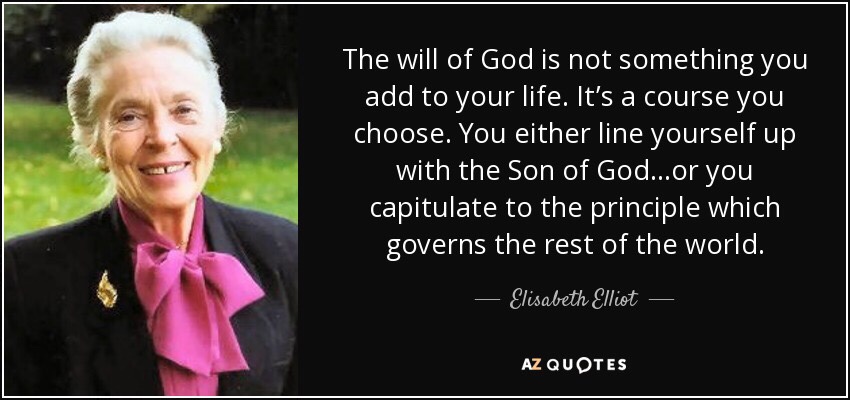
Elisabeth Elliot Testimony: The Missionary Who Lived With The Tribe That Killed Her Husband

She was born Elisabeth Howard in 1926 – one of six children – to missionary parents in Brussels, Belgium. Her parents moved to Philadelphia, USA, a few months after Elisabeth was born. She later described them as devout, disciplined Christians who built their family life around the Bible.

‘We grew up with the understanding that the scriptures were top priority… we had bible reading and prayer at the end of dinner every night as we sat around the table, and up until the age of, I suppose, seven or eight, each of us children was put to bed by one of our parents and prayed with, and sometimes we had the bible read to us again. so we heard the bible read aloud at least twice a day, sometimes three times a day.

‘And the other very very powerful influence in our lives, I’m sure was the fact that my father got up himself between 4:30 and 5:00 in the morning in order to have time alone with the Lord.

And when we came to breakfast, we knew that we had been prayed for… meaning my father was in his study for those hours before breakfast with his prayer lists and his notebooks and his bible and down on his knees praying for us.’

Elisabeth reckoned she herself came to faith at around the age of five. This was followed by a definite commitment to Christ when she was twelve: “I think I realised that if Jesus was my saviour, he also had to be my Lord, so I then committed my life and said, ‘Lord, I want you to do anything you want with me.’”

We can surmise from this that even at this tender age Elisabeth realised she had a calling to the mission field. She studied classical Greek at Wheaton college, Illinois, believing that it was the best tool to help her with her desire to translate the New Testament into a yet-unreached language.

It was at Wheaton where she met Jim Elliot. Before their marriage they both went individually to Ecuador to work with the Quechua Indians; the two married in 1953 in the city of Quito, Ecuador.

Before Elisabeth started her work, she listened to the words of Maruja, a woman of a neighbouring tribe who had been held captive for a year by the Huaorani, sometimes called the Aucas, or ‘savages’. She told Elisabeth that the tribe was fierce and they acted like savages, but that the women were likeable and kind. In 1955, only ten months before Jim was killed, Elisabeth gave birth to a daughter, Valerie.

Elisabeth said that she had a premonition that Jim’s mission might end in his death, explaining, “I often thought I was going to lose my husband.” In fact, just before he left for his fateful mission to the Aucas they had talked about what she would do if Jim should not return.

So as they said what turned out to be their last goodbyes in January 1956, her mind was a filled with thoughts as to whether that would be the last time she saw him alive.

Jim and four other Christian missionaries Nate Saint, Roger Youderian, Ed Mccully and Peter Fleming – were speared to death in the jungles of Ecuador. Their killers were Huaorani Indians, the same group that Elisabeth had been warned about earlier.

After Jim’s death, Elisabeth, together with Rachel saint, the sister of another of those killed, continued her work among the Quechua at a site which was several days by trail from Auca territory.

Despite what had happened to their men, Elisabeth and Rachel were still determined to reach the killers with the gospel. At the time, their only link with Auca culture came when they met Dayuma, a young woman who had fled the tribe some years before to live with white missionaries. Dayuma, who was by then a believing Christian, helped them with the Auca language.

In November 1957 came a breakthrough. Elisabeth heard that two more Auca women had left their tribe. She hurried to the neighbouring settlement where the women – Mintaka and Minkamu – were, and spent the next ten months with them, seeking to learn more of the Auca language and culture.

Eventually the two Auca women – together with Dayuma – decided to return to their native tribe, leaving Elisabeth and Rachel wondering what the fate of the three women might be when they arrived home.

However, after three weeks the women returned to the mission compound bringing along seven other Aucas, plus a invitation to the missionaries to visit the tribe!

‘As long as this is what the Lord requires of me, then all else is irrelevant’ Elisabeth Elliot

Elisabeth and Rachel lost no time in taking up this unprecedented offer. However, Elisabeth admitted that taking her three-year-old daughter, Valerie, along strapped to her back was ‘the biggest test of faith ever’.

As well as the usual dangers found in jungle terrain, she had to face the possibility that the Aucas might choose to kill her and carry off the youngster.

In a later interview she said that, although she appreciated the kind warnings of fellow Christians, she felt that ‘as long as this is what the Lord requires of me, then all else is irrelevant’.

The journey to the Auca village took two-and-a-half days by canoe and trail paths. Ironically, the party arrived on the afternoon of 8 October 1958, Jim’s birthday and the day which would have been the couple’s fifth wedding anniversary.

When the missionaries reached a clearing in the jungle, there stood a welcoming party of three Aucas.

Elisabeth described the reception as ‘friendly… it seemed like the most natural thing in the world’. For the next year the missionaries enjoyed a good relationship with the tribe as they ministered to them. the Aucas gave Elisabeth the tribal name ‘Gikari’, Huao for ‘Woodpecker.’

She later returned to the Quichua and worked with them until 1963, when she and Valerie returned to the USA. Rachel saint continued the work with the Aucas under the auspices of their sponsoring missionary society, the summer Institute of linguistics (sIl).

Over the years some anthropologists have criticised the missionaries’ work, viewing their intervention as the cause for the widely-recognised decline of Huaorani culture. In response Elisabeth Elliot said in an interview that there is absolutely no point in trying to reach tribes like the Huaorani unless you believe the New Testament message that people – however few and remote – are lost without the gospel of Jesus Christ.

And while no-one would claim the missionaries didn’t make mistakes along the way, the gospel they preached resulted in a marked decline in violence among tribe members, together with numerous conversions to Christianity and the growth of the local church.

Indeed, it has been argued by others that the effects of Christianity were very positive, as it served as a way for the Huaorani to escape the cycle of violence in their community, providing them with a motivation to abstain from killing. Ironically it was probably exposure to Western ‘civilisation’ – not the gospel – that had the most detrimental effect on the Huaorani people.

On her return to America, Elisabeth became a noted speaker and writer. Her book, ‘through gates of splendour’ is ranked among the most influential books that have shaped the thinking of evangelicals. The book became a bestseller, as did ‘shadow of the Almighty: the life and testimony of Jim Elliot.’

According to Kathryn long, professor of history at Wheaton college, ‘those books became the definitive inspirational mission stories for the second half of the 20th century. [Elisabeth Elliot] really had a sense of her audience as evangelicals, and she could tell this story in a way that keyed into [their] values.’

Elisabeth went on to write more than a dozen additional books and launched a raddio show, ‘gateway to Joy’, which ran until 2001. She almost always opened the programme with the phrase, “‘You are loved with an everlasting love,’ – that’s what the Bible says – ‘and underneath are the everlasting arms.’ this is your friend, Elisabeth Elliot…”

Two later books on missions, ‘no graven Image’ and ‘the savage my Kingsman’, raise important questions about mission work and reveal Elliot as a extraordinarily perceptive thinker and writer.

In 1969, Elisabeth married Addison Leitch, professor of theology at Gordon-Conwell theological seminary in south Hamilton, Massachusetts.

They were together until Leitch’s death in 1973. In 1974, Elliot became an adjunct professor on the faculty of Gordon Conwell theological seminary and for several years taught a popular course entitled ‘christian expression’.

Her third marriage to Lars Gren, a hospital chaplain, took place in 1977.

After their marriage the couple worked and travelled together.

‘Nothing can separate us from the love of Christ’ – Elisabeth Eliott

Elisabeth Elliot died in Magnolia, Massachusetts, on 15 June 2015, at the age of 88. Sadly in her last years she suffered from dementia. Her husband, Lars, said: “She accepted those things, [knowing] they were no surprise to god.

”It was something she would rather not have experienced, but she received it.”

Elisabeth’s only daughter, Valerie, who spent part of her childhood among the Aucas, married a pastor, Walter Shepard, in 1976. Since then Valerie has spent her time being a pastor’s wife, raising eight children, teaching the bible and speaking at conferences.

She described her mother as: “A speaker of the truth, a teacher of obedience, a woman of strength and dignity. She always loved and encouraged me. she was a woman of prayer.”

Perhaps Elisabeth Elliot’s whole philosophy of life and ministry can be summed up in the words she once wrote: “We have proved beyond any doubt that he [God] means what he says – his grace is sufficient – nothing can separate us from the love of Christ. We pray that if any, anywhere, are fearing that the cost of discipleship is too great, they may be given a glimpse of that treasure in heaven promised to all who forsake.”

———

** This article was taken from the October 2016 issue of Heroes Of The Faith by Dave Littlewood / Photos Elisabeth Elliot Foundation

Father I Know That All My Life

Father, I know that all my life is portioned out for me,
And the changes that are sure to come I do not fear to see;
But I ask Thee for a present mind intent on pleasing Thee.

I ask Thee for a thoughtful love, through constant watching wise,
To meet the glad with joyful smiles, and to wipe the weeping eyes;
And a heart at leisure from itself, to soothe and sympathize.

I would not have the restless will that hurries to and fro,
Seeking for some great thing to do or secret thing to know;
I would be treated as a child, and guided where I go.

Wherever in the world I am, in whatso’er estate,
I have a fellowship with hearts to keep and cultivate;
And a work of lowly love to do for the Lord on whom I wait.

So I ask Thee for the daily strength, to none that ask denied,
And a mind to blend with outward life while keeping at Thy side;
Content to fill a little space, if Thou be glorified.

And if some things I do not ask in my cup of blessing be,
I would have my spirit filled the more with grateful love to Thee,
More careful, not to serve Thee much, but to please Thee perfectly.

There are briers besetting every path that call for patient care;
There is a cross in every lot, and an earnest need for prayer;
But a lowly heart that leans on Thee is happy anywhere.

In a service which Thy will appoints there are no bonds for me;
For my inmost heart is taught “the truth” that makes Thy children “free”
And a life of self-renouncing love is a life of liberty.

—————

**By Anna Letitia Waring – 1850 / Photo by Lori McPherson

What He Must Be…

In pastor and author Voddie Baucham’s book, “What He Must Be,” he states that the man must lead in the Word.  To do so, he himself must be deeply rooted in the Word before he can lead his wife in this area.  I have outlined this book for single women to use as a reference guide for choosing a Godly mate and for men to strive for as God’s standard for them to follow.

The information detailed in this outline is not written by me, but was extracted from the book “What He Must Be,” written by Voddie Baucham Jr.  There are also additional notes I have added from his video series “Love and Marriage” on Youtube, the links are below. 

I am adding this to my blog to help raise my sisters’ standards in the men they consider as future husbands.  And to set the standard for brothers to live by and strive for as they prepare to be husbands to my sisters in Christ!

Ephesians 5:25-31 Husbands, love your wives, just as Christ loved the church and gave himself up for her to make her holy, cleansing her by the washing with water through the word,  and to present her to himself as a radiant church, without stain or wrinkle or any other blemish, but holy and blameless.  In this same way, husbands ought to love their wives as their own bodies. He who loves his wife loves himself.  After all, no one ever hated their own body, but they feed and care for their body, just as Christ does the church— for we are members of his body.  “For this reason a man will leave his father and mother and be united to his wife, and the two will become one flesh.”

Biblical Love

An act of the will, accompanied by emotion, that leads to action on behalf of its object; not led by emotion, nor is it void of emotion, that demonstrates itself by actions on behalf of its object

Marriage is a Ministry

  1 – It was God’s first command, “Be fruitful and multiply…”

  2 – A Training Ground for Church Leaders

  3 – An Illustration for a Lost World

  4 – The Preferred State

          a)  Be Prepared

          b)  Two States, One Standard

          c)  Jesus-Our Ultimate Guide

“Marriage is the God–appointed and legitimate union of man and woman in the hope of having children or at least for the purpose of avoiding fornication and sin and living to the glory of God.  The ultimate purpose is to obey God, to find aid and counsel against sin; to call upon God; to seek, love, and educate children for the glory of God; to live with one’s wife in the fear of God and to bear the cross.”  — Martin Luther

1 – He Must Be a Follower of Christ

a)  A True Believer is Regenerate

a.      He must be born again

b.     There is an infallible connection between regeneration and salvation

b)     A True Believer is Repentant

a.      Repentance is at the core of the gospel message.  A man cannot claim regeneration if he shows no evidence of repentance.

b.     True repentance is the result of an accurate understanding of the significance and gravity of sin, coupled with an overwhelming desire for the remission of that sin through the person and work of Christ.

c)      A True Believer is Reformed

a.      Consistent, perpetual, undeniable, evidence proceeding from his mouth and life on a daily basis.

b. No one who is born of God will continue to sin, because God’s seed remains in them; they cannot go on sinning, because they have been born of God. This is how we know who the children of God are and who the children of the devil are: Anyone who does not do what is right is not God’s child, nor is anyone who does not love their brother and sister. (1 John 3:9-10)

2 – He Must Be Prepared to Lead

a)  He must lead like Christ

a.  Lead in Love

A man who loves like Christ will protect his heart

A man who loves like Christ will protect her heart

b.  Lead in the Word

Leading in the word requires personal time in the word

Leading in the word requires a grasp of the word

Leading in the word requires a Plan for Growth

Leading in the word requires patient instruction

VIDEO: If he is not a man who can mentor you in the scriptures, he not worthy of being your husband. 

Can he disciple and mentor you in the Word of God?

He has to be equipped to mentor and disciple your children in The Word.

He MUST be this before you even think about him!!

c.  Lead in Righteousness

He must be marked with an upright life

He must nurture holiness in his bride

He must influence his family in righteousness

Video:  A man who ensures your purity.

What he’s saying if he wants to get physical: “I want to use you and I want to dishonor you.”

He must be a man who desires for me to be Pure.

A guy who wants you to move in with him is saying, “I want all the benefits with none of the responsibilities.”

“Sex is like Fire.  You put fire in a fireplace and it warms the whole room.  You let fire out of the fireplace, it will consume and destroy everything in its path. It must be in the proper context…and biblically, the only proper context is Marriage.” — Voddie Baucham Jr.

d.   Lead in Selflessness

He will show restraint and patience throughout the courtship process

He must show Christlike selflessness

He must demonstrate his willingness and desire to put her needs above his own

VIDEO: He must be a man who understands what it means to put others before himself.  If he’s more interested in what he can take from you than what he can give to you, then he’s not the kind of man who leads in selflessness.  If he doesn’t treat you like a delicate flower, keep stepping.  Cause what you’re looking for biblically is a man who nourishes you as he would his own flesh.

e.  Lead in Intimacy

External Intimacy

Internal Intimacy

VIDEO: Intimacy happens when I let someone into a part my life that is not readily available to everyone.

Creates a hedge of protection around the marriage relationship that says this relationship is prioritized above all others.

3 – He Must Be Committed to Children

a)  Committed to having children

b)  Committed to investing in children

c)  Committed to supporting children

4 – He Must Practice the 4 P’s

He must be a Protector

He must possess personal strength, wisdom, and courage

He must be a Provider (Dependence on others is a perversion of biblical manhood)

He must have a job

He must have a work ethic

He must have a plan

He must be a Prophet/Priest

A man must Pray for his family

A man must Preach to his family

A Priest is an intercessor who represents his people before God

A Prophet is one who instructs his people in God’s truth

God has given husbands the responsibility of washing their wives in the water of the Word; Diligently teaching the Law to their children; and bringing them up in the discipline and instruction in the Lord

Love and Marriage Video Series, Voddie Baucham

Love and Marriage, Part 1 (sermon starts at 32min:50sec)

http://www.youtube.com/watch?v=PnTCl6Dvr5U&feature=related

Love & Marriage (part 1 – In the Beginning).wmv – YouTube http://www.youtube.com* Sermon starts at – 32min:50sec A sermon series by Voddie Baucham spoken at the 7:22 service at the Northpoint Community Church in Atlanta in 2005

Love and Marriage, Part 2 (sermon starts at 29min)

http://www.youtube.com/watch?v=CKGyFyW3-D4&feature=relmfu

Love & Marriage (part 2 – True Love).wmv – YouTubehttp://www.youtube.com* Sermon starts at 29min * A sermon series by Voddie Baucham spoken at the 7:22 service at the Northpoint Community Church in Atlanta in 2005

Love and Marriage, Part 3 (sermon starts at 29min:15sec)

http://www.youtube.com/watch?v=7wAdURL_qdQ&feature=relmfu

Love & Marriage (part 3 – The Other Half).wmv – YouTubehttp://www.youtube.com* Sermon starts at 29min:15sec * A sermon series by Voddie Baucham spoken at the 7:22 service at the Northpoint Community Church in Atlanta in 2005

Love and Marriage, Part 4 (sermon starts at 17min:50sec)

http://www.youtube.com/watch?v=cybhnuvS1i0&feature=relmfu

——————————

***By Nina Andres author of the book, “God Ordained Relationship”

***More sermons to do with Christian relationships can be found HERE! Covering all stages of a Christian relationship for men and women: single, courting / dating, marriage, home, bringing up children and all the bits in-between.

Popular Articles

A Clear Gospel Message

The Abortion Debate

Human Trafficking / Child Abuse

Trusting God to Heal the Scars of Sexual Abuse

5 Ways Your Kids Are Under Attack and How to Take Action

The True Gift

True or False Conversion

Once Saved Always Saved?

The Judge – Upholding what is right comes at a cost

What is a True Christian or Believer

Prayer Speaking to God

Forgiving Others as God has Forgiving you

Prayer for forgiving others

Living Right Today

Lust Verses Love A Biblical Perspective

Most people know the difference between lust and love so what are they? What does the Bible define as love and as lust?

A Definition of Lust

Lust is an emotion or feeling of intense desire in the body and it can take nearly any form such as the lust for knowledge, the lust for sex or the lust for power. It is an overwhelming self-absorbed desire or craving for an object, person, or experience that might be good but in most cases, is not. For example, a man or a woman can lust after their spouse and since they are legally married, there is no sin in this, however lusting after someone else’s spouse or someone who’s not married is sin, so clearly, lust and love aren’t the same at all and in many ways, they are actually opposites of one another, for example we can lust after riches, for drugs, for alcohol, and for any number of things that are detrimental to our wellbeing.

A Definition of Love

The way the world defines love and the way that God defines love are not even close to the same thing. As far as the world sees, love is a strong and warm affection that someone has for another or others or for something. It could be like that of a parent for a child or a spouse for their mate or it could be a love for reading, eating, drugs, alcohol, or even shopping. Some of these are good and well, but others can lead to ruin. Love can certainly be a strong feeling of affection and concern toward another person, as that arising from a kinship or close friendship, which I have for my own spouse and children and grandchildren and even for my friends but from the biblical standpoint, love and lust are no co-equals since one can be good, while the other can lead to harm.

But-I-say-to-you-that

A Biblical Definition of Lust

I like what C.S. Lewis wrote many years ago. He wrote “If you look upon ham and eggs and lust, you have already committed breakfast in your heart.” This is a very good, biblical definition of lust in the heart. If you covet something or someone, that is lusting in the heart. Exodus 20:17 lists the tenth commandment as “You shall not covet your neighbor’s house. You shall not covet your neighbor’s wife, or his male or female servant, his ox or donkey, or anything that belongs to your neighbor” so lust is not just about looking at someone of the opposite sex, or for some, looking at someone with lust of the same sex, it is coveting what you don’t have. It is a passionate desire to have what someone else has.

What Lust Can Lead To

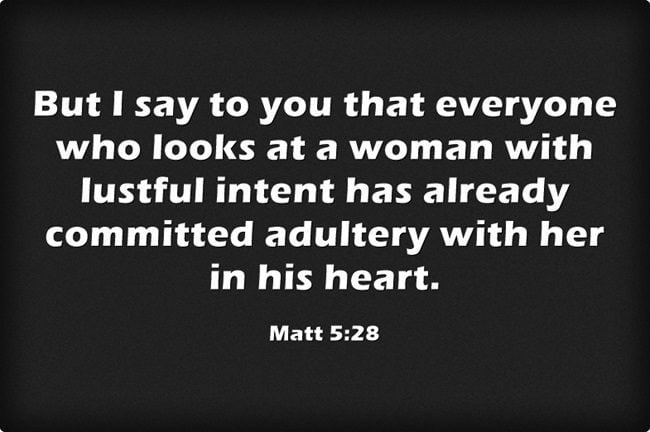
David let his lust carry him away as “One evening David got up from his bed and walked around on the roof of the palace. From the roof he saw a woman bathing. The woman was very beautiful” (2nd Sam 11:2) and so he lusted after her in his heart. This led to adultery and later, to the murder of Bathsheba’s husband, Uriah. This is why James wrote that “after desire (or lust) has conceived, it gives birth to sin; and sin, when it is full-grown, gives birth to death” (1:15). The proverbs say “Do not lust in your heart after her beauty or let her captivate you with her eyes” (6:25). Jesus said that it was “out of the heart come evil thoughts–murder, adultery, sexual immorality, theft, false testimony, slander” (Matt 15:19). Solomon understood this connection, writing that as a man “thinks within himself, so he is” (23:7a). You can commit adultery without ever committing the physical act. Jesus said that “that everyone who looks at a woman with lustful intent has already committed adultery with her in his heart” (Matt 5:28) and of course the same thing applies to women.

A Biblical Definition of Love

There are so many places that define love in the Bible that it will be hard to select only a few. Paul writes that “Love is patient and kind; love does not envy or boast; it is not arrogant or rude. It does not insist on its own way; it is not irritable or resentful; it does not rejoice at wrongdoing, but rejoices with the truth. Love bears all things, believes all things, hopes all things, endures all things” (1st Cor 13:4-7). The love of God is not about feelings or words but “God shows his love for us in that while we were still sinners, Christ died for us” (Rom 5:8). Love is a verb; it is what you do more than what you say or what you think. We know that Jesus did not feel like taking on all of the sins of humanity, but His great love for us on the cross proved what the love of God is like. He died for us while we were still wicked sinners and His enemies (Rom 5:8, 10).

Conclusion

The differences between love and lust are that we don’t covet what we don’t have. We shouldn’t covet (lust after) our neighbor’s spouse or their goods (Ex 20:17). Love, on the other hand, “does no wrong to a neighbor; therefore love is the fulfilling of the law” (Rom 13:10) and this means “You shall love your neighbor as yourself” (Matt 19:19) but above all “You shall love the Lord your God with all your heart and with all your soul and with all your mind” (Matt 22:37). The difference for believers is that we are told “Love your enemies and pray for those who persecute you” (Matt 5:44). The greatest display of love was not what Jesus felt or what God feels but it was revealed at Calvary. Jesus said “Greater love has no one than this, that someone lay down his life for his friends” (John 15:13) and that’s just what He did. Lust harms, love sacrifices.

—————-

**By Jack Wellman at what Christians wat to know / Photo by Mark Stebnicki at Pexels

Popular Articles

A Clear Gospel Message

The Abortion Debate

Human Trafficking / Child Abuse

The True Gift

True or False Conversion

Once Saved Always Saved?

The Judge – Upholding what is right comes at a cost

What is a True Christian or Believer

Prayer Speaking to God

Forgiving Others as God has Forgiving you

Prayer for forgiving others

Living Right Today