Resurrection Power

In 2 Kings 2:13-14, we read about Elisha dividing Jordan which is symbolic of a ministry of life that conquers and overcomes spiritual death. The waters of Jordan, in the Bible, are symbolic of death. And the parting of the waters is therefore symbolic of triumph over death. In the ministry of Elisha, we find him engaged again and again in bringing life out of death. In Jericho, he brought life into the barren land there (2 Kings 2:19-22). In Shunem, he brought life into the barren womb of a woman (2 Kings 4:8-17). Later, he brought life into a dead child (2 Kings 4: 18-37). He once brought life into a pot of deadly food (2 Kings 4: 38-41). He ministered life to a leprous general’s dying body too ( 2 Kings 5 : 1-14) Elisha’s power never faded away. Even after he was dead and buried and his body had disintegrated,when a dead man was thrown into his grave, the dead man arose!(2 Kings 13:20-21) This was Elisha’s ministry-bringing life out of death wherever he went. This was a direct result of his being anointed. This is the type of power that the anointing of the Holy Spirit brings-power to bring life out of death, resurrection power. This alone is the unmistakable evidence of the anointing. We read of this power often in the New Testament. Paul writing to the Ephesian Christians, says that his prayer for them is that they may know this power. He goes on to tell them that the greatest manifestation of God’s power was not in creation nor in the miracles recorded in the Bible, but in the raising of Christ from the dead (Eph. 1:19-23). Writing to the Philippian Christians, Paul tells them that his own desire is that he may know more of this resurrection power (Phil. 3:10).This, I am convinced, is the power that Jesus said His disciples would receive when the Holy Spirit came upon them (Acts 1:8) – resurrection power, the power to bring life out of spiritual death. And God desires to communicate this to us too.

This, brothers and sisters, is the mark of the anointing. Not some experience, not some utterance, but the power to bring spiritual life out of death wherever we go. Is our ministry accomplishing this? This is the acid test whether we have the anointing or not. Alas, so often Christians, instead of ministering life are ministering death. The heathen are so often driven away from the Lord instead of being drawn to Him, because of the bickering and quarrels, the lack of integrity and other un-Christlike habits that they see in the lives of those who profess to be born-again Christians. How we need to humble ourselves before God and ask for His forgiveness for bringing reproach upon His Name by our behaviour.

Let us not glory merely in the fact that we are “evangelicals.” If we are not careful, we can end up like the church in Sardis, having a name that we are alive but in reality being dead (Rev. 3:1). It is not enough that the creed we repeat and the statement of faith we sign are Scripturally sound. We may be able to sign the most fundamental statement of faith. So can the Devil! He knows the Bible well and so he is no modernist. He is a thorough fundamentalist as far as doctrines go! It is not much use therefore taking credit merely for our fundamentalism. Doctrines are important. God forbid that I should decry their value. But over and above doctrine, the thing that counts with God is whether we are ministering spiritual life or not.

The Apostle Paul could say that through God’s help, he was an able minister of the New Testament, ministering spiritual life (2 Cor. 3:5,6). He didn’t just boast that he was a fundamentalist. Neither did he merely talk of his experiences-either the Damascus Road one or the Straight Street one. No. He demonstrated the reality of his fundamental beliefs and of his spiritual experiences by constantly bringing life into situations of spiritual death.

In Paul’s life, as in Elisha’s, there was no fading away of the power. There was no losing of the anointing in later years, as seems to be the case with so many servants of God in our day. Paul and Elisha never came to a stage where all they could do was to glory in what God did in days of yore. They constantly lived in the present enjoyment of the anointing and of God’s power. Their spiritual strength instead of waning, waxed more and more. As their days, so was their strength. Their light shone brighter and brighter until the perfect day. What a blessed way to live! And yet this is the path that God desires all His children to walk in (Prov. 4:18).

Elisha lived in constant touch with God and this was why he was always able to bring life out of death wherever he went. And so people came to him with their problems and their needs. He didn’t have to go looking for a ministry. He didn’t have to go around asking people to sponsor him and to invite him. No. Opportunities for ministry came to him in abundance, without any fleshly efforts on his part.

———

** Copyright – Zac Poonen. No changes whatsoever are to be made to the content of the article without written permission from the author at cfcindia.com / Photo by Rachel Claire from Pexels by

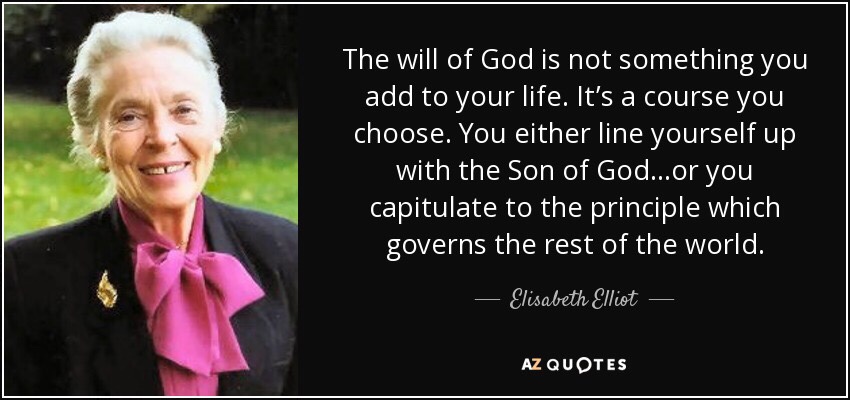
Elisabeth Elliot Testimony: The Missionary Who Lived With The Tribe That Killed Her Husband

She was born Elisabeth Howard in 1926 – one of six children – to missionary parents in Brussels, Belgium. Her parents moved to Philadelphia, USA, a few months after Elisabeth was born. She later described them as devout, disciplined Christians who built their family life around the Bible.

‘We grew up with the understanding that the scriptures were top priority… we had bible reading and prayer at the end of dinner every night as we sat around the table, and up until the age of, I suppose, seven or eight, each of us children was put to bed by one of our parents and prayed with, and sometimes we had the bible read to us again. so we heard the bible read aloud at least twice a day, sometimes three times a day.

‘And the other very very powerful influence in our lives, I’m sure was the fact that my father got up himself between 4:30 and 5:00 in the morning in order to have time alone with the Lord.

And when we came to breakfast, we knew that we had been prayed for… meaning my father was in his study for those hours before breakfast with his prayer lists and his notebooks and his bible and down on his knees praying for us.’

Elisabeth reckoned she herself came to faith at around the age of five. This was followed by a definite commitment to Christ when she was twelve: “I think I realised that if Jesus was my saviour, he also had to be my Lord, so I then committed my life and said, ‘Lord, I want you to do anything you want with me.’”

We can surmise from this that even at this tender age Elisabeth realised she had a calling to the mission field. She studied classical Greek at Wheaton college, Illinois, believing that it was the best tool to help her with her desire to translate the New Testament into a yet-unreached language.

It was at Wheaton where she met Jim Elliot. Before their marriage they both went individually to Ecuador to work with the Quechua Indians; the two married in 1953 in the city of Quito, Ecuador.

Before Elisabeth started her work, she listened to the words of Maruja, a woman of a neighbouring tribe who had been held captive for a year by the Huaorani, sometimes called the Aucas, or ‘savages’. She told Elisabeth that the tribe was fierce and they acted like savages, but that the women were likeable and kind. In 1955, only ten months before Jim was killed, Elisabeth gave birth to a daughter, Valerie.

Elisabeth said that she had a premonition that Jim’s mission might end in his death, explaining, “I often thought I was going to lose my husband.” In fact, just before he left for his fateful mission to the Aucas they had talked about what she would do if Jim should not return.

So as they said what turned out to be their last goodbyes in January 1956, her mind was a filled with thoughts as to whether that would be the last time she saw him alive.

Jim and four other Christian missionaries Nate Saint, Roger Youderian, Ed Mccully and Peter Fleming – were speared to death in the jungles of Ecuador. Their killers were Huaorani Indians, the same group that Elisabeth had been warned about earlier.

After Jim’s death, Elisabeth, together with Rachel saint, the sister of another of those killed, continued her work among the Quechua at a site which was several days by trail from Auca territory.

Despite what had happened to their men, Elisabeth and Rachel were still determined to reach the killers with the gospel. At the time, their only link with Auca culture came when they met Dayuma, a young woman who had fled the tribe some years before to live with white missionaries. Dayuma, who was by then a believing Christian, helped them with the Auca language.

In November 1957 came a breakthrough. Elisabeth heard that two more Auca women had left their tribe. She hurried to the neighbouring settlement where the women – Mintaka and Minkamu – were, and spent the next ten months with them, seeking to learn more of the Auca language and culture.

Eventually the two Auca women – together with Dayuma – decided to return to their native tribe, leaving Elisabeth and Rachel wondering what the fate of the three women might be when they arrived home.

However, after three weeks the women returned to the mission compound bringing along seven other Aucas, plus a invitation to the missionaries to visit the tribe!

‘As long as this is what the Lord requires of me, then all else is irrelevant’ Elisabeth Elliot

Elisabeth and Rachel lost no time in taking up this unprecedented offer. However, Elisabeth admitted that taking her three-year-old daughter, Valerie, along strapped to her back was ‘the biggest test of faith ever’.

As well as the usual dangers found in jungle terrain, she had to face the possibility that the Aucas might choose to kill her and carry off the youngster.

In a later interview she said that, although she appreciated the kind warnings of fellow Christians, she felt that ‘as long as this is what the Lord requires of me, then all else is irrelevant’.

The journey to the Auca village took two-and-a-half days by canoe and trail paths. Ironically, the party arrived on the afternoon of 8 October 1958, Jim’s birthday and the day which would have been the couple’s fifth wedding anniversary.

When the missionaries reached a clearing in the jungle, there stood a welcoming party of three Aucas.

Elisabeth described the reception as ‘friendly… it seemed like the most natural thing in the world’. For the next year the missionaries enjoyed a good relationship with the tribe as they ministered to them. the Aucas gave Elisabeth the tribal name ‘Gikari’, Huao for ‘Woodpecker.’

She later returned to the Quichua and worked with them until 1963, when she and Valerie returned to the USA. Rachel saint continued the work with the Aucas under the auspices of their sponsoring missionary society, the summer Institute of linguistics (sIl).

Over the years some anthropologists have criticised the missionaries’ work, viewing their intervention as the cause for the widely-recognised decline of Huaorani culture. In response Elisabeth Elliot said in an interview that there is absolutely no point in trying to reach tribes like the Huaorani unless you believe the New Testament message that people – however few and remote – are lost without the gospel of Jesus Christ.

And while no-one would claim the missionaries didn’t make mistakes along the way, the gospel they preached resulted in a marked decline in violence among tribe members, together with numerous conversions to Christianity and the growth of the local church.

Indeed, it has been argued by others that the effects of Christianity were very positive, as it served as a way for the Huaorani to escape the cycle of violence in their community, providing them with a motivation to abstain from killing. Ironically it was probably exposure to Western ‘civilisation’ – not the gospel – that had the most detrimental effect on the Huaorani people.

On her return to America, Elisabeth became a noted speaker and writer. Her book, ‘through gates of splendour’ is ranked among the most influential books that have shaped the thinking of evangelicals. The book became a bestseller, as did ‘shadow of the Almighty: the life and testimony of Jim Elliot.’

According to Kathryn long, professor of history at Wheaton college, ‘those books became the definitive inspirational mission stories for the second half of the 20th century. [Elisabeth Elliot] really had a sense of her audience as evangelicals, and she could tell this story in a way that keyed into [their] values.’

Elisabeth went on to write more than a dozen additional books and launched a raddio show, ‘gateway to Joy’, which ran until 2001. She almost always opened the programme with the phrase, “‘You are loved with an everlasting love,’ – that’s what the Bible says – ‘and underneath are the everlasting arms.’ this is your friend, Elisabeth Elliot…”

Two later books on missions, ‘no graven Image’ and ‘the savage my Kingsman’, raise important questions about mission work and reveal Elliot as a extraordinarily perceptive thinker and writer.

In 1969, Elisabeth married Addison Leitch, professor of theology at Gordon-Conwell theological seminary in south Hamilton, Massachusetts.

They were together until Leitch’s death in 1973. In 1974, Elliot became an adjunct professor on the faculty of Gordon Conwell theological seminary and for several years taught a popular course entitled ‘christian expression’.

Her third marriage to Lars Gren, a hospital chaplain, took place in 1977.

After their marriage the couple worked and travelled together.

‘Nothing can separate us from the love of Christ’ – Elisabeth Eliott

Elisabeth Elliot died in Magnolia, Massachusetts, on 15 June 2015, at the age of 88. Sadly in her last years she suffered from dementia. Her husband, Lars, said: “She accepted those things, [knowing] they were no surprise to god.

”It was something she would rather not have experienced, but she received it.”

Elisabeth’s only daughter, Valerie, who spent part of her childhood among the Aucas, married a pastor, Walter Shepard, in 1976. Since then Valerie has spent her time being a pastor’s wife, raising eight children, teaching the bible and speaking at conferences.

She described her mother as: “A speaker of the truth, a teacher of obedience, a woman of strength and dignity. She always loved and encouraged me. she was a woman of prayer.”

Perhaps Elisabeth Elliot’s whole philosophy of life and ministry can be summed up in the words she once wrote: “We have proved beyond any doubt that he [God] means what he says – his grace is sufficient – nothing can separate us from the love of Christ. We pray that if any, anywhere, are fearing that the cost of discipleship is too great, they may be given a glimpse of that treasure in heaven promised to all who forsake.”

———

** This article was taken from the October 2016 issue of Heroes Of The Faith by Dave Littlewood / Photos Elisabeth Elliot Foundation

Be Anointed With the Holy Spirit and Power

Acts 2 we find that when those 120 people waited for the Holy Spirit, they did not know how long they would have to wait, because Jesus never told them. If they knew it would be only ten days, it would have been easier for them to wait. When God keeps us waiting for something, He does not usually tell us how long we have to wait for an answer.

God wants us to live by faith, because that is the only way to grow spiritually – and waiting is one way by which our faith is strengthened. If we knew how long we had to wait, then there would be no faith there. It is only afterwards when we look back that we can say, “I had to wait for three days (or three years)” for that.

If you had gone to those waiting disciples and asked them, “How will you know when you have been baptised in the Holy Spirit?” – They would not have said that they would speak in tongues. They would have said that Jesus had told them that they would receive power. You may ask “How will I know that I have received this power?” God can assure us of that, just like He assured us that our sins were forgiven. The Holy Spirit, Who bears witness with our spirit that our sins have been forgiven will also bear witness that we have been endued with power. Ask God to give you the assurance for both these important matters. So they were waiting for power. But when they got power they also received the gift of speaking in unknown languages (tongues).

The tragedy today is that many who claim to have the gift of tongues do not seem to have any power. Tongues can be imitated, whereas power to overcome sin and to be a bold witness for Christ cannot be imitated.

Consider this illustration: You go to a shop to buy a computer (power). The shopkeeper tells you that a free CD (tongues) is also being offered with every computer. You didn’t go to the shop to buy a CD but a computer. But since the CD is being offered freely, you take both the computer and the CD. But now your friend sees your CD and goes to the same shop and pays for the computer but brings home only the free CD!! How foolish! That is a picture of those who received the gift of tongues but not the power.

We read that a noise and a wind filled the house where they were praying and tongues as of fire rested on everyone’s head. These were only the externals. The receiving of an anointing and power were the major events. The externals were different when Jesus was anointed. In His case, there was no wind or fire but a dove and a voice. But the power and anointing He received were the same as these apostles received. We all need to be “anointed with the Holy Spirit and power” as Jesus was (Acts 10:38).

The physical and emotional experiences may vary with each of us. If someone were to give you an expensive diamond as a gift, it wouldn’t make any difference if it came wrapped crudely in ordinary brown paper or in a shiny paper with fancy ribbons? It is the gift inside that is important. Only babies are taken up with the wrappings, the externals – the wind, the fire, the noise, the tingling sensations, etc. Adults are taken up with the gift – the anointing and the power of the Holy Spirit. When people testify about and glory in the wrapping in which they got the gift, you know that they are still baby-Christians.

The tongues of fire that sat on everyone’s heads indicated that the most important part of our body that God would be using in the new covenant age would be the tongue – a tongue set on fire by the Holy Spirit and under His total control all the time. This is also part of the symbolism of the gift of tongues. God wants to use your tongue to bless others with, not only if you are a preacher, but also in your ordinary conversations with people every day. But for this, you must let the Holy Spirit have full control of your speech, 24 hours a day, seven days a week. In 2:14, we see one wonderful result of the Spirit indwelling all the apostles. We read here, “Peter stood up, backed by the other eleven” (MSG).

What Jesus could not accomplish in His entire lifetime is now accomplished at last: The twelve are all one body now. They did not compete to have the honour to preach. They supported Peter and were 100% behind him as he spoke. This is the greater work that Jesus had said they would do after the Spirit came – the Holy Spirit had baptised them into one body.

In 2:17, Peter said that the outpouring of the Holy Spirit was the fulfilment of the prophecy of Joel. All men and women could now have the Spirit poured out on them and they could prophesy. This was a privilege reserved only for kings and priests under the old covenant. But under the new covenant, all can receive the Spirit. We need to recognise what a tremendous honour this is.

——-

** Copyright – Zac Poonen. No changes whatsoever are to be made to the content of the article without written permission from the author at CFC India.com / Photo by Jahoo Clouseau at Pexels

Screening An Un-Blanked-Out Documentary

“Therefore do not go on passing judgment before the time, but wait until the Lord comes who will both bring to light the things hidden in the darkness and disclose the motives of men’s hearts; and then each man’s praise will come to him from God.”

‭‭1 Corinthians‬ ‭4:5‬ ‭NASB‬‬

At the judgment seat of Christ, all of God’s ways will be seen to be perfectly just and righteous. That’s why we’re commanded to wait to judge — because there will come a day when even the secret motives of men’s hearts will be revealed, and then and only then can we judge righteously. Jesus says the same thing in Luke 12:2-3:

“But there is nothing covered up that will not be revealed, and hidden that will not be known. Accordingly, whatever you have said in the dark will be heard in the light, and what you have whispered in the inner rooms will be proclaimed upon the housetops.”
‭‭
The picture I have of the judgment seat is one where everyone who has ever lived will see my every thought, word, deed, and motive, and will be able to see that God’s judgment of my life is perfectly righteous. It’s as if a documentary of all my life — inward and outward — will be on a giant movie screen for everyone who’s ever lived to see. And all people, finally having “perfect information” so to speak, will come to the same exact conclusion that God does in His judgment of my life. For some, that may be an absolutely terrifying idea. But for Christians, we can take comfort knowing that God has “blotted out” those sinful spots on the tape (Psalm 51:9), because He chooses not to remember (Isaiah 43:25) any of the sins that we confess in the name of Jesus Christ (1 John 1:7,9). Praise God for that!!

But Christian, let me ask you a question: how will you feel if, when it’s “showtime” for your documentary in heaven, your entire movie is just a series of blanked-out scenes and bleeped-out speech? No sound, no video, all blank? Definitely no sin there to speak of, just hours and hours of silence. Non-footage, so to speak. It’s as if your life almost never took place. Will that be cause for rejoicing?

Or does that sound terrible to you? I must say that I will be utterly heartbroken if my documentary is all bleeped-out footage, with nothing worth screening in the final day! I want more than that! I want a life that brings God glory and honor and praise (Philippians 1:10-11), a life He can put on display to the rulers and authorities in the heavenly places as evidence of His trustworthiness and wisdom and power (Ephesians 3:10, Job 1:8), a life that is not merely stripped of all evidence of bad, but that fulfills all the good that God had in His heart when He made me (Ephesians 2:10)! (I encourage you to read those verses and see whether that is God’s hope for your life too.)

The Holy Spirit says that “each man’s work will become evident; for the day will show it because it is to be revealed with fire, and the fire itself will test the quality of each man’s work. If any man’s work which he has built on it remains, he will receive a reward. If any man’s work is burned up, he will suffer loss; but he himself will be saved, yet so as through fire” (‭‭1 Corinthians‬ ‭3:13-15‬)‬‬. I don’t know about you, but that’s not what I want the subtitle of my movie to be: “saved, yet so as through fire.” To be sure, I’m not interested in reward, except that it will be something I get to throw at my precious Savior’s feet (Revelation 4:10). What I’m interested in is a life that brings God praise and glory in the final day, and the way to do that is to seek for there to be something left on the tape after the fire blots out all of the footage that dishonors the Lord.

Lord, according to Your Holy Spirit’s work in me, I want an un-bleeped tape! I want my life to count for You! I want to be a part of the manifestation that shames the devil and brings glory to Jesus Christ in the final day, that extols His trustworthiness and power.

“But you are A CHOSEN RACE, A royal PRIESTHOOD, A HOLY NATION, A PEOPLE FOR God’s OWN POSSESSION, so that you may proclaim the excellencies of Him who has called you out of darkness into His marvelous light; for you once were NOT A PEOPLE, but now you are THE PEOPLE OF GOD; you had NOT RECEIVED MERCY, but now you have RECEIVED MERCY. Beloved, I urge you as aliens and strangers to abstain from fleshly lusts which wage war against the soul. Keep your behavior excellent among the Gentiles, so that in the thing in which they slander you as evildoers, they may because of your good deeds, as they observe them, glorify God in the day of visitation.”
‭‭1 Peter‬ ‭2:9-12‬ ‭NASB‬‬

Our good deeds may never be evident to worldly-minded people during our life on earth. But our hope is that, in the final day, when all things are known perfectly, and they watch the movies of our lives, they would have cause to glorify God. Not because there’s a blank tape (unlike their filthy tape), but there’s a tape filled with evidence of God’s glory.

—————————

**By Jeremy Utley © Copyright – Jeremy Utley. No changes whatsoever are to be made to the content of the article without written permission from the author at NCCF Church

How to Get and Keep a Good Conscience

I strive always to keep my conscience clear before God and man. (Acts 24:16)

Conscience gives you the ability to evaluate your own thoughts and desires, to discern what is right and wrong, and to distinguish between what is good and what is best. 

To help us get a handle on conscience and how it functions, I want you to think about an alarm clock. A good alarm clock does two things: It stays quiet when you should be asleep, and it makes a noise when you need to wake up! 

That’s how your conscience is supposed to work. When you are on the right path, a good conscience will be at peace (Colossians 3:15). But when you are tempted towards the wrong path, a good conscience will sound the alarm. The problem with the conscience is that, like every other part of your soul, it has been disordered by sin. 

Like an alarm clock, conscience can malfunction and stay silent when it should go off.

My Alarm Didn’t Go Off! 

The corrupt conscience 

To the pure, all things are pure, but to those who are corrupted and do not believe, nothing is pure. In fact, both their minds and consciences are corrupted. (Titus 1:15) 

Acting against your conscience will bring a change in your inner life. It will change how your conscience functions. A corrupt conscience approves the wrong things. 

An easy way to see this is to picture a teenager using drugs for the first time. He knows that drugs are addictive and destructive, and his conscience tells him that taking them is wrong. But his friends are encouraging him to try them. He wants his friends to like him. So he over-rides his conscience.

In over-ruling his conscience, he diminishes its power. His conscience is weakened. It is less sensitive, and therefore less effective. Next time, the decision to take the drug will be much easier. If the boy repeats this choice again, the boy’s conscience changes. After a while he will feel that there is nothing wrong with what he is doing.

The important point to grasp here is that the conscience is corrupted whenever a person acts against it over time. When a person’s conscience is corrupted over time, it can become seared.

The seared conscience 

Such teachings come through hypocritical liars, whose consciences have been seared as with a hot iron. (1 Timothy 4:2) 

In the ancient world, doctors would use a hot iron to cauterize a wound. It hardly bears thinking about what this must have been like before anesthetic, but if you had a wound and the bleeding could not be stopped, your best hope was the hot iron pressed on your flesh.

Once you recovered from the pain, you would discover that the bleeding had stopped, but you would also find that you had lost all feeling in the area that had been seared. The hot iron killed off the nerves so that you no longer had feeling where the iron had been applied. 

Paul says, “That’s how it is with some people’s conscience.” They have been “seared as with a hot iron” (Ephesians 4:19). Their conscience has lost all sensitivity. When that happens, a person can lie, cheat, or steal without their conscience raising any objection. They feel no guilt because their conscience is seared.

As he was on the road to Damascus, that’s exactly what Saul of Tarsus thought. Do you think he was worried about doing something wrong? The seared conscience calls evil “good” and good “evil” (Isaiah 5:20). 

How to Get and Keep a Good Conscience

I strive always to keep my conscience clear before God and man. (Acts 24:16) 

If a conscience has become corrupt, so that it is no longer functioning correctly, how can it become pure? If a conscience has become seared, it has become insensitive, like thick skin. How can it be made sensitive again? 

A good conscience is powered by the Spirit: If I take the batteries out of my alarm clock, it will not work. It is also set by the Word and cleansed by the blood of Jesus Christ. 

A good conscience is powered by the Holy Spirit 

When he comes, he will convict the world of guilt in regard to sin and righteousness and judgment. (John 16:8)

Jesus is speaking about the Holy Spirit. When he comes, when he begins working in your life, what you can expect is that he awakens your conscience. When the Holy Spirit comes, he wakens you up to reality. Jesus describes that reality in three ways—sin, righteousness, and judgment: 

The Holy Spirit convicts of guilt in regard to sin

The first work of the Holy Spirit is deeply disturbing—he activates your conscience. He brings you to a place where you see your own sin.

The Holy Spirit convicts of guilt in regard to righteousness

You don’t know what righteousness is until you know Jesus. When you get to know him, you see that his righteousness is so far beyond what you have at your best that you haven’t a hope of getting near him.

The Holy Spirit convicts of guilt in regard to judgment

The Holy Spirit convinces of sin and righteousness and judgment. A true Christian wants more of this, not less, because that is what authentic godliness is looking for.

It wants to know more of its own sin and more of God’s righteousness, so that it might embrace God’s mercy even more. 

A good conscience is set by the Word of God 

I have hidden your word in my heart that I might not sin against you. (Psalm 119:11) 

If the alarm clock is to function, it has to be powered, but it also has to be set. A good conscience is powered by the Spirit and set by the Word. Hiding God’s Word in your heart will train your conscience to sound the alarm and keep you from sin. 

Are you, like David, hiding God’s word in your heart? Or is it just flitting across your brain? When You hide God’s Word in your heart that Word shapes and strengthens your conscience. And a good conscience is your best defense against sin and temptation.

A good conscience is cleansed by the blood of Christ 

How much more, then, will the blood of Christ, who through the eternal Spirit offered himself unblemished to God, cleanse our consciences from acts that lead to death, so that we may serve the living God! (Hebrews 9:14) 

This is an amazing promise! Christ cleansing our consciences from acts that lead to death! 

How does he do it? By the blood of Christ, because on the cross he offered himself unblemished to God! He offered himself—his unblemished, perfect life—as a sacrifice to God for us on account of our sins. Therefore, he alone is able to cleanse our consciences through his blood. 

Your conscience may have been corrupted, even seared. Christ can make it good. That’s what redemption is all about. It is powered by the Spirit, set by the Word, and cleansed by the blood.

————-

*** By Colin Smith at Unlocking the Bible / Picture by Chandra Elancher