Screening An Un-Blanked-Out Documentary

“Therefore do not go on passing judgment before the time, but wait until the Lord comes who will both bring to light the things hidden in the darkness and disclose the motives of men’s hearts; and then each man’s praise will come to him from God.”

‭‭1 Corinthians‬ ‭4:5‬ ‭NASB‬‬

At the judgment seat of Christ, all of God’s ways will be seen to be perfectly just and righteous. That’s why we’re commanded to wait to judge — because there will come a day when even the secret motives of men’s hearts will be revealed, and then and only then can we judge righteously. Jesus says the same thing in Luke 12:2-3:

“But there is nothing covered up that will not be revealed, and hidden that will not be known. Accordingly, whatever you have said in the dark will be heard in the light, and what you have whispered in the inner rooms will be proclaimed upon the housetops.”
‭‭
The picture I have of the judgment seat is one where everyone who has ever lived will see my every thought, word, deed, and motive, and will be able to see that God’s judgment of my life is perfectly righteous. It’s as if a documentary of all my life — inward and outward — will be on a giant movie screen for everyone who’s ever lived to see. And all people, finally having “perfect information” so to speak, will come to the same exact conclusion that God does in His judgment of my life. For some, that may be an absolutely terrifying idea. But for Christians, we can take comfort knowing that God has “blotted out” those sinful spots on the tape (Psalm 51:9), because He chooses not to remember (Isaiah 43:25) any of the sins that we confess in the name of Jesus Christ (1 John 1:7,9). Praise God for that!!

But Christian, let me ask you a question: how will you feel if, when it’s “showtime” for your documentary in heaven, your entire movie is just a series of blanked-out scenes and bleeped-out speech? No sound, no video, all blank? Definitely no sin there to speak of, just hours and hours of silence. Non-footage, so to speak. It’s as if your life almost never took place. Will that be cause for rejoicing?

Or does that sound terrible to you? I must say that I will be utterly heartbroken if my documentary is all bleeped-out footage, with nothing worth screening in the final day! I want more than that! I want a life that brings God glory and honor and praise (Philippians 1:10-11), a life He can put on display to the rulers and authorities in the heavenly places as evidence of His trustworthiness and wisdom and power (Ephesians 3:10, Job 1:8), a life that is not merely stripped of all evidence of bad, but that fulfills all the good that God had in His heart when He made me (Ephesians 2:10)! (I encourage you to read those verses and see whether that is God’s hope for your life too.)

The Holy Spirit says that “each man’s work will become evident; for the day will show it because it is to be revealed with fire, and the fire itself will test the quality of each man’s work. If any man’s work which he has built on it remains, he will receive a reward. If any man’s work is burned up, he will suffer loss; but he himself will be saved, yet so as through fire” (‭‭1 Corinthians‬ ‭3:13-15‬)‬‬. I don’t know about you, but that’s not what I want the subtitle of my movie to be: “saved, yet so as through fire.” To be sure, I’m not interested in reward, except that it will be something I get to throw at my precious Savior’s feet (Revelation 4:10). What I’m interested in is a life that brings God praise and glory in the final day, and the way to do that is to seek for there to be something left on the tape after the fire blots out all of the footage that dishonors the Lord.

Lord, according to Your Holy Spirit’s work in me, I want an un-bleeped tape! I want my life to count for You! I want to be a part of the manifestation that shames the devil and brings glory to Jesus Christ in the final day, that extols His trustworthiness and power.

“But you are A CHOSEN RACE, A royal PRIESTHOOD, A HOLY NATION, A PEOPLE FOR God’s OWN POSSESSION, so that you may proclaim the excellencies of Him who has called you out of darkness into His marvelous light; for you once were NOT A PEOPLE, but now you are THE PEOPLE OF GOD; you had NOT RECEIVED MERCY, but now you have RECEIVED MERCY. Beloved, I urge you as aliens and strangers to abstain from fleshly lusts which wage war against the soul. Keep your behavior excellent among the Gentiles, so that in the thing in which they slander you as evildoers, they may because of your good deeds, as they observe them, glorify God in the day of visitation.”
‭‭1 Peter‬ ‭2:9-12‬ ‭NASB‬‬

Our good deeds may never be evident to worldly-minded people during our life on earth. But our hope is that, in the final day, when all things are known perfectly, and they watch the movies of our lives, they would have cause to glorify God. Not because there’s a blank tape (unlike their filthy tape), but there’s a tape filled with evidence of God’s glory.

—————————

**By Jeremy Utley © Copyright – Jeremy Utley. No changes whatsoever are to be made to the content of the article without written permission from the author at NCCF Church

Father I Know That All My Life

Father, I know that all my life is portioned out for me,
And the changes that are sure to come I do not fear to see;
But I ask Thee for a present mind intent on pleasing Thee.

I ask Thee for a thoughtful love, through constant watching wise,
To meet the glad with joyful smiles, and to wipe the weeping eyes;
And a heart at leisure from itself, to soothe and sympathize.

I would not have the restless will that hurries to and fro,
Seeking for some great thing to do or secret thing to know;
I would be treated as a child, and guided where I go.

Wherever in the world I am, in whatso’er estate,
I have a fellowship with hearts to keep and cultivate;
And a work of lowly love to do for the Lord on whom I wait.

So I ask Thee for the daily strength, to none that ask denied,
And a mind to blend with outward life while keeping at Thy side;
Content to fill a little space, if Thou be glorified.

And if some things I do not ask in my cup of blessing be,
I would have my spirit filled the more with grateful love to Thee,
More careful, not to serve Thee much, but to please Thee perfectly.

There are briers besetting every path that call for patient care;
There is a cross in every lot, and an earnest need for prayer;
But a lowly heart that leans on Thee is happy anywhere.

In a service which Thy will appoints there are no bonds for me;
For my inmost heart is taught “the truth” that makes Thy children “free”
And a life of self-renouncing love is a life of liberty.

—————

**By Anna Letitia Waring – 1850 / Photo by Lori McPherson

Lust Verses Love A Biblical Perspective

Most people know the difference between lust and love so what are they? What does the Bible define as love and as lust?

A Definition of Lust

Lust is an emotion or feeling of intense desire in the body and it can take nearly any form such as the lust for knowledge, the lust for sex or the lust for power. It is an overwhelming self-absorbed desire or craving for an object, person, or experience that might be good but in most cases, is not. For example, a man or a woman can lust after their spouse and since they are legally married, there is no sin in this, however lusting after someone else’s spouse or someone who’s not married is sin, so clearly, lust and love aren’t the same at all and in many ways, they are actually opposites of one another, for example we can lust after riches, for drugs, for alcohol, and for any number of things that are detrimental to our wellbeing.

A Definition of Love

The way the world defines love and the way that God defines love are not even close to the same thing. As far as the world sees, love is a strong and warm affection that someone has for another or others or for something. It could be like that of a parent for a child or a spouse for their mate or it could be a love for reading, eating, drugs, alcohol, or even shopping. Some of these are good and well, but others can lead to ruin. Love can certainly be a strong feeling of affection and concern toward another person, as that arising from a kinship or close friendship, which I have for my own spouse and children and grandchildren and even for my friends but from the biblical standpoint, love and lust are no co-equals since one can be good, while the other can lead to harm.

But-I-say-to-you-that

A Biblical Definition of Lust

I like what C.S. Lewis wrote many years ago. He wrote “If you look upon ham and eggs and lust, you have already committed breakfast in your heart.” This is a very good, biblical definition of lust in the heart. If you covet something or someone, that is lusting in the heart. Exodus 20:17 lists the tenth commandment as “You shall not covet your neighbor’s house. You shall not covet your neighbor’s wife, or his male or female servant, his ox or donkey, or anything that belongs to your neighbor” so lust is not just about looking at someone of the opposite sex, or for some, looking at someone with lust of the same sex, it is coveting what you don’t have. It is a passionate desire to have what someone else has.

What Lust Can Lead To

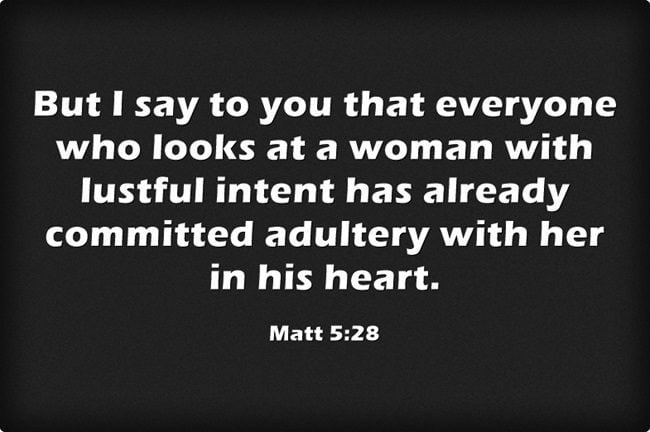
David let his lust carry him away as “One evening David got up from his bed and walked around on the roof of the palace. From the roof he saw a woman bathing. The woman was very beautiful” (2nd Sam 11:2) and so he lusted after her in his heart. This led to adultery and later, to the murder of Bathsheba’s husband, Uriah. This is why James wrote that “after desire (or lust) has conceived, it gives birth to sin; and sin, when it is full-grown, gives birth to death” (1:15). The proverbs say “Do not lust in your heart after her beauty or let her captivate you with her eyes” (6:25). Jesus said that it was “out of the heart come evil thoughts–murder, adultery, sexual immorality, theft, false testimony, slander” (Matt 15:19). Solomon understood this connection, writing that as a man “thinks within himself, so he is” (23:7a). You can commit adultery without ever committing the physical act. Jesus said that “that everyone who looks at a woman with lustful intent has already committed adultery with her in his heart” (Matt 5:28) and of course the same thing applies to women.

A Biblical Definition of Love

There are so many places that define love in the Bible that it will be hard to select only a few. Paul writes that “Love is patient and kind; love does not envy or boast; it is not arrogant or rude. It does not insist on its own way; it is not irritable or resentful; it does not rejoice at wrongdoing, but rejoices with the truth. Love bears all things, believes all things, hopes all things, endures all things” (1st Cor 13:4-7). The love of God is not about feelings or words but “God shows his love for us in that while we were still sinners, Christ died for us” (Rom 5:8). Love is a verb; it is what you do more than what you say or what you think. We know that Jesus did not feel like taking on all of the sins of humanity, but His great love for us on the cross proved what the love of God is like. He died for us while we were still wicked sinners and His enemies (Rom 5:8, 10).

Conclusion

The differences between love and lust are that we don’t covet what we don’t have. We shouldn’t covet (lust after) our neighbor’s spouse or their goods (Ex 20:17). Love, on the other hand, “does no wrong to a neighbor; therefore love is the fulfilling of the law” (Rom 13:10) and this means “You shall love your neighbor as yourself” (Matt 19:19) but above all “You shall love the Lord your God with all your heart and with all your soul and with all your mind” (Matt 22:37). The difference for believers is that we are told “Love your enemies and pray for those who persecute you” (Matt 5:44). The greatest display of love was not what Jesus felt or what God feels but it was revealed at Calvary. Jesus said “Greater love has no one than this, that someone lay down his life for his friends” (John 15:13) and that’s just what He did. Lust harms, love sacrifices.

—————-

**By Jack Wellman at what Christians wat to know / Photo by Mark Stebnicki at Pexels

Popular Articles

A Clear Gospel Message

The Abortion Debate

Human Trafficking / Child Abuse

The True Gift

True or False Conversion

Once Saved Always Saved?

The Judge – Upholding what is right comes at a cost

What is a True Christian or Believer

Prayer Speaking to God

Forgiving Others as God has Forgiving you

Prayer for forgiving others

Living Right Today

How to Get and Keep a Good Conscience

I strive always to keep my conscience clear before God and man. (Acts 24:16)

Conscience gives you the ability to evaluate your own thoughts and desires, to discern what is right and wrong, and to distinguish between what is good and what is best. 

To help us get a handle on conscience and how it functions, I want you to think about an alarm clock. A good alarm clock does two things: It stays quiet when you should be asleep, and it makes a noise when you need to wake up! 

That’s how your conscience is supposed to work. When you are on the right path, a good conscience will be at peace (Colossians 3:15). But when you are tempted towards the wrong path, a good conscience will sound the alarm. The problem with the conscience is that, like every other part of your soul, it has been disordered by sin. 

Like an alarm clock, conscience can malfunction and stay silent when it should go off.

My Alarm Didn’t Go Off! 

The corrupt conscience 

To the pure, all things are pure, but to those who are corrupted and do not believe, nothing is pure. In fact, both their minds and consciences are corrupted. (Titus 1:15) 

Acting against your conscience will bring a change in your inner life. It will change how your conscience functions. A corrupt conscience approves the wrong things. 

An easy way to see this is to picture a teenager using drugs for the first time. He knows that drugs are addictive and destructive, and his conscience tells him that taking them is wrong. But his friends are encouraging him to try them. He wants his friends to like him. So he over-rides his conscience.

In over-ruling his conscience, he diminishes its power. His conscience is weakened. It is less sensitive, and therefore less effective. Next time, the decision to take the drug will be much easier. If the boy repeats this choice again, the boy’s conscience changes. After a while he will feel that there is nothing wrong with what he is doing.

The important point to grasp here is that the conscience is corrupted whenever a person acts against it over time. When a person’s conscience is corrupted over time, it can become seared.

The seared conscience 

Such teachings come through hypocritical liars, whose consciences have been seared as with a hot iron. (1 Timothy 4:2) 

In the ancient world, doctors would use a hot iron to cauterize a wound. It hardly bears thinking about what this must have been like before anesthetic, but if you had a wound and the bleeding could not be stopped, your best hope was the hot iron pressed on your flesh.

Once you recovered from the pain, you would discover that the bleeding had stopped, but you would also find that you had lost all feeling in the area that had been seared. The hot iron killed off the nerves so that you no longer had feeling where the iron had been applied. 

Paul says, “That’s how it is with some people’s conscience.” They have been “seared as with a hot iron” (Ephesians 4:19). Their conscience has lost all sensitivity. When that happens, a person can lie, cheat, or steal without their conscience raising any objection. They feel no guilt because their conscience is seared.

As he was on the road to Damascus, that’s exactly what Saul of Tarsus thought. Do you think he was worried about doing something wrong? The seared conscience calls evil “good” and good “evil” (Isaiah 5:20). 

How to Get and Keep a Good Conscience

I strive always to keep my conscience clear before God and man. (Acts 24:16) 

If a conscience has become corrupt, so that it is no longer functioning correctly, how can it become pure? If a conscience has become seared, it has become insensitive, like thick skin. How can it be made sensitive again? 

A good conscience is powered by the Spirit: If I take the batteries out of my alarm clock, it will not work. It is also set by the Word and cleansed by the blood of Jesus Christ. 

A good conscience is powered by the Holy Spirit 

When he comes, he will convict the world of guilt in regard to sin and righteousness and judgment. (John 16:8)

Jesus is speaking about the Holy Spirit. When he comes, when he begins working in your life, what you can expect is that he awakens your conscience. When the Holy Spirit comes, he wakens you up to reality. Jesus describes that reality in three ways—sin, righteousness, and judgment: 

The Holy Spirit convicts of guilt in regard to sin

The first work of the Holy Spirit is deeply disturbing—he activates your conscience. He brings you to a place where you see your own sin.

The Holy Spirit convicts of guilt in regard to righteousness

You don’t know what righteousness is until you know Jesus. When you get to know him, you see that his righteousness is so far beyond what you have at your best that you haven’t a hope of getting near him.

The Holy Spirit convicts of guilt in regard to judgment

The Holy Spirit convinces of sin and righteousness and judgment. A true Christian wants more of this, not less, because that is what authentic godliness is looking for.

It wants to know more of its own sin and more of God’s righteousness, so that it might embrace God’s mercy even more. 

A good conscience is set by the Word of God 

I have hidden your word in my heart that I might not sin against you. (Psalm 119:11) 

If the alarm clock is to function, it has to be powered, but it also has to be set. A good conscience is powered by the Spirit and set by the Word. Hiding God’s Word in your heart will train your conscience to sound the alarm and keep you from sin. 

Are you, like David, hiding God’s word in your heart? Or is it just flitting across your brain? When You hide God’s Word in your heart that Word shapes and strengthens your conscience. And a good conscience is your best defense against sin and temptation.

A good conscience is cleansed by the blood of Christ 

How much more, then, will the blood of Christ, who through the eternal Spirit offered himself unblemished to God, cleanse our consciences from acts that lead to death, so that we may serve the living God! (Hebrews 9:14) 

This is an amazing promise! Christ cleansing our consciences from acts that lead to death! 

How does he do it? By the blood of Christ, because on the cross he offered himself unblemished to God! He offered himself—his unblemished, perfect life—as a sacrifice to God for us on account of our sins. Therefore, he alone is able to cleanse our consciences through his blood. 

Your conscience may have been corrupted, even seared. Christ can make it good. That’s what redemption is all about. It is powered by the Spirit, set by the Word, and cleansed by the blood.

————-

*** By Colin Smith at Unlocking the Bible / Picture by Chandra Elancher

Shall We Sin So Grace May Abound?

Sin. It’s something most of us would rather not think about. For the unsaved person, sin is something that separates them from God, due to his perfect holiness. Yet for the Christian, their sin has been paid for. When God looks at them, he doesn’t see their sin, but instead righteousness.

How can that be? The answer is Jesus.

Jesus took the place of us on the cross. He paid the price of our sins with his very life and his holiness was accounted to us (2 Corinthians 5:21). God made it possible for us to be with him through the blood of his holy Son. Instead of condemnation, we receive grace. Instead of rightful punishment for our sins, God sees us as his sons and daughters. Indeed, this is the miracle of the Christian faith for all who believe.

But this brings up an important question. If our sin is already paid for, why should we stop sinning? In fact, doesn’t the vastness of our sin just make his grace more beautiful? Shall we sin that grace may abound?

Shall We Continue in Sin?

Paul demolished this dangerous line of thought in Romans 6. Christ died to free us from sin, not enable us to sin. When Jesus died, he was releasing us from our bondage to sin, because that is what sin is — slavery. Sin is what separates us from God. It’s damaging, and for the unredeemed, it is damning (Romans 6:23).


“For we know that our old self was crucified with him so that the body ruled by sin might be done away with, that we should no longer be slaves to sin — because anyone who has died has been set free from sin.” – Romans 6:6-7 

So, shall we then continue in sin that grace may abound? Paul replies with a resounding “God forbid” (Romans 6:2). To desire to continue in sin shows a misunderstanding of this abundant grace and a contempt for Jesus’ sacrifice. Either we believe what God says is true or we don’t. Either we take him at his word when he equates sin to death, or we do not believe him at all (Ephesians 2:1).

What is the point of the Christian faith if we get to pick and choose what we want to believe? Do we think God is that small, insignificant or somehow uninformed? Do we trifle with the very thing that God sent his Son to save us for? Do we misuse the grace that he gifted us with in his death and resurrection? Surely not.

Sin and Grace

Grace is a gift. Forgiveness of sins and his salvation are gifts. Grace is not, however, a license to sin. Throughout the Bible, fathers of our faith are seen distressed, tormented by their sin.

Consider David after his adultery with Bathsheba or Peter after denying Christ (Psalms 51:17 and Matthew 26:75). They did not discount their sin as simply something atoned for. Just because the Christian’s sin is paid for by Jesus, sin is still damaging to the believer and their relationship with God.

When David tried to ignore his sin, his “bones wasted away through my groaning all day long” (Psalms 32:3). He did, however, find freedom in confession.


“Then I acknowledged my sin to you and did not cover up my iniquity. I said, ‘I will confess my transgressions to the LORD’ – and you forgave the guilt of my sin.” – Psalms 32:5 

A Christian who pursues sin despite claiming Christ as their Savior is living outside the blessing and fullness of the relationship that comes with an obedient life. We cannot equate grace with freedom to sin. Instead, we should be thankful that grace provides freedom from sin and its eternal consequences.

Doesn’t that kind of grace make you want to obey the one who set you free?

What Is Sanctification?


“If you love me, you will obey my commandments. I will ask the Father, and he will give you another helper who will be with you forever. That helper is the Spirit of Truth. The world cannot accept him, because it doesn’t see or know him. You know him, because he lives with you and will be in you.” – John 14:5-17

The Christian’s spiritual journey doesn’t begin and end at a one-time prayer of confession. When we truly see our need for God, his grace and Christ’s sacrifice for us, we will want to obey him. Why? Because we will overflow with love and gratitude that the God of all creation cares enough to save us from ourselves. And if we love him, we trust him when he calls us to higher things. This pursuit toward Christ, and refining of our faith, is sanctification. Sanctification is progressing toward Christlikeness. A Christian cannot pursue both Christlikeness and sin.

So Christians, remember his abounding grace toward you. Turn from sin and embrace your new life as a vessel of light. You are dead to sin, alive in Christ.

Now go live it.

———

***By Lizzie Hoover at Grand Canyon University: gcu.edu / Photo by Mike Waters at Joyful Toons