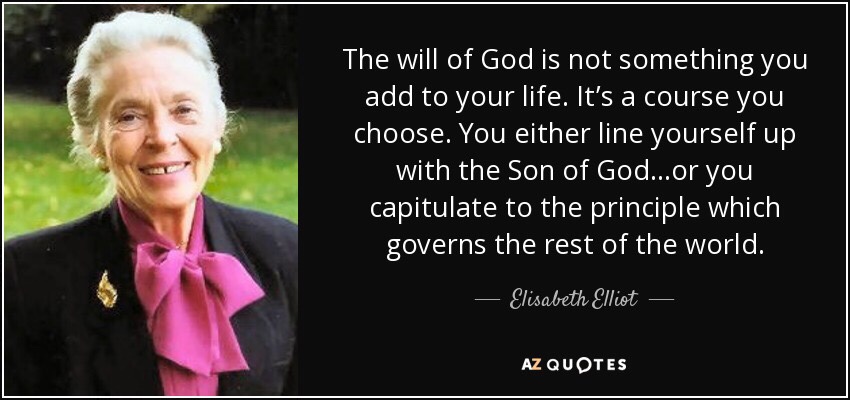
Elisabeth Elliot Testimony: The Missionary Who Lived With The Tribe That Killed Her Husband

She was born Elisabeth Howard in 1926 – one of six children – to missionary parents in Brussels, Belgium. Her parents moved to Philadelphia, USA, a few months after Elisabeth was born. She later described them as devout, disciplined Christians who built their family life around the Bible.

‘We grew up with the understanding that the scriptures were top priority… we had bible reading and prayer at the end of dinner every night as we sat around the table, and up until the age of, I suppose, seven or eight, each of us children was put to bed by one of our parents and prayed with, and sometimes we had the bible read to us again. so we heard the bible read aloud at least twice a day, sometimes three times a day.

‘And the other very very powerful influence in our lives, I’m sure was the fact that my father got up himself between 4:30 and 5:00 in the morning in order to have time alone with the Lord.

And when we came to breakfast, we knew that we had been prayed for… meaning my father was in his study for those hours before breakfast with his prayer lists and his notebooks and his bible and down on his knees praying for us.’

Elisabeth reckoned she herself came to faith at around the age of five. This was followed by a definite commitment to Christ when she was twelve: “I think I realised that if Jesus was my saviour, he also had to be my Lord, so I then committed my life and said, ‘Lord, I want you to do anything you want with me.’”

We can surmise from this that even at this tender age Elisabeth realised she had a calling to the mission field. She studied classical Greek at Wheaton college, Illinois, believing that it was the best tool to help her with her desire to translate the New Testament into a yet-unreached language.

It was at Wheaton where she met Jim Elliot. Before their marriage they both went individually to Ecuador to work with the Quechua Indians; the two married in 1953 in the city of Quito, Ecuador.

Before Elisabeth started her work, she listened to the words of Maruja, a woman of a neighbouring tribe who had been held captive for a year by the Huaorani, sometimes called the Aucas, or ‘savages’. She told Elisabeth that the tribe was fierce and they acted like savages, but that the women were likeable and kind. In 1955, only ten months before Jim was killed, Elisabeth gave birth to a daughter, Valerie.

Elisabeth said that she had a premonition that Jim’s mission might end in his death, explaining, “I often thought I was going to lose my husband.” In fact, just before he left for his fateful mission to the Aucas they had talked about what she would do if Jim should not return.

So as they said what turned out to be their last goodbyes in January 1956, her mind was a filled with thoughts as to whether that would be the last time she saw him alive.

Jim and four other Christian missionaries Nate Saint, Roger Youderian, Ed Mccully and Peter Fleming – were speared to death in the jungles of Ecuador. Their killers were Huaorani Indians, the same group that Elisabeth had been warned about earlier.

After Jim’s death, Elisabeth, together with Rachel saint, the sister of another of those killed, continued her work among the Quechua at a site which was several days by trail from Auca territory.

Despite what had happened to their men, Elisabeth and Rachel were still determined to reach the killers with the gospel. At the time, their only link with Auca culture came when they met Dayuma, a young woman who had fled the tribe some years before to live with white missionaries. Dayuma, who was by then a believing Christian, helped them with the Auca language.

In November 1957 came a breakthrough. Elisabeth heard that two more Auca women had left their tribe. She hurried to the neighbouring settlement where the women – Mintaka and Minkamu – were, and spent the next ten months with them, seeking to learn more of the Auca language and culture.

Eventually the two Auca women – together with Dayuma – decided to return to their native tribe, leaving Elisabeth and Rachel wondering what the fate of the three women might be when they arrived home.

However, after three weeks the women returned to the mission compound bringing along seven other Aucas, plus a invitation to the missionaries to visit the tribe!

‘As long as this is what the Lord requires of me, then all else is irrelevant’ Elisabeth Elliot

Elisabeth and Rachel lost no time in taking up this unprecedented offer. However, Elisabeth admitted that taking her three-year-old daughter, Valerie, along strapped to her back was ‘the biggest test of faith ever’.

As well as the usual dangers found in jungle terrain, she had to face the possibility that the Aucas might choose to kill her and carry off the youngster.

In a later interview she said that, although she appreciated the kind warnings of fellow Christians, she felt that ‘as long as this is what the Lord requires of me, then all else is irrelevant’.

The journey to the Auca village took two-and-a-half days by canoe and trail paths. Ironically, the party arrived on the afternoon of 8 October 1958, Jim’s birthday and the day which would have been the couple’s fifth wedding anniversary.

When the missionaries reached a clearing in the jungle, there stood a welcoming party of three Aucas.

Elisabeth described the reception as ‘friendly… it seemed like the most natural thing in the world’. For the next year the missionaries enjoyed a good relationship with the tribe as they ministered to them. the Aucas gave Elisabeth the tribal name ‘Gikari’, Huao for ‘Woodpecker.’

She later returned to the Quichua and worked with them until 1963, when she and Valerie returned to the USA. Rachel saint continued the work with the Aucas under the auspices of their sponsoring missionary society, the summer Institute of linguistics (sIl).

Over the years some anthropologists have criticised the missionaries’ work, viewing their intervention as the cause for the widely-recognised decline of Huaorani culture. In response Elisabeth Elliot said in an interview that there is absolutely no point in trying to reach tribes like the Huaorani unless you believe the New Testament message that people – however few and remote – are lost without the gospel of Jesus Christ.

And while no-one would claim the missionaries didn’t make mistakes along the way, the gospel they preached resulted in a marked decline in violence among tribe members, together with numerous conversions to Christianity and the growth of the local church.

Indeed, it has been argued by others that the effects of Christianity were very positive, as it served as a way for the Huaorani to escape the cycle of violence in their community, providing them with a motivation to abstain from killing. Ironically it was probably exposure to Western ‘civilisation’ – not the gospel – that had the most detrimental effect on the Huaorani people.

On her return to America, Elisabeth became a noted speaker and writer. Her book, ‘through gates of splendour’ is ranked among the most influential books that have shaped the thinking of evangelicals. The book became a bestseller, as did ‘shadow of the Almighty: the life and testimony of Jim Elliot.’

According to Kathryn long, professor of history at Wheaton college, ‘those books became the definitive inspirational mission stories for the second half of the 20th century. [Elisabeth Elliot] really had a sense of her audience as evangelicals, and she could tell this story in a way that keyed into [their] values.’

Elisabeth went on to write more than a dozen additional books and launched a raddio show, ‘gateway to Joy’, which ran until 2001. She almost always opened the programme with the phrase, “‘You are loved with an everlasting love,’ – that’s what the Bible says – ‘and underneath are the everlasting arms.’ this is your friend, Elisabeth Elliot…”

Two later books on missions, ‘no graven Image’ and ‘the savage my Kingsman’, raise important questions about mission work and reveal Elliot as a extraordinarily perceptive thinker and writer.

In 1969, Elisabeth married Addison Leitch, professor of theology at Gordon-Conwell theological seminary in south Hamilton, Massachusetts.

They were together until Leitch’s death in 1973. In 1974, Elliot became an adjunct professor on the faculty of Gordon Conwell theological seminary and for several years taught a popular course entitled ‘christian expression’.

Her third marriage to Lars Gren, a hospital chaplain, took place in 1977.

After their marriage the couple worked and travelled together.

‘Nothing can separate us from the love of Christ’ – Elisabeth Eliott

Elisabeth Elliot died in Magnolia, Massachusetts, on 15 June 2015, at the age of 88. Sadly in her last years she suffered from dementia. Her husband, Lars, said: “She accepted those things, [knowing] they were no surprise to god.

”It was something she would rather not have experienced, but she received it.”

Elisabeth’s only daughter, Valerie, who spent part of her childhood among the Aucas, married a pastor, Walter Shepard, in 1976. Since then Valerie has spent her time being a pastor’s wife, raising eight children, teaching the bible and speaking at conferences.

She described her mother as: “A speaker of the truth, a teacher of obedience, a woman of strength and dignity. She always loved and encouraged me. she was a woman of prayer.”

Perhaps Elisabeth Elliot’s whole philosophy of life and ministry can be summed up in the words she once wrote: “We have proved beyond any doubt that he [God] means what he says – his grace is sufficient – nothing can separate us from the love of Christ. We pray that if any, anywhere, are fearing that the cost of discipleship is too great, they may be given a glimpse of that treasure in heaven promised to all who forsake.”

———

** This article was taken from the October 2016 issue of Heroes Of The Faith by Dave Littlewood / Photos Elisabeth Elliot Foundation

Testimony of Gladys Aylward: A Small Woman with a Mighty God

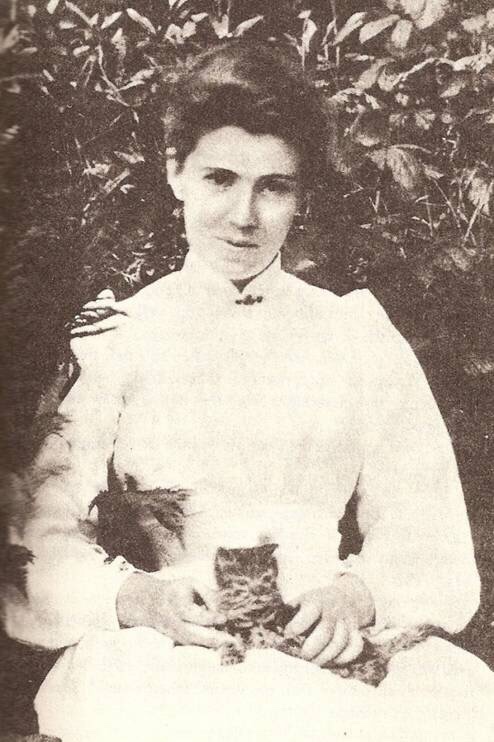
This inspiring documentary presents the events of Gladys Aylward’s life. Gladys was a commoner from a poor family in London, barely five feet tall, who worked as a maid, in a kitchen and other odd jobs to make ends meet. She was considered ordinary in every way, as there was nothing to distinguish her amongst her peers, but it was this very woman the Lord picked up, this empty and open vessel, God filled and used for His honour and glory, to be a blessing to the Chinese people and spread the good news of the gospel, as it’s not our ability the Lord wants, but our willingness and AVAILabilty, “use me Lord, send me!”

Gladys was rejected from the CIM (Chinese Inland Missions) because she couldn’t keep up with the academic studies. The CIM was set up by none other than Hudson Taylor to train new missionaries. Gladys was sure the Lord had called her and was not deterred. She needn’t have worried for she was in good company with others that had gone before her; people like Peter, Andrew, James and John lowly fishermen whom Jesus chose to be His disciples, who also in their day would’ve been rejected from the Bible colleges! But it’s these unlearned people that the Lord picked up and used. People wondered how these so called simpletons, knew and did the things they did. It was obviously all God’s doing, He had quickened their spirits, given them wisdom, guidance and much grace. He opened the doors He wanted opened, and closed the doors He wanted shut, and showed them favour. He doesn’t call the qualified, He qualifies the called! So not one could ever touch His glory.

God’s ways are not our ways, and His thoughts are not our thoughts, as stated in 1 Corinthians 1:27-29, ‘But God chose the foolish things of this world to put the wise to shame. He chose the weak things of this world to put the powerful to shame. What the world thinks is worthless, useless, and nothing at all is what God has used to destroy what the world considers important. God did all this to keep anyone from bragging to Him.’ To help us remain humble in our endeavours may we never forget that, all good gifts are from above, given to us by our loving Father. What is it we have that the Lord didn’t give us? Let us pray that the Lord will keep us humble like the examples of Godly men and women who have gone before us, such as Gladys.

Gladys Aylward’s biography can be found on Amazon:

Popular Articles

A Clear Gospel Message

The Abortion Debate

Human Trafficking / Child Abuse

The True Gift

True or False Conversion

Once Saved Always Saved?

The Judge – Upholding what is right comes at a cost

What is a True Christian or Believer

Prayer Speaking to God

Forgiving Others as God has Forgiving you

Prayer for forgiving others

Living Right Today

Testimony of Former Iranian Prisoners Maryam Rostampour and Marziyeh Amirizadeh

Watch this inspiring interview with Maryam and Marziyeh at HTB Church, London. In 2009 in Iran, Maryam and Marziyeh were imprisoned and sentenced to death because of their Christian faith. Maryam and Marziyeh were born into Muslim families but converted to Christianity and began to share the Gospel with those around them. They were arrested in March 2009 after being accused of evangelism and apostasy. After 259 days in Tehran’s notorious Evin Prison they were released.

** Maryam and Marziyeh’s book called, ‘Captive In Iran‘ is available on Amazon Here

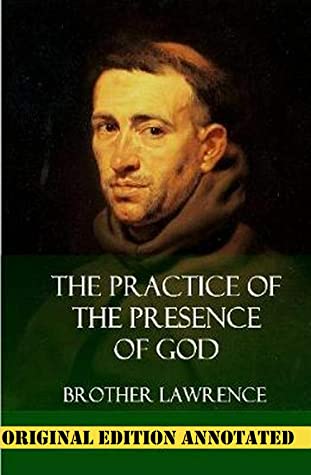
Practising The Presence of God ~ Free eBook

One of the most adored books on living in God’s presence comes from an unlikely source— a man who was maimed as a young soldier and later became a footman “who was clumsy and broke everything.”

That is the early life of Nicholas Herman before he became Brother Lawrence.

Herman was born around 1610 in Herimenil, Lorraine, a Duchy of France. His birth records were destroyed in a fire at his parish church during the Thirty Years War, a war in which he fought as a young soldier. It was also the war in which he sustained a near-fatal injury that left him quite crippled and in chronic pain for the rest of his life.

Brother Lawrence Learned to Be in God’s Presence While Doing Chores

At mid-life he entered a newly established monastery in Paris where he became the cook for the community which grew to over one hundred members. After fifteen years, his duties were shifted to the sandal repair shop but, even then, he often returned to the busy kitchen to help out.

While repairing sandals or working in the kitchen, Brother Lawrence discovered and then followed a pure and uncomplicated way to walk continually in God’s presence. For some forty years, he lived and walked with God at his side. 

It was not until after his death that a few of his letters were collected. Joseph de Beaufort, representative, and counsel to the local archbishop, first published the letters in a small pamphlet. The following year, in a second publication which he titled, “The Practice of the Presence of God,’ de Beaufort included, as introductory material, the content of four conversations he had with Brother Lawrence.

In this small book, through letters and conversations, Brother Lawrence simply and beautifully explains how to continually walk with God, not from the head but from the heart. 

Brother Lawrence also left the gift of a direct approach to living in God’s presence that is as practical today as it was four hundred years ago.

The conversations between Brother Lawrence and de Beaufort covered many topics but most dealt with man’s responsibility to continually commune with God:

Brother Lawrence related that we should establish ourselves in a sense of God’s Presence by continually conversing with Him. It was a shameful thing to quit His conversation to think of trifles and fooleries. We should feed and nourish our souls with high notions of God which would yield us great joy in being devoted to Him.

He said we ought to quicken and enliven our faith. It was lamentable we had so little. Instead of taking faith for the rule of their conduct, men amused themselves with trivial devotions which changed daily. He said that faith was sufficient to bring us to a high degree of perfection. We ought to give ourselves up to God with regard both to things temporal and spiritual and seek our satisfaction only in the fulfilling of His will. Whether God led us by suffering or by consolation all would be equal to a soul truly resigned.

Brother Lawrence said that the worst that could happen to him was to lose that sense of God which he had enjoyed so long. Yet the goodness of God assured him He would not forsake him utterly and that He would give him strength to bear whatever evil He permitted to happen to him. Brother Lawrence, therefore, said he feared nothing. 

The book includes 15 short letters written by Brother Lawrence during the last ten years of his life to a variety of long time friends.  They are the heart and soul of his ability to live in the constant presence of God.

The account I can give you is: Having found in many books different methods of going to God and diverse practices of the spiritual life, I thought this would serve rather to puzzle me than facilitate what I sought after, which was nothing but how to become wholly God’s. This made me resolve to give the all for the All. After having given myself wholly to God, to make all the satisfaction I could for my sins, I renounced, for the love of Him, everything that was not He, and I began to live as if there was none but He and I in the world.

Sometimes I considered myself before Him as a poor criminal at the feet of his judge. At other times I beheld Him in my heart as my Father, as my God. I worshipped Him the oftenest I could, keeping my mind in His holy presence and recalling it as often as I found it wandered from Him. I made this my business, not only at the appointed times of prayer but all the time; every hour, every minute, even in the height of my work, I drove from my mind everything that interrupted my thoughts of God.

Brother Lawrence never advanced beyond being the cook at the Paris monastery, but he developed the unique gift of being able to pray incessantly with God throughout the entire day and regardless of whatever else he was doing. This unique gift produced such a spiritual change in Brother Lawrence that many people sought him out to learn how to practice the presence of God themselves.

By Daniel So at Justice Ventures International / Picture by Janez Podnar at Pexels

—————————————————————

FREE eBook Download:

Testimonies to Strengthen Faith: Trials and Tribulation


“I have told you these things, so that in me you may have peace. In this world you will have trouble. But take heart! I have overcome the world.” John 16:33

These video testimonies will strengthen your faith. In times of trials and tribulations, many lessons can be learned from these: hope, endurance, patience, forgiveness and much more, as well as how to be over-comers in these last days.

As Christian believers we’re to look unto Jesus and His finished work on the Cross, as He is the author and perfecter of our faith. We’re not to be afraid of those who want to kill the body; they cannot touch our soul. Fear only God, who can destroy both soul and body in hell. We don’t put our trust in man, but in God alone. Jesus will give us His peace that surpasses all understanding, and help us to rest in Him amidst the storms. Jesus, our Lord and saviour and soon coming King forewarned us that times of tribulation will come as we’re in the last days: And all nations will hate you because you are my followers. But everyone who endures to the end will be saved (Matthew 10:22 NLT)

And they have defeated him by the blood of the Lamb and by their testimony. And they did not love their lives so much that they were afraid to die. (Revelation 12:11)

Blessed is the man who remains steadfast under trial, for when he has stood the test he will receive the crown of life, which God has promised to those who love Him. (James 1:12)

For if you forgive other people when they sin against you, your heavenly Father will also forgive you. But if you do not forgive others their sins, your Father will not forgive your sins (Matthew 6:14-15)

I have said these things to you, that in me you may have peace. In the world you will have tribulation. But take heart; I have overcome the world. (John 16:33)

For there will be greater anguish than at any time since the world began. And it will never be so great again. In fact, unless that time of calamity is shortened, not a single person will survive. But it will be shortened for the sake of God’s chosen ones… See, I have warned you about this ahead of time… Immediately after the anguish of those days, the sun will be darkened, the moon will give no light, the stars will fall from the sky, and the powers in the heavens will be shaken. And then at last, the sign that the Son of Man is coming will appear in the heavens, and there will be deep mourning among all the peoples of the earth. And they will see the Son of Man coming on the clouds of heaven with power and great glory. And he will send out his angels with the mighty blast of a trumpet, and they will gather his chosen ones from all over the world—from the farthest ends of the earth and heaven. (Matthew 24:21-22; 25; 29-31 NLT)

but those who hope in the Lord will renew their strength.They will soar on wings like eagles; they will run and not grow weary, they will walk and not be faint. (Isaiah 40:31)

Can anything ever separate us from Christ’s love? Does it mean he no longer loves us if we have trouble or calamity, or are persecuted, or hungry, or destitute, or in danger, or threatened with death? As the Scriptures say, “For your sake we are killed every day; we are being slaughtered like sheep.” No, despite all these things, overwhelming victory is ours through Christ, who loved us. And I am convinced that nothing can ever separate us from God’s love. Neither death nor life, neither angels nor demons, neither our fears for today nor our worries about tomorrow—not even the powers of hell can separate us from God’s love. No power in the sky above or in the earth below—indeed, nothing in all creation will ever be able to separate us from the love of God that is revealed in Christ Jesus our Lord. (Romans 8:35-39).

By Lori McPherson