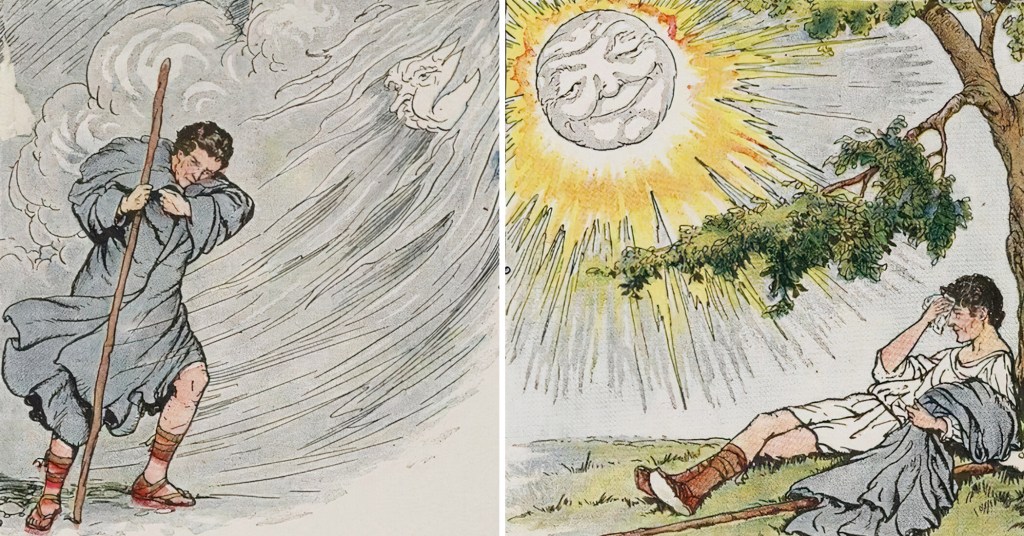
The North Wind and the Sun had a quarrel about which of them was the stronger. While they were disputing with much heat and bluster, a Traveler passed along the road wrapped in a cloak.
“Let us agree,” said the Sun, “that he is the stronger who can strip that Traveler of his cloak.”
“Very well,” growled the North Wind, and at once sent a cold, howling blast against the Traveler.
With the first gust of wind the ends of the cloak whipped about the Traveler’s body. But he immediately wrapped it closely around him, and the harder the Wind blew, the tighter he held it to him. The North Wind tore angrily at the cloak, but all his efforts were in vain.
Then the Sun began to shine. At first his beams were gentle, and in the pleasant warmth after the bitter cold of the North Wind, the Traveler unfastened his cloak and let it hang loosely from his shoulders. The Sun’s rays grew warmer and warmer. The man took off his cap and mopped his brow. At last he became so heated that he pulled off his cloak, and, to escape the blazing sunshine, threw himself down in the welcome shade of a tree by the roadside.
The moral of the story is that gentleness and kind persuasion achieve what force and bluster cannot. The lesson here is that it is more effective to warm someone’s heart with love than to try to control them with anger or force.
Is our Heavenly Father like the wind or the sun? The Bible tells us that it is God’s love that draws us to Him (1 John 4:19), and His kindness that leads us to repentance (Romans 2:4). I believe this principle also applies in our relationships with others. When we love others with patience and selflessness, we foster unity and understanding, rather than engaging in conflict or trying to force them to agree with us or treat us a certain way.
————-
**Parable By Aesop and conclusion by Bobby McDonald at NCCF Church based on article: Difficult People / Pictures by Library of Congress
“Lord, bend that proud and stiffnecked “I,” Help me to bow the neck and die, Beholding Him on Calvary, Who bowed His Head for me.”
The following are some of the features and manifestations of the self-life. The Holy Spirit alone can interpret and apply this to your individual case. As you read, examine yourself in the very presence of God. Are you ever conscious of:
A secret spirit of pride-an exalted feeling in view of your success or position; because of your good training or appearance; because of your natural gifts and abilities. An important, independent spirit?
Love of human praise; a secret fondness to be noticed; love of supremacy, drawing attention to self in conversation; a swelling out of self when you have had a free time in speaking or praying?
The stirrings of anger or impatience, which, worst of all, you call nervousness or holy indignation; a touchy, sensitive spirit; a disposition to resent and retaliate when disapproved of or contradicted; a desire to throw sharp, heated flings at another?
Self-will; a stubborn, unteachable spirit; an arguing, talkative spirit; harsh, sarcastic expression; an unyielding, headstrong disposition; a driving, commanding spirit; a disposition to criticize and pick flaws when set aside and unnoticed; a peevish, fretful spirit; a disposition that loves to be coaxed and humored?
Carnal fear; a man-fearing spirit; a shrinking from reproach and duty; reasoning around your cross; a shrinking from doing your whole duty by those of wealth or position; a fearfulness that someone will offend and drive some prominent person away; a compromising spirit?
A jealous disposition, a secret spirit of envy shut up in your heart; an unpleasant sensation in view of the great prosperity and success of another; a disposition to speak of the faults and failings, rather than the gifts and virtues of those more talented and appreciated than yourself?
A dishonest, deceitful disposition; the evading and covering of the truth; the covering up of your real faults; leaving a better impression of yourself than is strictly true; false humility; exaggeration; straining the truth?
Unbelief; a spirit of discouragement in times of pressure and opposition; lack of quietness and confidence in God; lack of faith and trust in God; a disposition to worry and complain in the midst of pain, poverty, or at the dispensations of Divine Providence; an overanxious feeling whether everything will come out all right?
Formality and deadness; lack of concern for lost souls; dryness and indifference?
Selfishness; love of ease; love of money?
These are some of the traits which generally indicate carnality in the heart. By prayer, hold your heart open to the searchlight of God. “Search me, O God, and know my heart: try me, and know my thoughts: and see if there be any wicked way in me” (Psalms 139:23-24).
The Holy Spirit will enable you, by confession and faith, to bring your “self-life” to the death (Romans 8:12-13). Do not patch over, but go to the bottom. It alone will pay.
Oh, to be saved from myself, dear Lord, Oh, to be lost in Thee; Oh, that it might be no more I, But Christ that lives in me. “Create in me a clean heart, O God; and renew a right spirit within me” (Psalm 51:10).
~ Poem by Roy Hession author of ‘The Calvary Road’
A New Year prayer: “Teach us Lord, to number our days, so that we can present to Thee a heart full of wisdom” (Psalms 90:12)
Spiritual growth and transformation into Christlikeness do not happen overnight. It happens slowly – day by day and little by little. As we sing in the chorus: “Little by little and day by day; little by little in every way, my Jesus is changing me; I am not the same as I was last year; and though the picture is not quite clear, I know He is changing me; Although it’s slow going, this I am knowing – that one day like Him I shall be”. So, let us yield ourselves to the Lord every day this year, so that He can do that work of transformation in us.
Transformed by the Holy Spirit and God’s Word
When the Holy Spirit is allowed to be Lord in our lives, He will liberate us first of all (2 Corinthians 3:17) – freeing us from the power of sin, from the love of money, from the traditions of men that are contrary to the Word of God, and from being enslaved to the opinions of people. The Holy Spirit will then show us the glory of Jesus in the Scriptures and seek to transform us slowly into that likeness, by changing our way of thinking so that we begin to think the way Jesus thought (2 Corinthians 3:18; Romans 12:2). The Holy Spirit wants to do that work in us this year. So, submit to Him.
Transformed by Praise and Thanksgiving
“Be filled with the Spirit, speaking to one another in psalms and hymns and spiritual songs (Ephesians 5:18-20). The Holy Spirit wants to give us a spirit of thankfulness that frees us from all gossip, slander, bitterness, and anger. In the seven glimpses of heaven that we see in the book of Revelation, we find that the inhabitants of heaven are constantly praising God. The atmosphere of heaven is one of constant praise, without any complaining or grumbling. The Holy Spirit wants to bring this atmosphere into our hearts and into our homes this year. So, submit to Him.
Transformed by the Grace of God
“The grace of God enables us to deny ungodliness and worldly desires and to live in a righteous, godly way in this evil world” Titus 2:11-12. God wants to transform our thought-life through His grace and make our speech so gracious that it blesses everyone we meet this year (Colossians 4:6). God’s grace also wants to transform the way husbands and wives behave towards each other this year (1 Peter 3:7). And in every trial that we face this year, God can give us grace that is sufficient to meet the need (2 Corinthians 12:9). So, humble yourself in every situation this year – for God gives His grace only to the humble (1 Peter 5:5).
Transformed by Obedience
We are told that Jesus “learned obedience through the things He suffered” (Hebrews 5:8). Anything that His Father said “No” to, Jesus also said, “No” to. That involved the suffering of denying His own will always. After years of such self-denial, “Jesus was made perfect” (Hebrews 5:9). “Perfect” here means “complete”. In other words, Jesus graduated from the school of obedience and got His degree. This is the degree the Holy Spirit wants us to get too. So, He will take us through many tests. If we fail in any test, He will give us a chance to do it again! He wants us to get the same “degree” that Jesus got and to make us overcomers (Revelation 3:21)! This is the most important degree that we can ever get. So, this year, let us say “No” to our own will and “Yes” to God’s will in every situation, by the power of the Holy Spirit.
Transformed by Encouragement from God
“God wants to encourage us in all our trials, so that we can encourage others with the same encouragement that He gives us in our trials” (2 Corinthians 1:3-4). We are surrounded by people who are facing many trials and problems. If we want to help them to overcome, we have to go through many trials and problems ourselves first and overcome. The strength and encouragement that God gives us to overcome in our trials will then be what we can offer to others. God wants to make us a blessing to every person and every family that we meet this year (See Galatians 3:8-9, 14). He wants us to encourage someone or the other every day of this year (Read Hebrews 3:13). May it be so.
There are a few theories out there on why women over a certain age are not married. Many of these may be stereotypical while others hold some truth.
I will be focusing on one of the most important reasons for why some single women are not married.
Before I go ahead, I want you to know this was hard to write, not because it’s not true but because of the magnitude of truth. I had touched on it in a previous post but had felt the burden in my spirit to focus squarely on it.
I know God wants me to speak about this and to do so in clear terms.
Here it is:
We are not married because we will forget God. Because getting married will take us away from God.
We have knowingly or unknowingly replaced God with marriage where our true service and our true love is not God but marriage or what we believe marriage will give us.
Our prayers for a good man have been unanswered and heaven has been silent not because God wants to deny us the good gifts he has for us but because he knows that this very thing we want will take us away from him.
We may promise or vow that we will be closer to him when we get married but is that really the truth?
We have to realise that God sees through our words. He is the only one that knows the true state of our hearts and our intentions.
Which means we can’t pay lip service to loving him.
WHERE IS GOD IN YOUR LIFE?
What are the things that matter to you? The things you focus all of your time and energy on. Many of us are so consumed with the need to get married and have children that every other thing takes second place.
Marriage becomes an idol in our lives and this idol will only grow bigger when we’re married to include the very husband and children we have desperately desired.
When we do this, we miss out on the most important relationship we could ever have.
One thing about idols is that we often don’t even realize what they are. We don’t realise how our identity, our happiness and our successes are tied to these idols.
Dear friend, it’s time for some honest introspection. Have you placed marriage on a pedestal? Do you believe your life will only make sense when you’re married and have children?
Do you equate your marriage with finding your purpose?
Well, I’m here to tell you that it will not happen. Should you force God’s hand or marry without recourse to him, you may find that your marriage becomes a den of problems rather than a haven of peace.
These words may seem harsh and hard but it wouldn’t be the first time. A look at the Bible will show how God feels when we demote him from his rightful place in our lives. The first and everlasting commandment is that we love God and that he remains number one in our lives.
“Love the Lord your God with all your heart and with all your soul and with all your strength and with all your mind.”
Luke 10:27(NKJV)
“You shall fear the Lord your God and him only shall you serve…”
Deutronomy 6:13 (para.)
GOD MUST COME BEFORE MARRIAGE
Nothing and no one should take his place.
If you know you may have unknowingly done this, I know God is calling you to repent and come back to him.
“Repent then, and turn to God, so that your sins may be wiped out, that times of refreshing may come from the Lord,”
Acts 3:19(NIV)
Never forget that God gave us marriage as a gift and for a purpose – for companionship, for his glory and propagation of his kingdom. We cannot misuse this gift.
Similarly, God is not a trader neither is he Santa Clause. Be careful that your worship is not a trade by barter where you believe you should be rewarded with a good husband for serving God.
We are to serve him and love him because his is God and is worthy of all our praise.
GOD LOVES YOU AND WANTS THE BEST FOR YOU
Here’s another truth, repenting and changing our ways does not mean we will get married. Even if we were to love God without pretence or expectation, we have to realise this is not an automatic opening for marriage.
Marriage is not a reward for being good
Why? Because God’s plan for your life may mean that you will get married now, later or not at all.
I know this is hard to read much more accept but it doesn’t change the truth. God knows the path he has for you, trust him to bring it to pass. I promise you that it will be the best for you.
We need to remember that Our time on earth is merely a blip in eternity.
According to Rick Warren of The Purpose Driven Life “Measured against eternity, our time on earth is just a blink of an eye, but the consequences of it will last forever. The deeds of this life are the destiny of the next.”
Which means we have to be careful how we spend it since it is this temporary life that determines our permanent location (heaven or hell, life or death).
I hope looking at your life this way gives you perspective and helps you prioritize the permanent things over the temporary.
GET MARRIED FOR THE RIGHT REASONS
Dear friend, please don’t get married for marriage’s sake. Do it because you believe it is the right time and the right person.
Don’t scheme, pretend, lie or sin to get married, your life and identity in Christ is worth more than that.
I am always comforted knowing that God knows what’s best for us. You might not understand why it’s taken this long, you might even think he’s forgotten you, but know that he hasn’t.
He wants us to trust that he will give us what is right for us. Even if you’re feeling the pressures, even if everyone around you is getting married (and did it on their own terms, without God), realise that you’re different. No two lives are the same, so stop focusing on the lives of others.
As God’s child, you’re working under heaven’s rules not earth’s rules. This means you cannot live according to the precepts of the world even though you’re in the world.
Be encouraged! Remember that with God, it will all work out for your good and will definitely be better than anything you could have imagined for yourself.
“And we know that in all things God works for the good of those who love him, who have been called according to his purpose.”
A dictionary definition of a Christian would be something similar to “a person professing belief in Jesus as the Christ or in the religion based on the teachings of Jesus.” While this is a good starting point, like many dictionary definitions, it falls somewhat short of really communicating the biblical truth of what it means to be a Christian. The word “Christian” is used three times in the New Testament (Acts 11:26; 26:28; 1 Peter 4:16). Followers of Jesus Christ were first called “Christians” in Antioch (Acts 11:26) because their behavior, activity, and speech were like Christ. The word “Christian” literally means, “belonging to the party of Christ” or a “follower of Christ.”
Unfortunately over time, the word “Christian” has lost a great deal of its significance and is often used of someone who is religious or has high moral values but who may or may not be a true follower of Jesus Christ. Many people who do not believe and trust in Jesus Christ consider themselves Christians simply because they go to church or they live in a “Christian” nation. But going to church, serving those less fortunate than you, or being a good person does not make you a Christian. Going to church does not make you a Christian any more than going to a garage makes you an automobile. Being a member of a church, attending services regularly, and giving to the work of the church does not make you a Christian.
A Christian is not all about rituals, going to church, or doing certain things while refraining from other things. Becoming a Christian is all about having a personal relationship with Jesus Christ. A personal relationship with Jesus Christ, through repentance and faith, is what makes a person a Christian.
The Bible teaches that the good works we do cannot make us acceptable to God. Titus 3:5 says, “He saved us, not because of righteous things we had done, but because of his mercy. He saved us through the washing of rebirth and renewal by the Holy Spirit.” So, a Christian is someone who has been born again by God (John 3:3; John 3:7; 1 Peter 1:23) and has put faith and trust in Jesus Christ. Ephesians 2:8 tells us that it is “…by grace you have been saved, through faith—and this not from yourselves, it is the gift of God.”
A true Christian is a person who has put faith and trust in the person and work of Jesus Christ, including His death on the cross as payment for sins and His resurrection on the third day. John 1:12 tells us, “Yet to all who received him, to those who believed in his name, he gave the right to become children of God.” The mark of a true Christian is love for others and obedience to God’s Word (1 John 2:4, 10). A true Christian is indeed a child of God, a part of God’s true family, and one who has been given new life in Jesus Christ.
What Is a Believer?
In the New Testament, the word believer is used for a person who is convinced that Jesus is the Messiah and the author of salvation. The Greek word usually translated “believer” or “believing” carries the idea of faithfulness and loyalty (John 20:27; Acts 16:1; 2 Corinthians 6:15). A believer is one who faithfully trusts in Jesus Christ.
A believer is one who has received the truth that Jesus Christ is the Son of God into their hearts and repented of their sins, resulting in a new creation (John 1:12; 2 Corinthians 5:17). A believer does more than hear Jesus’ words and accept what He said about God; a believer allows the information to change him (see John 2:23–24). Saving faith is more than mental acceptance of the facts regarding Christ; it involves repentance and unreserved commitment to Him. True believers are those who hear the Word of God, believe it in their hearts, and recognize the value of the message to the extent that they take up their crosses to follow Jesus (Luke 9:23; 14:26–33).
In the Bible, believers were also called disciples. A disciple is one who actively pursues becoming like the one he or she admires. The disciples of Jesus were so committed to becoming like Him that their detractors began calling them “little Christs,” or “Christians” (Acts 11:26). The unbelievers may have meant the term as an insult, but such a name is the highest compliment believers can receive. Our goal as believers is to be “little Christs” in our words, actions, and values (Romans 8:29).
Sadly, the term Christian has lost most of its meaning in our secular world. It has come to mean one’s religious preference, akin to Buddhist, Muslim, or atheist. Today, many people call themselves “Christians” or “believers,” but the label has more to do with culture or upbringing than true faith in Christ. Not so in the first century. Believers lived quite differently from their unbelieving peers. They may have come from any number of wicked pasts, but they had been redeemed and transformed by the power of the Holy Spirit (1 Corinthians 6:9–11). There were no cultural benefits of being a believer. To believe in Jesus of Nazareth as the promised Messiah often meant persecution, rejection, and even death (Acts 8:1; 1 Thessalonians 3:7; 2 Corinthians 4:8–10).
Believers “seek first the kingdom of God and His righteousness” (Matthew 6:33). Such faith often comes at a high cost relationally, socially, financially, and even physically. Jesus warned prospective believers to “count the cost” of following Him (Luke 14:25–33). Paul warned that “everyone who wants to live a godly life in Christ Jesus will be persecuted” (2 Timothy 3:12). Believers across the world are right now suffering for their faith, just as Paul and the other apostles did. Even in nations once free, believers are facing increasing hostility toward the exercise of their faith.
A believer has many promises of God to comfort and encourage him and motivate him to greater service. A believer has experienced the new birth: “Everyone who believes that Jesus is the Christ is born of God” (1 John 5:1). A believer has a relationship with God that sets him free from his old life of guilt, shame, and sin (John 8:36; Romans 8:2). A believer experiences a love like no other and is empowered to love others (John 10:11; Romans 5:8; 1 John 4:11). A believer has access to God’s presence and fellowship with the Holy Spirit, who comforts, protects, leads, and guides (Ephesians 2:13, 18; Hebrews 4:16; John 14:16–18).
Jesus said, “Enter through the narrow gate. For wide is the gate and broad is the road that leads to destruction, and many enter through it. But small is the gate and narrow the road that leads to life, and only a few find it” (Matthew 7:13–14). Believers are those who have found the narrow road that leads to life and remain steadfastly on it no matter who or what opposes them (John 8:31; 2 John 1:9).
How Do I Know If I’m A Christian?
Jesus taught that the condition of a person’s heart will manifest itself in his or her behavior: “No good tree bears bad fruit, nor does a bad tree bear good fruit. Each tree is recognized by its own fruit. People do not pick figs from thornbushes, or grapes from briers. A good man brings good things out of the good stored up in his heart, and an evil man brings evil things out of the evil stored up in his heart” (Luke 6:43–45; cf. Matthew 7:16). So, when considering whether or not you are a Christian, you can consider the kind of fruit that is produced in the life of a Christian:
1. Complete trust in Christ’s death and resurrection as sufficient payment for the debt we owe God. A Christian is one who trusts Christ exclusively. Doubts come when we fear we must add something to the work of Christ to ensure our salvation. Ephesians 2:8–9 makes it clear that we are not saved by our works, but by God’s grace alone. No matter how righteous we may appear, none of us come close to earning salvation (Romans 3:23; 5:12; 6:23). We can neither add anything nor take anything away from the Savior’s sacrifice. When Jesus cried, “It is finished!” He meant that He had paid in full the sin debt of all who trust in Him (John 19:30). A Christian rests in the gracious promises of God in Christ.
2. Obedience. A Christian is one who obeys the Lord. In our rush to magnify the wonderful grace of God, we often treat obedience to God as optional. But 1 John 3:6–9 says that a person’s attitude toward sin is how we tell who belongs to God and who belongs to the devil. Salvation transforms our hearts (James 1:22). Romans 6 gives a thorough explanation of why we turn from sin when we are saved: we have died to it and are now alive in Christ. The attitude of a true follower of Jesus is one of sorrow over sin. Proverbs 8:13says, “To fear the Lord is to hate evil.” A Christian hates his own sin and has a strong desire to turn from it. A Christian loves the Lord and shows that love through obedience (John 14:21).
3. The witness of the Holy Spirit. A Christian is one who is led and encouraged by the Spirit. Romans 8:16 says, “The Spirit himself testifies with our spirit that we are God’s children.” When we surrender our lives to Jesus, His Holy Spirit comes to indwell us and changes the way we view the world, ourselves, and God. He brings an understanding of spiritual truths we could never before grasp (John 14:26). He helps us commune with the Father when we don’t know how to pray (Romans 8:26). He comforts us by bringing to mind the promises of God. He gives us a knowing that quiets our hearts when doubts arise. Romans 8:14 says that “as many as are led by the Spirit of God, these are the children of God.” A Christian has confidence of his or her adoption into God’s family because of the testimony of the Holy Spirit (Romans 8:15).
4. The love of God’s people. A Christian is one who shows a sincere love for the family of God. First John 3:14 says, “We know that we have passed from death to life, because we love each other. Anyone who does not love remains in death.” Although we should love and befriend everyone, Christians naturally gravitate toward other Christians. Second Corinthians 6:14–18 explains why. God’s instructions are for us to grow in love by serving our brothers and sisters and helping them bear their loads (Galatians 5:13–14; Ephesians 5:21; 1 Peter 1:22). A Christian is known for his love for other Christians (John 13:35).
5. Ongoing discipleship. A Christian is one who continues to “grow in the grace and knowledge of our Lord and Savior Jesus Christ” (2 Peter 3:18). Jesus did not call us to be fans, but followers. He calls us to deny ourselves, take up our crosses, and follow Him (Luke 9:23). All Christians go through seasons of greater and lesser growth, but there is always an upward move toward God. It may at times be two steps forward and one step back, but there will be progress. If we continue in the same worldly mindset we had before conversion, chances are that we were never really converted at all. A disciple is one who looks to Christ for instructions. A disciple yearns to be more like Jesus and rids his or her life of distractions, temptations, and obstacles to that goal. When God adopts us as His children, He desires that we take on a family resemblance (Romans 8:29). A Christian will look more and more like the Savior.
It is good to “examine yourselves to see whether you are in the faith; test yourselves” (2 Corinthians 13:5). If you question whether or not you are a Christian, then self-examination is in order. Doubts about our salvation can be troubling, but false assurances are worse. Thankfully, we have Scripture as our guide. There are specific things we can look for when determining the validity of our profession of faith: trust in Christ, obedience to His Word, the presence of the Holy Spirit, love for God’s people, and continued spiritual growth. We don’t need to live in doubt. When Jesus is Lord of our lives and we live to please and honor Him, we can know beyond a doubt that we are Christians (Matthew 6:33; Luke 6:46; John 14:15).
How To Become a Christian
Jesus Christ declared that He “did not come to be served, but to serve, and to give His life as a ransom for many” (Mark 10:45). The question then arises – why did we need to be ransomed? The idea of a ransom is a payment that must be made in exchange for the release of a person. The idea of a ransom is most frequently used in instances of kidnapping, when someone is kidnapped and held prisoner until a ransom is paid for the person’s release.
Jesus paid our ransom to free us from bondage! Bondage from what? Bondage to sin and its consequences, physical death followed by eternal separation from God. Why did Jesus need to pay this ransom? Because we are all infected with sin (Romans 3:23), and are therefore worthy of judgment from God (Romans 6:23). How did Jesus pay our ransom? By dying on the cross to pay the penalty for our sins (1 Corinthians 15:3; 2 Corinthians 5:21). How could Jesus’ death sufficiently pay for all of our sins? Jesus was God in human form, God come to earth to become one of us so He could identify with us and die for our sins (John 1:1,14). As God, Jesus’ death was infinite in value, sufficient to pay for the sins of the entire world (1 John 2:2). Jesus’ resurrection after His death demonstrated that His death was the sufficient sacrifice, that He had truly conquered sin and death.
This is the best part. Because of His love for us, God has made it exceedingly simple to become a Christian. All you have to do is repent and turn from your sinful ways, and receive Jesus as your Savior, fully accepting His death as the sufficient sacrifice for your sins (John 3:16), fully trusting Him alone as your Savior (John 14:6; Acts 4:12). As mentioned, becoming a Christian is not all about rituals, going to church, or doing certain things while refraining from other things. Becoming a Christian is all about having a personal relationship with Jesus Christ. A personal relationship with Jesus Christ, through faith, is what makes a person a Christian.
Are you ready to become a Christian?
If you are ready to become a true Christian by receiving Jesus Christ as your Savior, all you have to do is believe. Do you understand and believe that you have sinned and are worthy of judgment from God? Do you understand and believe that Jesus took your punishment upon Himself, dying in your place? Do you understand and believe that His death was the sufficient sacrifice to pay for your sins? If your answers to these three questions are yes, then repent of your sins and place your trust in Jesus as your Savior. Receive Him, by faith, fully trusting in Him alone and making Him Lord of your life. That is all it takes to become a Christian!
**More on how to become a Christian? To be born-again or saved? HERE





 The Sisterhood Hub