
The Cost of Playing God: How Transhumanism, Vanity, and Modern Culture Are Shaping a One-World Agenda

In our modern era, humanity stands at a crossroads. Science and technology now offer possibilities once confined to science fiction — genetic editing, longevity research, neural enhancement, cosmetic transformation, artificial intelligence, and even the dream of transcending biological limits. What was once impossible is now within reach.

Across history, human beings have wrestled with the temptation to control, perfect, and redefine life itself. From the atrocities of the Nazi eugenics program — which sought to rank human worth by genetics — to today’s movements in transhumanism and extreme appearance culture, the underlying impulse remains the same: to determine value apart from the Creator, to overcome limits rather than receive them, to elevate human will above divine design.

This desire is not new. It is ancient. It is the impulse to “be like God” — not in holiness or love, but in authority over life itself.

At the heart of this cultural moment lies a crisis of identity. When human worth is no longer anchored in being created in the image of God, it becomes negotiable — measured by beauty, intelligence, productivity, longevity, or genetic advantage. The result is a generation pressured to optimize rather than receive, to compete rather than rest, to enhance rather than belong.

Scripture offers a radically different foundation:

“For you created my inmost being; you knit me together in my mother’s womb. I praise you because I am fearfully and wonderfully made.” — Psalm 139:13–14

“So God created mankind in his own image…” — Genesis 1:27

Human dignity is not earned. It is given. It is not engineered. It is bestowed. When this truth is forgotten, pride expands, control intensifies, and moral lines blur. But when identity is rooted in God’s love, technology becomes a tool rather than a master, enhancement becomes stewardship rather than rebellion, and human life remains sacred rather than commodified.

The following seven signs reveal how transhumanism, looksmaxxing, and the “playing God” mentality reflect a deeper spiritual disconnection — and why rediscovering our identity in God is the only foundation strong enough to withstand the pressures of a self-optimizing age.

1. Transhumanism and the Pursuit of Human Enhancement

Transhumanism is perhaps the most radical expression of humanity’s desire to reshape itself, overcome natural limits, and achieve perfection through science and technology. It is a movement that envisions a future where humans can radically enhance intelligence, physical ability, and longevity. Artificial intelligence, neural implants, gene editing, and cybernetic integration are no longer just theoretical; they are actively being researched and developed.

Brain-computer interfaces and neural implants could one day allow direct communication with machines or even memory enhancement. Genetic editing tools like CRISPR could prevent certain diseases — but they also tempt humans to select traits for “enhancement” rather than healing. Cybernetic limbs and synthetic organs offer incredible restoration, but also blur the line between human and machine, raising questions about identity and dignity.

While the possibilities are staggering, the spiritual and moral implications are profound. Transhumanism represents more than just science — it reflects the human heart’s deep longing to control life, transcend limitation, and define value on our own terms. The danger arises when enhancement is pursued not for healing, restoration, or stewardship, but to satisfy pride, vanity, or fear of mortality.

Technological marvels can be used for restoration and good, but they can also become instruments of deception when the enemy masks pride and self-exaltation as innovation or progress. What seems like human advancement can subtly lead hearts away from God.

Scripture reminds us of the dangers of this kind of pride:

Proverbs 16:18: “Pride goes before destruction, a haughty spirit before a fall.”

Genesis 3:5: “For God knows that when you eat from it your eyes will be opened, and you will be like God, knowing good and evil.”

Even with the most advanced technologies at our disposal, we are reminded that true human dignity and purpose are given by God, not defined by our abilities or enhancements.

2. Historical Lessons: Eugenics and the Nazi Regime

History offers chilling proof of what can happen when humanity attempts to redefine worth apart from God. The eugenics programs of the early 20th century, culminating in the atrocities of the Nazi regime, sought to engineer a “perfect” human race, eliminating those deemed genetically or physically unworthy. Millions of lives were devalued, and millions more destroyed.

Early 20th-century eugenics encouraged forced sterilizations in multiple countries, aiming to remove “undesirable” traits. Nazi Germany’s obsession with racial purity led to mass extermination and dehumanization, showing the catastrophic consequences of attempting to play God.

History reveals how the enemy works through human ambition, turning the desire for improvement into cruelty, oppression, and death. Those in power, deceived by pride and ideology, sought to play God — a timeless strategy of the enemy.

These events are more than lessons in politics or science — they are stark warnings about the spiritual consequences of pride and rebellion. Attempts to assume God’s role in determining value, life, and death lead inevitably to cruelty, injustice, and moral collapse.

Today, modern parallels are clear: abortion, euthanasia, extreme cosmetic enhancement, social media-driven appearance obsession, and radical life-extension experiments reflect the same human desire to control life apart from God.

Scripture makes the opposite clear:

Genesis 1:27: “So God created mankind in his own image, in the image of God he created them; male and female he created them.”

Psalm 139:13–14: “For you created my inmost being; you knit me together in my mother’s womb. I praise you because I am fearfully and wonderfully made.”

Every human life carries intrinsic worth. Attempts to assign value based on appearance, intelligence, or genetic traits reflect arrogance and a fundamental misunderstanding of God’s design. Modern enhancement pursuits echo these ancient desires to control and “perfect” humanity, but history reminds us of the tragic cost when human pride dominates divine instruction.

3. Obsession with Youth, Looks, and Appearance

Powerful individuals and groups often leverage social media, influencers, and cultural trends to shape society according to ideological agendas, subtly grooming the population to accept values and behaviors aligned with their vision. This manipulation is part of a spiritual battle, as Scripture reminds us:

“For we do not fight against flesh and blood, but against the rulers, against the authorities, against the powers of this dark world and against the spiritual forces of evil in the heavenly realms.” — Ephesians 6:12

Modern society amplifies the desire to look perfect, maintain youth, and command social approval. Social media platforms, fashion, fitness culture, and the booming cosmetic surgery industry create a world where appearance becomes an identity marker. Terms like “looksmaxxing” describe deliberate efforts to optimize attractiveness, from fitness and diet to grooming and fashion, and the cosmetic surgery industry makes these ideals increasingly attainable.

Procedures like rhinoplasty, Botox, or lip fillers normalize extreme focus on appearance. Fitness influencers and social media create constant comparison pressure, teaching people to measure worth externally. This can lead to obsessive behavior, mental health challenges, and spiritual distraction from God’s truth of inherent value.

Even the pursuit of beauty can become a tool of deception. The enemy entices hearts to measure worth by fleeting appearances, masking vanity and dissatisfaction as self-care, confidence, or empowerment.

While taking care of one’s body is not inherently wrong, these behaviors become spiritually dangerous when they replace recognition of intrinsic worth. The Bible teaches that external perfection is fleeting, but the heart reflects true worth:

1 Samuel 16:7: “The Lord does not look at the things people look at. People look at the outward appearance, but the Lord looks at the heart.”

Proverbs 31:30: “Charm is deceptive, and beauty is fleeting; but a person who fears the Lord is to be praised.”

Obsession with appearance is not simply vanity — it is a symptom of a deeper spiritual hunger for validation, control, and meaning.

4. The Pursuit of Longevity and Control
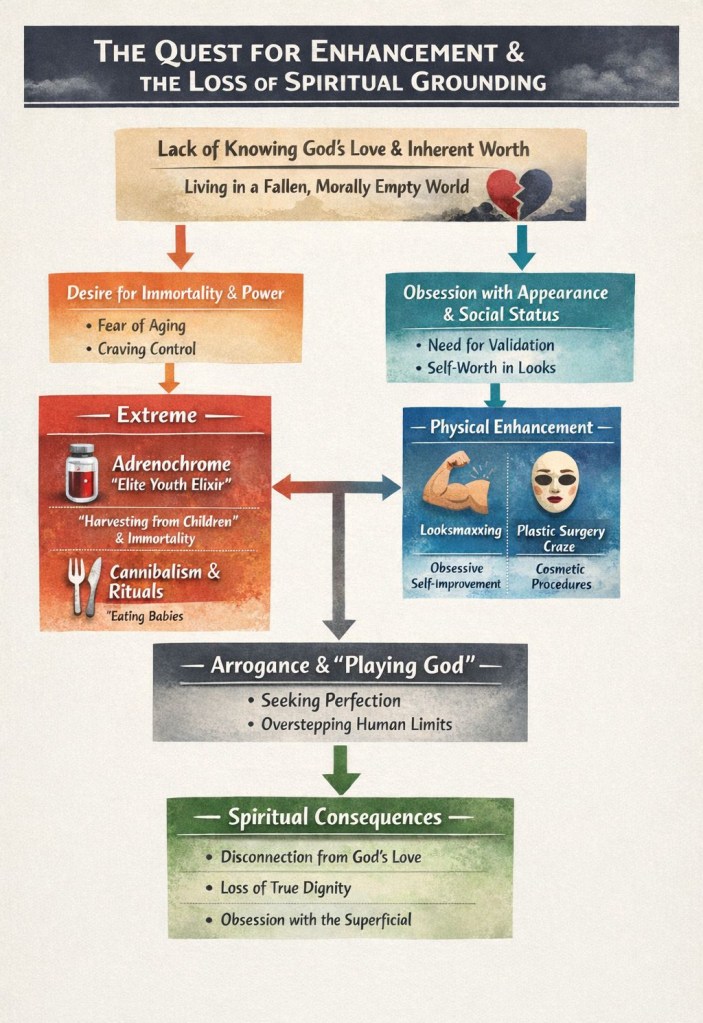
Beyond looks, many modern pursuits focus on extending life, preserving youth, and mastering the human body. Anti-aging medicine, regenerative therapies, extreme fitness regimens, and even ideas like adrenochrome as an elixir of vitality reveal the depth of human anxiety about mortality.

Regenerative medicine — stem cell therapies, organ regeneration, and gene therapy — aims to repair or replace damaged tissues, offering a glimpse at life extension. Anti-aging interventions and experimental pharmaceuticals, all promise to slow the aging process, but they can foster obsession and fear of the natural life cycle.

Fear of death and the desire to extend life beyond God’s design can also be exploited by the enemy. Even when pursuits appear noble — seeking health or longevity — they can become channels of deception when pride and fear drive the heart.

These pursuits are not inherently wrong when aimed at restoration or health, but they become spiritually dangerous when driven by fear of death, pride, or a refusal to accept the natural boundaries of life.

The Bible reminds us that life is a gift, not a possession to manipulate at will:

Job 12:10: “In his hand is the life of every creature and the breath of all mankind.”

Ecclesiastes 3:1–2: “There is a time for everything, and a season for every activity under the heavens… a time to be born and a time to die.”

True peace comes not from controlling life, but from trusting in God’s wisdom, timing, and care.

5. Spiritual Implications of Obsession and Arrogance

The enemy thrives when humans forget their God-given worth. He disguises pride, obsession, and the desire to surpass God’s design as ambition, success, or enlightenment, leading hearts into emptiness and moral compromise.

When people forget that their value comes from God, they often seek meaning in external achievements, appearance, or technological mastery.

This can manifest as:

Pride and arrogance, believing humans can surpass God’s design.

Obsessive focus on perfection, whether in appearance, intellect, or lifespan.

Emotional emptiness, feeling dissatisfied even after achieving worldly success.

Moral compromise, prioritizing self-interest over love, stewardship, and the care of others.

Historical examples, like the Nazi pursuit of “racial perfection,” illustrate how obsession and arrogance can lead to destruction on a massive scale. Modern parallels include extreme cosmetic procedures, abortion, euthanasia, social media pressures, and life extension experiments that ignore moral and spiritual consequences. Technological enhancement, when pursued without ethical or spiritual discernment, reflects a human heart seeking control over life itself rather than acknowledging God’s sovereignty.

Scripture reminds us that human worth is intrinsic, given by God, and not contingent on external measures:

Ephesians 2:10: “For we are God’s handiwork, created in Christ Jesus to do good works, which God prepared in advance for us to do.”

James 4:6: “God opposes the proud but gives grace to the humble.”

Security, identity, and purpose are found not in controlling life or chasing perfection, but in embracing God’s design with humility, gratitude, and love for others.

6. Integrating Knowledge, Enhancement, and Stewardship

Modern technologies and health innovations can serve humanity, but they require discernment, humility, and moral responsibility.

Genetic and technological enhancements can restore function, prevent disease, or improve quality of life — but they should never be pursued to glorify self or assert control over life itself. Cosmetic and lifestyle interventions can provide confidence or repair, yet obsession with appearance reflects spiritual misalignment if it becomes the primary source of self-worth. Radical life extension goals must be tempered by respect for God’s natural boundaries and the spiritual reality of mortality.

Discernment is key because the enemy often disguises self-aggrandizement as innovation or stewardship. Humility, obedience, and alignment with God’s design guard against this deception. Stewardship involves using gifts, knowledge, and technology responsibly — for healing, restoration, and service, not for prideful perfection or dominion over life. True advancement aligns with God’s purpose, not human ambition.

7. Lessons from History, Scripture, and Modern Culture

Modern culture reflects timeless human struggles: pride, obsession, fear of mortality, and desire for perfection.

Historical warnings like the Nazi eugenics program show the catastrophic consequences of attempting to determine worth apart from God. Modern trends — transhumanism, cosmetic obsession, anti-aging interventions, abortion, euthanasia, social media influence, and life-extension experiments — echo the same prideful desire to control life.

Scripture provides the guiding principle: true worth is intrinsic, life is a gift, and fulfillment comes from alignment with God, not external perfection:

Psalm 139:14: “I praise you because I am fearfully and wonderfully made.”

Proverbs 3:5–6: “Trust in the Lord with all your heart and lean not on your own understanding; in all your ways submit to him, and he will make your paths straight.”

Security, identity, and purpose are found not in controlling life or chasing perfection, but in embracing God’s design with humility, gratitude, and love for others. Modern obsessions, whether through technological enhancement, cosmetic trends, or social media influence, reflect ancient pride and rebellion against God. Yet His truth offers a timeless refuge, reminding us that intrinsic worth is found in His image, not human-imposed standards.

—-—————-

*** Photo by Cottonbro Studio at Pexels

The Magnificence of Christ Our Savior and Soon-Coming King

The Magnificence of Christ Our Savior and Soon-Coming King

The story of Jesus Christ is the centerpiece of human history. His birth, life, death, resurrection, and promised return encapsulate the glory of God’s redemptive plan. Jesus, whose name means “The Lord saves,” is also called Emmanuel, meaning “God with us” (Matthew 1:21-23). His magnificence is proclaimed not only by heavenly hosts but also by humble shepherds, learned Magi, devout prophets, and even the unborn John the Baptist, pointing to His divine mission to save humanity from sin and reconcile us to God.

The Prophecies of the Messiah

Long before His earthly arrival, the coming of the Messiah was foretold by the prophets. These prophecies reveal the grandeur of His identity and mission:

  1. His Virgin Birth:
    Isaiah prophesied that the Messiah would be born of a virgin, signifying a divine and miraculous conception:
    “The virgin will conceive and give birth to a son, and will call him Emmanuel” (Isaiah 7:14).
  2. His Identity and Mission:
    Isaiah described the Messiah as both a mighty ruler and a source of eternal peace:
    “For to us a child is born, to us a son is given, and the government will be on his shoulders. And he will be called Wonderful Counselor, Mighty God, Everlasting Father, Prince of Peace” (Isaiah 9:6).
  3. His Eternal Kingship:
    The prophet Daniel foretold that the Messiah’s kingdom would never end:
    “His dominion is an everlasting dominion that will not pass away, and his kingdom is one that will never be destroyed” (Daniel 7:14).
  4. The Place of His Birth:
    Micah foretold that the Messiah would be born in Bethlehem:
    “But you, Bethlehem Ephrathah, though you are small among the clans of Judah, out of you will come for me one who will be ruler over Israel, whose origins are from of old, from ancient times” (Micah 5:2).

The Announcements of His Birth

The fulfillment of these prophecies was marked by divine announcements and extraordinary events.

To Mary

The angel Gabriel appeared to Mary, a humble young woman in Nazareth, and declared:
“Do not be afraid, Mary; you have found favor with God. You will conceive and give birth to a son, and you are to call him Jesus. He will be great and will be called the Son of the Most High. The Lord God will give him the throne of his father David, and he will reign over Jacob’s descendants forever; his kingdom will never end” (Luke 1:30-33).

Mary, in awe, humbly accepted God’s will, saying:
“I am the Lord’s servant. May your word to me be fulfilled” (Luke 1:38).

To Joseph

Joseph, initially troubled upon learning of Mary’s pregnancy, was reassured by an angel in a dream:
“Joseph son of David, do not be afraid to take Mary home as your wife, because what is conceived in her is from the Holy Spirit. She will give birth to a son, and you are to give him the name Jesus, because he will save his people from their sins” (Matthew 1:20-21).

The Joy of Elizabeth and Unborn John

After receiving the angel Gabriel’s announcement, Mary went to visit her relative Elizabeth, who was miraculously pregnant with John the Baptist in her old age. As soon as Mary greeted Elizabeth, an extraordinary event occurred:

“When Elizabeth heard Mary’s greeting, the baby leaped in her womb, and Elizabeth was filled with the Holy Spirit. In a loud voice, she exclaimed: ‘Blessed are you among women, and blessed is the child you will bear! But why am I so favored, that the mother of my Lord should come to me? As soon as the sound of your greeting reached my ears, the baby in my womb leaped for joy’” (Luke 1:41-44).

This moment underscores Jesus’s divine nature even as an unborn child. John, filled with the Holy Spirit even in the womb, recognized and rejoiced in the presence of the Savior.

The Birth of the Savior

The birth of Jesus was marked by simplicity and splendor. Born in Bethlehem, He was laid in a manger because there was no room for them in the inn. This humble setting did not diminish His magnificence but instead highlighted His mission to bring salvation to all people, from the lowliest to the greatest.

The Celebration of His Birth

The Shepherds – The First Witnesses

On the night of Jesus’s birth, shepherds in the fields outside Bethlehem became the first to hear the good news. An angel of the Lord appeared to them, proclaiming:
“Do not be afraid. I bring you good news that will cause great joy for all the people. Today in the town of David a Savior has been born to you; he is the Messiah, the Lord. This will be a sign to you: You will find a baby wrapped in cloths and lying in a manger” (Luke 2:10-12).

Suddenly, a multitude of heavenly hosts praised God, saying:
“Glory to God in the highest heaven, and on earth peace to those on whom his favor rests” (Luke 2:14).

The shepherds, filled with wonder, hurried to Bethlehem. Finding Mary, Joseph, and the baby as the angel described, they became the first earthly witnesses to proclaim His arrival:
“When they had seen him, they spread the word concerning what had been told them about this child, and all who heard it were amazed” (Luke 2:17-18).

The Magi – Honored Guests from the East

Some time later, wise men (Magi) from the East arrived in Jerusalem, guided by a miraculous star. They asked:
“Where is the one who has been born king of the Jews? We saw his star when it rose and have come to worship him” (Matthew 2:2).

Herod, troubled by their inquiry, sought to use the Magi to locate Jesus for sinister purposes. But the star led the Magi to Bethlehem, where they found Jesus. They worshiped Him and offered gifts of gold, frankincense, and myrrh—symbols of His kingship, divinity, and sacrificial death (Matthew 2:11).

Warned in a dream not to return to Herod, the Magi departed another way, protecting the child from harm.

Simeon and Anna’s Testimonies

When Mary and Joseph brought Jesus to the temple for consecration, Simeon, a devout man awaiting the Messiah, took the child in his arms and praised God:
“Sovereign Lord, as you have promised, you may now dismiss your servant in peace. For my eyes have seen your salvation, which you have prepared in the sight of all nations: a light for revelation to the Gentiles, and the glory of your people Israel” (Luke 2:29-32).

The prophetess Anna, who worshiped in the temple day and night, also recognized Jesus as the Redeemer. She gave thanks to God and spoke about Him to all who were awaiting the redemption of Jerusalem (Luke 2:36-38).

Jesus: The Savior and Soon-Coming King

The magnificence of Jesus extends far beyond His birth. He lived a sinless life, taught with divine authority, performed miracles, and ultimately gave His life as a ransom for many (Mark 10:45). Through His death and resurrection, He conquered sin and death, offering eternal life to all who believe in Him:
“For God so loved the world that he gave his one and only Son, that whoever believes in him shall not perish but have eternal life” (John 3:16).

As we celebrate His birth, we also look forward to His glorious return, when He will reign as King of Kings and Lord of Lords:
“Look, he is coming with the clouds, and every eye will see him” (Revelation 1:7).

Conclusion

The birth of Jesus Christ is a cause for joy and celebration. His arrival fulfilled ancient prophecies, was heralded by angels, acknowledged by shepherds, worshiped by wise men, and even celebrated by John the Baptist in the womb. He is Emmanuel, God with us, who came to save His people from their sins and bring light to the world.

As we await His return, let us proclaim with the heavenly hosts:
“Glory to God in the highest heaven, and on earth peace to those on whom his favor rests” (Luke 2:14).

———————

**Photo by Krivec Ales at Pexels

Spiritual Pride: A Hidden Danger for Believers

“Your heart became proud on account of your beauty, and you corrupted your wisdom because of your splendor.” ~Ezekiel 28:17. The sin that corrupted Lucifer was self-generated pride. He became so impressed with his own beauty, intelligence, power, and position that he began to desire for himself the honor and glory that belonged to God alone, and thus he was cast out of heaven. ~Ezekiel 28:18.

As Christians, we are called to walk in humility, following the example of Jesus Christ. However, as we pursue a life of faith, we may unknowingly face a dangerous pitfall along the way: spiritual pride. Spiritual pride can be difficult to recognize because it often masquerades as a sense of religious conviction or spiritual accomplishment. This form of pride can harm our relationship with God and others, drawing us away from the humility Christ taught. Understanding what spiritual pride is, how it manifests, and how to guard against it can help us live a faith that is truly centered on God’s grace.

What Is Spiritual Pride?

Spiritual pride occurs when a believer begins to take undue pride in their own righteousness, knowledge, or “spiritual achievements.” It can start subtly, creeping in as we grow in our faith, gain biblical knowledge, or feel closer to God. Rather than focusing on God’s grace, we may start to view ourselves as more “holy” or “enlightened” than those around us. While growth in faith is a wonderful thing, the danger of spiritual pride lies in shifting our focus from God to ourselves.

Biblical Warnings About Spiritual Pride

The Bible provides numerous examples of spiritual pride, often contrasting it with humility. Here are some key passages that warn us about the dangers of pride, especially when it enters our spiritual lives:

1. The Pharisee and the Tax Collector (Luke 18:9-14)

Jesus tells the parable of a Pharisee and a tax collector who went to the temple to pray. The Pharisee’s prayer was filled with self-righteousness, thanking God that he was “not like other men.” The tax collector, on the other hand, humbly asked for mercy. Jesus declared that the tax collector, not the Pharisee, went home justified before God. This parable reminds us that God values humility over pride, especially pride based on religious actions.

2. Pride Before a Fall (Proverbs 16:18)

“Pride goes before destruction, a haughty spirit before a fall.” When we allow pride to seep into our spiritual lives, it blinds us to our need for God’s grace, making us vulnerable to stumbling. This verse reminds us that humility is essential to walking in alignment with God’s will.

3. Paul’s Teaching on Grace (Ephesians 2:8-9)

Paul emphasizes that salvation is a gift from God, “not of works, lest any man should boast.” If we start to view our faith as something we’ve achieved, we risk boasting in ourselves rather than in the saving grace of Christ. Spiritual pride undermines the foundation of the Gospel, which is based on God’s grace, not our own merit.

Signs of Spiritual Pride in Our Lives

Spiritual pride can be hard to spot, especially since it often comes disguised as faithfulness or dedication. Here are a few signs that spiritual pride may be creeping into our lives:

1. Judgmental Attitude Toward Others

Spiritual pride often manifests as a judgmental attitude. We may find ourselves looking down on others who don’t seem as “mature” in their faith, questioning their sincerity or devotion. This judgment is rooted in pride, not in God’s love. Jesus reminded us not to judge others, as only He can see the heart (Matthew 7:1-5), however we are called to discern the spirit (1 John 4:1).

2. Desire for Recognition

Do we feel a need for others to see or acknowledge our spiritual efforts? Jesus warned against practicing our faith for the sake of appearance. He taught that when we give, pray, or fast, we should do so in secret, so that our reward is from God, not human praise (Matthew 6:1-6).

3. A Sense of “Arrival” in Our Faith

Spiritual pride can make us feel as though we’ve “arrived” at a place of deep understanding or holiness, diminishing our desire for further growth. This mindset blocks the Holy Spirit’s work in our lives, as it blinds us to our own weaknesses. The Christian life is a lifelong journey, and we should always approach it with a teachable spirit.

4. Isolation from Those “Less Mature”

When spiritual pride takes hold, we may avoid those we consider “less mature” in faith, seeing ourselves as above them. Yet Jesus spent time with sinners and outcasts, showing us that true spirituality is marked by compassion and connection, not separation.

Touching God’s Glory: A Warning Against Self-Centered Faith

In Christian teaching, God’s glory is central to everything we do. Isaiah 42:8 reminds us, “I am the LORD; that is my name; my glory I give to no other.” When we take credit for spiritual accomplishments or make faith about our own achievements, we are at risk of “touching” or taking credit for God’s glory. This often happens subtly as we grow in our spiritual lives, especially if we start to feel more “advanced” or “righteous” than others. This desire for recognition or approval, even in matters of faith, can lead us to take ownership of things only God has done.

Spiritual pride, when unchecked, tempts us to claim credit for the growth, insights, and transformations that are truly the work of the Holy Spirit in us. We may forget that any good we do, any understanding we have, and any growth we experience are ultimately God’s gifts to us, not our own achievements. Jesus taught in John 15:5, “Apart from me you can do nothing.” This truth reminds us that the power and goodness in our lives flow from God alone. To take credit for them not only misrepresents the truth but also diminishes our awe and gratitude toward God, who deserves all the glory.

Misplacing Credit: Recognizing the Holy Spirit’s Role and Discernment Against Deception

As we grow in faith, it’s essential to recognize that every good work, every insight, and every blessing in our lives is ultimately from God through the power of the Holy Spirit. Sometimes, however, spiritual pride or a lack of discernment can lead us to give credit for these works elsewhere—perhaps to a revered saint, man of God or even our own strength—rather than acknowledging God’s hand in our lives. While people may honor and seek intercession from saints, Scripture is clear that the power to transform lives, perform miracles, and guide us into truth belongs to the Holy Spirit alone and there is only one intercessor between God and men, Jesus Christ (John 14:26, Acts 1:8, 1 Timothy 2:5). Misplacing this credit, however well-intentioned, can obscure our reliance on God and His truth.

Moreover, the Bible warns us about the enemy’s tactics to deceive through counterfeit signs and miracles. Jesus cautioned in Matthew 24:24 that false prophets and false signs could lead people astray, even those in the faith. Satan’s deceptive works are meant to distract us from the truth, enticing people to give honor where it doesn’t belong. Understanding this reminds us to remain vigilant and discerning, always comparing any spiritual experience to the truth of God’s Word.

When spiritual pride enters, it can make us more vulnerable to these deceptions, as we may become focused on external displays of faith rather than genuine reliance on God. By maintaining humility and giving credit to the Holy Spirit alone, we guard our hearts from both misplaced honor and deception.

How Spiritual Pride Affects Our Relationship with God and Others

Spiritual pride can be extremely damaging, both to our relationship with God and with our fellow believers. Here are some ways it impacts our walk with Christ:

Weakening Our Dependence on God

Spiritual pride makes us rely more on our own efforts than on God’s grace. When we focus on our accomplishments or knowledge, we lose sight of our continual need for God’s mercy and guidance.

Creating Barriers in Community

Pride can create walls between us and other believers. The body of Christ is meant to be unified, with each member supporting and learning from one another. Spiritual pride disrupts this unity by fostering a spirit of judgment or competition.

Preventing Personal Growth

Pride stops us from seeing our own shortcomings. When we’re too focused on what we think we know or have achieved, we close ourselves off to the refining work of the Holy Spirit. True growth requires humility and an openness to God’s correction.

How to Guard Against Spiritual Pride

Guarding against spiritual pride requires a commitment to humility, self-reflection, and a reliance on God’s grace. Here are some practical steps to help us stay on track:

1. Pray for a Humble Heart

Scripture encourages us to “clothe ourselves with humility” (1 Peter 5:5). We can pray that God would reveal any areas of pride in our hearts and give us a humble spirit. Regularly seeking God’s help in maintaining humility keeps us aware of our dependence on Him.

2. Examine Our Motives

It’s essential to check our motives, especially in our acts of faith. Are we seeking to glorify God or to receive approval from others? Taking time for honest self-reflection keeps our hearts aligned with God’s purposes.

3. Focus on Serving Others

Jesus taught us that the greatest among us should be a servant (Matthew 23:11). When we focus on quietly serving others rather than elevating ourselves, we are reminded of Christ’s humility and love. Acts of selfless service without looking for honour can help dismantle pride.

4. Remember Our Need for Grace

Meditating on God’s grace keeps us grounded. Paul wrote, “What do you have that you did not receive?” (1 Corinthians 4:7). Everything we have, including our faith, is a gift from God. By regularly reflecting on our dependence on His grace, we maintain a spirit of gratitude and humility, remembering that our spiritual journey is not one of personal achievement but one of God’s generosity and love.

A Prayer for Humility and Freedom from Spiritual Pride

Heavenly Father,

We come before You with humble hearts, acknowledging that without Your grace, we are nothing. Lord, we confess that pride sometimes creeps into our hearts, leading us to rely on ourselves rather than on You. Help us to see ourselves honestly and to root out any spiritual pride that blinds us to our dependence on You.

Holy Spirit, fill us with a deeper sense of Your presence and Your work in our lives. Remind us that every good thing, every insight, and every blessing comes from You alone. Guard our hearts against deception and any temptation to give glory to anyone or anything other than You. May we recognize the subtle ways the enemy seeks to distract us and remember that true power and goodness come from You alone.

Jesus, teach us to walk in the humility You modeled. Help us to focus not on our own achievements or knowledge but on serving others and bringing glory to Your name. May our lives be a reflection of Your love and grace, shining light not on ourselves but on You, our Lord and Savior.

In Your name we pray Jesus, Amen.

———————-

** Photo by Pixabay at Pexels / Intro by Ron Rhodes from Reasoning from the Scripture ministries

The Story of The Birdcage

“For our struggle is not against flesh and blood [contending only with physical opponents], but against the rulers, against the powers, against the world forces of this [present] darkness, against the spiritual forces of wickedness in the heavenly (supernatural) places.” ~ Ephesians 6:12

In the 1800s, an old Baptist pastor was preparing his Sunday sermon on a Saturday afternoon. After several hours of study, he grew tired and went for a walk to stretch his legs. While wandering through town, he saw a young boy carrying a birdcage in one hand and a stick in the other. Inside the cage were a dozen little field birds. The boy was jabbing the birds through the bars with the stick. The birds shrieked, feathers flew, and the boy laughed.

The pastor approached the boy and asked, “Son, why are you tormenting those birds?”

The boy replied, “Sir, I love to hear them shriek. I love to see their feathers fly. It is so much fun.”

“What will you do when you are finished having your fun?” the pastor asked.

The boy smiled broadly. “Oh sir, that’s the best part. I will bring them home, take them out of the cage one by one, pluck their feathers, and feed them to my cat.”

The pastor’s heart was broken. “Son, let me have those birds,” he said.

“No, these are my birds. I caught them myself. You can get your own birds. You can catch some in the field.”

“But I want those birds.”

“Why? They don’t even sing. They aren’t canaries, you know. They are just ordinary field birds.”

“Please, son. I’ll buy them from you. How much do you want?”

The pastor took out his wallet and opened it up. The boy saw an opportunity. “How much money do you have, sir?”

The pastor counted two hundred dollars, which was a significant amount of money in those days. “What a coincidence,” the boy said. “They cost exactly two hundred dollars, cage included.”

Knowing he was being taken advantage of, the pastor handed over all his money. The next day, he recounted this story to his congregation. He said, “I took that cage out into the field, opened the door, and backed away. One by one, the birds hopped to the open door. One by one, they spread their wings and began to fly. As they flew to freedom, they sang the same song: ‘Redeemed, Redeemed, Redeemed.’”

The Message of Redemption

You might wonder, what does this story have to do with us? The tale of the birdcage mirrors our relationship with God. Just as the birds were tormented by the boy, we too can feel trapped, harassed, and tormented by the enemy—Satan, who delights in our suffering and captivity to sin, addiction, and depression. The enemy Satan uses people who are willing to do his bidding. The Lord said he was a liar and murderer from the beginning, who comes to kill, steal, and destroy everything good in people’s lives. People are being tormented by the enemy and are hurting by present methods used to oppress the people. Satan torments with feelings of hopelessness, worthlessness, fear, depression, and suicidal thoughts.

The old Baptist pastor symbolizes God, who intervenes to set us free. Just as the pastor bought the birds at a great cost, God paid the ultimate price for our freedom through Jesus Christ. Jesus came to set the captives free and to break the chains that bind us, whether they are chains of sin, addiction, or despair.

When the pastor let the birds go, they flew away one by one, just like how God sets us free from being trapped by the things of this world and sin. The birds’ joyful song of “Redeemed, Redeemed, Redeemed” illustrates the happiness and freedom we feel when we accept God’s rescue—His redemption through Jesus Christ. This story beautifully shows how God’s love and grace change us, freeing us from sin’s chains so we can live freely and praise Him.

Understanding Our Condition

All of us have done wrong and fallen short of God’s standards. Sin is not just about major wrongdoings but also includes knowing what is right and failing to do it. It encompasses acts like lying, stealing, unforgiveness, hatred, jealousy, anger, sexual immorality, idolatry, addictions, pornography, drugs, and wanting to live separately from God. These wrongdoings separate us from a holy and righteous God.

God judges the heart, including our thoughts, words, deeds, and motives. While people can pretend to have a holy exterior and act pious, God sees through our facades and knows our true nature. It’s not about religion, where you have to do things to be accepted by God. It’s about a relationship with God who is near and accessible. Our good works cannot save us; they are like filthy rags in comparison to God’s purity, you cannot buy salvation. The Bible states that the wages of sin is death—eternal separation from God in hell, a fate none of us would wish upon anyone.

The Sacrifice of Jesus

Jesus Christ paid the price for our sins on the cross so we can be restored to God, our heavenly Father. There needed to be a sacrifice, and God so loved the world that He gave His only begotten Son, Jesus, who was sinless, to take our place. It’s like a mother giving away her newborn baby or you giving away your only child to pay someone else’s debt, someone who couldn’t care less about you or love you back. God was willing to do that for you and me.

Jesus Christ was crucified, with nails driven through His hands and feet and a crown of thorns pressed onto His head. He was whipped until His skin was torn off, becoming unrecognizable. As He hung on that cross, He did it for your sins. He took our sins upon Himself, including the very sins that have destroyed our lives. He was destroyed for those sins on that cross. He bled and died for our sins, which were buried with Him in the grave. Three days later, Jesus Christ was raised from the dead. Jesus is alive!

The Call to Salvation

This message is for everyone. Regardless of your wealth, status, sexual orientation or religious background, Jesus invites you to turn from sin and accept His gift of salvation. No amount of money, social standing, or religious observance can save you. It’s not about comparing yourself to others; the only comparison that matters is with God, and we all fall short, we all have sinned. God doesn’t want our religion; He wants a relationship with us. We are created with a God-shaped vacuum that nothing else can fill. He said, “I am the light of the world. Whoever follows me will never walk in darkness but will have the light of life.”

A Prayer of Salvation

If you feel the call in your heart, don’t wait. Embrace this good news today and pray:

Remember, it’s not the prayer that saves you; it’s the heartfelt belief and confession, turning away from sin, and choosing to trust in Jesus for a righteous life. Now is the time for salvation. Turn from darkness to light, from sin to salvation, and follow Jesus.


What Next?

Download the free guide on the 7 Things To Do After Getting Saved:


Photo by Kai-Chieh Chan at Pexels

The Traditions of Men Versus the Word of God

In Mark 7:8, Jesus speaks with profound clarity: “You disregard and neglect the commandment of God, and cling [faithfully] to the tradition of men.” This verse cuts to the heart of an ongoing tension that has existed since the days of Christ: the elevation of human traditions over the divine Word of God. Jesus’ confrontation with the Pharisees reveals a dangerous practice where man-made traditions overshadow and even invalidate God’s commandments.

Traditions: A Challenge in Jesus’ Time

Mark 7:2-9 paints a vivid picture of this confrontation. The Pharisees and scribes, having observed Jesus’ disciples eating with unwashed hands, found fault with them. They weren’t just concerned with hygiene, but with the breaking of religious customs—the “tradition of the elders”—which had become a cornerstone of Jewish religious practice. They viewed this tradition as equal to, or even above, God’s commandments.

Jesus’ response is striking. He calls them hypocrites, quoting Isaiah: “This people honors Me with their lips, but their heart is far from Me.” He condemns their practices, stating, “For laying aside the commandment of God, you hold the tradition of men.” This indictment is as relevant today as it was then. The Pharisees placed their traditions on a pedestal, and in doing so, lost sight of the heart of God’s law. They honored God with outward rituals, but their hearts were far from Him.

The Danger of Tradition Today

In the present age, many Christians find themselves at a similar crossroads. The traditions of men can still creep into our faith, subtly undermining the pure Word of God. Colossians 2:8 warns us to be vigilant: “Beware lest anyone cheat you through philosophy and empty deceit, according to the tradition of men, according to the basic principles of the world, and not according to Christ.” Tradition, when unchecked by Scripture, can lead us into a form of religion that has the appearance of wisdom but lacks the power to transform.

One of the greatest dangers of these traditions is that they often seem harmless or even beneficial. After all, they may have been passed down for generations and become ingrained in our communities and culture. But as 1 Peter 1:17-19 reminds us, we were not redeemed with corruptible things, like silver or gold, “from your aimless conduct received by tradition from your fathers, but with the precious blood of Christ.” Our salvation is not found in human traditions but in the sacrifice of Jesus Christ.

The Pharisees’ Blindness: An Ongoing Struggle

When Jesus rebuked the Pharisees for their traditions, He pointed to the deeper issue of the heart. The Pharisees had developed a system of religion that was all about outward appearances, with rules about washing hands and cleaning vessels (Mark 7:4). But their focus on external purity blinded them to the internal transformation that God desires. As Romans 10:3 states, “They being ignorant of God’s righteousness, and seeking to establish their own righteousness, have not submitted to the righteousness of God.”

This is a profound warning for believers today. If we are not careful, we can also fall into the trap of relying on human traditions or self-imposed practices to define our righteousness. But no amount of religious ritual can make us right with God—only faith in Jesus Christ, submission to His Word, and His finished work on the Cross can do that. No amount of external works or accolades will suffice, for obedience is better than sacrifice.

God’s Commandments are Sufficient

Deuteronomy 12:29-32 gives a stern warning: “Whatever I command you, be careful to observe it; you shall not add to it nor take away from it.” God’s Word is complete and sufficient. We are not to add to it with human traditions, nor are we to take away from it through selective obedience. The Scripture is clear: anything that detracts from the purity of God’s Word is not to be followed.

Traditions often evolve over time and may start with good intentions, but they can lead us away from the truth of the Gospel. In Matthew 15:1-9, Jesus again confronts the Pharisees, accusing them of transgressing the commandments of God in favor of their traditions. Their interpretation of the law had become twisted, allowing them to bypass God’s true commands—such as honoring father and mother—while upholding human rules that seemed religious.

Direct Access to God Through Christ

One of the most beautiful gifts that Christians have is direct access to God through Jesus Christ. As believers, we are not bound by the traditions of men that create barriers between us and God. The veil has been torn (Matthew 27:51), and we can approach the throne of grace with confidence (Hebrews 4:16). Through the sacrifice of Jesus, we have the privilege of a personal relationship with God. We no longer need a human intermediary to offer sacrifices or perform rituals on our behalf.

Because Jesus is our mediator, we have the incredible privilege of direct communication with God through prayer. He intercedes for us (Romans 8:34), making our prayers effective and heard by the Father. This divine access reminds us that our relationship with God is intimate and unbroken, secured through Christ’s finished work on the cross, as He alone died for our sins.

Conclusion: Cling to God’s Word, Not Man’s Tradition

The Word of God is living and powerful (Hebrews 4:12). It is our guide, our light, and our foundation. We must be careful not to allow human traditions—however well-meaning they may seem—to overshadow the authority of Scripture. Galatians 1:8 gives a sobering warning: “But even if we, or an angel from heaven, preach any other gospel to you than what we have preached to you, let him be accursed.” This shows the seriousness with which we must guard the purity of God’s Word, for Jesus Himself warned, “Get away from Me; I never knew you, you who practice disobedience” (Matthew 7:23). To neglect the truth of Scripture and substitute it with human traditions is to risk eternal separation from God.

As born-again believers, our allegiance is to Christ alone, not to any denomination, human traditions, or rituals. Let us examine our hearts and lives to ensure that we are following the Word of God rather than the traditions of men. Only by doing so can we worship God in spirit and truth (John 4:24), honoring Him with our lives and not just our lips. Our faith must be rooted in a personal relationship with Jesus, guided by His Word, and not defined by external affiliations or practices.