Welcome to The Sisterhood Hub! The Hub is where I share insights, resources, and reflections that have deepened my faith and strengthened my Christian walk. My hope is that you find encouragement and inspiration, be uplifted and challenged as you navigate your own journey. The Hub is dedicated to empowering women to embrace their God-given identity, rooted in the love, grace, mercy, truth and sacrifice of our Lord, Saviour, and soon-coming King, Jesus Christ. May this be a source of strength and renewal, fostering your self-worth and guiding you to live out your faith authentically. Together, let us walk confidently in our callings, trusting God every step of the way. May our lives reflect humility, integrity, and reverence for Him, as the Holy Spirit leads us to live fruitfully for His glory. The mission is to parade God’s love by sharing the gospel, writing, engaging in outreach and missionary work, distributing Christian resources, and serving communities both locally and internationally—as a pro-life advocate, committed to the sanctity of life from the womb to the tomb and beyond the grave, in both the physical and spiritual realms, as every life matters. Blessings, Lori 💕
In a world that often celebrates compromise and neutrality, the idea of “sitting on the fence” can seem harmless, even wise. Yet when it comes to God, eternity, and the eternal state of our souls, neutrality is impossible. Scripture is clear: every heart will respond to God’s truth, and our response determines our eternal destiny.
In recent discussions, some leaders have presented neutrality on deeply moral issues as a ‘balanced’ position. Yet Scripture never offers a middle ground when it comes to sin, truth, life, or eternity. God calls every heart to respond—either toward Him or away from Him.
“See, I have set before you today life and good, death and evil. If you obey the commandments of the Lord your God that I am commanding you today, loving the Lord your God, walking in His ways, and keeping His commandments, you will live and multiply, and the Lord your God will bless you. But if your heart turns away and you are not obedient…” — Deuteronomy 30:15–17
The Lord’s Word does not return void (Isaiah 55:11). Every message of Scripture, every gospel witness, every call to repentance and faith carries power. It either softens a heart toward God, producing life and salvation, or hardens it, leaving a soul in rebellion. There is no neutral effect. To ignore God, to delay repentance, or to compromise on truth is not neutrality—it is sin of omission, and Scripture warns that such negligence carries consequences.
Consider the teaching of Jesus:
“Whoever is not with Me is against Me, and whoever does not gather with Me scatters.” — Matthew 12:30
This is the heart of the issue: sitting on the fence is, in effect, standing against God. When faced with the living Word, each of us must decide. Every person is either softened or hardened by it; every heart is changed for better or worse. Indecision in the spiritual realm is still a choice—and every choice has eternal consequences.
In practical terms, compromise can take many forms. For instance, professing faith while condoning or excusing sin, remaining silent when Scripture calls us to speak, or following cultural trends over God’s Word—all of these are ways people “sit on the fence.” While society may call this tolerance, God calls it rebellion.
Paul reminds us in Romans 1:18–20 that even what is seen in creation testifies to God, leaving humanity “without excuse.” Our consciences, our reasoning, and our encounters with Scripture all demand a response. And every moment of inaction is not neutral—it is part of the account each of us will give before a holy God:
“So then, each of us will give an account of ourselves to God.” — Romans 14:12
The choice is urgent. Eternity is binary: life in Christ, or separation from Him. The fence cannot hold us forever. It is not a safe resting place; it is a spiritual danger zone where hearts can grow calloused, where souls can drift into rebellion, and where opportunities to repent may be lost.
The good news is that God does not leave anyone on the fence by design. His invitation is clear, persistent, and loving:
“Come to Me, all you who are weary and burdened, and I will give you rest.” — Matthew 11:28
Turning to Jesus, repenting of sin, and surrendering to Him is the only secure place. God’s grace is ready to transform hearts, forgive sins, and grant eternal life. But the fence cannot save. It only delays the inevitable choice each soul must make.
Conclusion
There is no neutral position with God. Every heart will respond to His Word, whether in faith or rebellion, whether softened or hardened. To sit on the fence is to risk eternal consequence. The call is urgent: turn from sin, accept Christ, and follow Him fully. Neutrality is a luxury eternity does not afford. Choose today whom you will serve.
Mind games the devil plays are not imaginary battles. In this post, we uncover how the enemy manipulates your thoughts and how you can shut those lies down with truth.
Have you ever experienced a day where nothing catastrophic actually happened, yet internally it felt like everything was collapsing? You felt anxious for no clear reason. Condemnation lingered. Confusion clouded your thinking. Temptation felt stronger than usual. Later, when you stepped back, you realized most of the battle did not happen around you. It happened within you. That is not random emotion or personality. That is spiritual warfare targeting the mind.
Jesus called Satan the father of lies. Paul instructed believers to take every thought captive. Scripture tells us we are transformed by renewing our mind. Therefore, the battlefield is often not external drama but internal dialogue. The enemy understands that if he can influence your thoughts, he can influence your direction, your decisions, and eventually your destiny. Let us expose five mind games he frequently uses and learn how to shut each one down with truth.
Game One: What If Anxiety
One of the most common mind games the devil plays is the “what if” scenario. It is fear projected into a future that does not exist. The whispers sound subtle at first. What if you fail? What if you lose everything? What if God does not come through this time? What if you fall back into the same mistake? Gradually, your imagination becomes a theater of worst case outcomes. Although nothing has happened, your emotions respond as if disaster is certain.
Jesus addressed this directly when He told His followers not to worry about tomorrow. He was not teaching irresponsibility. He was protecting peace. Anxiety is faith pointed in the wrong direction. It uses your God given imagination to rehearse defeat instead of trusting promise. That is why breaking this pattern requires intentional redirection. Replace “what if” with “even if.” Even if the storm comes, God will sustain me. Even if the door closes, He remains faithful. Even if I stumble, He will lift me again. When you bring your requests to God with thanksgiving, as Scripture teaches, gratitude interrupts fear and peace begins to guard your heart.
Game Two: Condemnation After You Fall
Another powerful mind game is condemnation. Many believers confuse conviction with condemnation, yet they function very differently. Conviction pulls you toward God for restoration. Condemnation pushes you away from Him in shame. Conviction says repent and return. Condemnation says you are a hypocrite and God is tired of you.
Because of this lie, many people stay stuck not because they sinned, but because they believed they cannot come back. However, Scripture clearly declares that there is now no condemnation for those who are in Christ Jesus. That statement is not emotional comfort. It is a legal truth established at the cross. The enemy wants distance between you and God because distance weakens your devotion and dulls your sensitivity. Therefore, the solution is immediate response. Confess quickly. Receive forgiveness confidently. Run toward God instead of hiding from Him. The cross covered your worst days as much as your best ones.
Game Three: Comparison and Insecurity
Comparison is another subtle but destructive mind game. The enemy constantly invites you to measure your life against someone else’s visible success. He highlights their growth, their platform, their gifting, and then magnifies your perceived lack. Before long, you feel behind and overlooked.
Comparison does more than steal joy. It slowly erodes calling. When you compete in someone else’s lane, you neglect your own assignment. Instead of stewarding the grace on your life, you resent the grace on theirs. Yet Scripture reminds us that we have gifts according to the grace given to us. Grace is not distributed equally, but it is distributed intentionally. Calling is not a competition, and God does not grade you based on someone else’s obedience.
Breaking this mind game requires gratitude and perspective. Thank God for what He is doing in others. Celebrate their victories sincerely. At the same time, thank Him for your season and your process. When gratitude grows, insecurity loses its grip.
Game Four: Delay Does Not Mean Denial
Few mind games test faith more than delay. The enemy whispers that if God were going to answer, He would have done it already. He suggests that silence equals rejection and waiting equals abandonment. Over time, delay can feel personal.
Yet Scripture repeatedly shows that delay often precedes breakthrough. Lazarus was raised after hope appeared gone. Jairus’ daughter was restored when the situation seemed final. The Red Sea parted when there was no visible escape. In each case, timing did not match human expectation, but God’s faithfulness never failed.
Delay is not denial. Often it is development. God builds endurance in hidden seasons. He forms character where applause is absent. Therefore, hold onto His promise more tightly than your preferred timeline. Faith does not require visible progress every day. It requires trust in the One who holds the outcome.
Game Five: Isolation and Mental Fog
The final mind game attacks clarity because clarity produces courage. When confusion, heaviness, and distraction fill your thoughts, decision making becomes difficult and faith feels distant. Then the enemy adds isolation. He suggests staying silent. He convinces you that nobody will understand.
Isolation amplifies lies because there is no external voice speaking truth. However, bringing struggle into the light weakens deception immediately. Speaking with a mature believer or trusted leader often restores perspective. Worship shifts atmosphere. Honest prayer realigns the heart. Even practical steps such as rest, proper nutrition, and stepping outside can restore mental clarity. Spiritual warfare does not exclude practical wisdom. Your body affects your mind, and healthy rhythms support spiritual strength.
How to Win the Mind War
To defeat mind games the devil plays, follow a clear pattern. First, name the lie specifically. Identify whether it is fear, condemnation, comparison, delay, or isolation. Second, replace that lie with Scripture and speak truth aloud. Third, refuse agreement. Thoughts may come, but you choose whether they stay. Fourth, refocus your attention through worship and gratitude. Finally, resist consistently. Scripture promises that when you resist the devil, he will flee.
Victory in the mind is not achieved by ignoring the battle but by confronting it with truth. Many struggles feel overwhelming because they are believed, not because they are true. When agreement shifts, power shifts.
You are not a victim of illusions. The battlefield may be the mind, but the victory was secured at the cross. Renew your thoughts daily. Guard your focus intentionally. Stand firmly in truth.
Editor’s Note
If you recognize some of these mind games in your own life, do not feel discouraged. Awareness is often the first step toward freedom. When the enemy’s strategies are exposed, they lose much of their influence. Identifying the patterns described above can help believers confront them with truth rather than silently struggling against them.
Spiritual battles in the mind are rarely won in a single moment. They are usually overcome through daily renewal, consistent prayer, and returning to truth when lies attempt to take root. Over time, what once felt overwhelming becomes easier to recognize and resist.
——————
** Copyright (C) 2026 Article By Vladimir Savchuk Ministries / Photo by Vinícius Vieira at Pexels
The Ten Commandments are widely recognized as the moral foundation of Scripture. Most people can recite them by heart, and many glance at them and think, “I’ve never done that, so I’m fine.” But there is a serious danger in this superficial reading. Too often, people look only at the headline of each commandment — “Do not murder,” “Do not steal,” “Do not commit adultery” — and assume that outward obedience is enough. They fail to realize that each commandment carries a range of subcategories and heart-level sins that God examines closely.
For example, a person might say, “I have never murdered anyone,” yet harbor hatred, anger, or revenge in their heart — all of which fall under the same command in God’s eyes (Matthew 5:21–22; 1 John 3:15). Another might think, “I’ve never committed adultery,” yet struggle with lust, pornography, or emotional affairs. Many people overlook that the commandments are not simply legalistic rules about behavior, but mirrors revealing the inner life, including thoughts, desires, and attitudes.
God gave the Ten Commandments to show the depth of human sin and the impossibility of self-righteousness. They are meant to reveal that obedience is not just about outward compliance, but about loyalty, purity, integrity, and contentment in the heart. This study presents the Ten Commandments along with their attached attitudes and sins, helping us understand the full scope of what God requires. When read in this way, the Law becomes a lens into the human soul — exposing pride, idolatry, envy, lust, and more — and showing why Scripture declares, “None is righteous, no, not one” (Romans 3:10).
The Ten Commandments can be found in Exodus 20:2-17 and Deuteronomy 5:6-21. The breakdown follows below:
1) YOU SHALL HAVE NO OTHER GODS BEFORE ME
Attached attitudes & sins:
– Idolatry (putting anything above God — money, power, status)
– Atheism / practical unbelief
– Occult practices
– Trusting in self instead of God
– Loving anything more than God
This command is about ultimate loyalty and allegiance. God demands that He alone occupies the throne of our hearts, because what we trust, love, or fear ultimately controls our actions. Anything we rely on for security, identity, or purpose — wealth, status, relationships, personal ability — can become an idol. Matthew 6:24 states, “You cannot serve God and money,” emphasizing that divided loyalty violates the Law.
Practical unbelief — planning without God, relying solely on human ability, or refusing to seek divine guidance — is hidden idolatry. Even love for family or career can become a rival god if it displaces devotion to God. Occult practices or spiritual manipulation are external manifestations of placing power, knowledge, or control above Him. The command reveals that obedience is not just outward compliance, but total devotion of the heart.
2) YOU SHALL NOT MAKE IDOLS
Attached attitudes & sins:
– Worshiping images or objects
– Creating a false idea of God to suit oneself
– Superstition
– Manipulating religion for personal control
– Reducing God to something manageable
This command addresses how we think about God. Beyond literal idols, humans have a natural tendency to shrink or distort God’s character to fit comfort, convenience, or personal preference. Romans 1:23 warns of exchanging “the glory of the immortal God for images resembling mortal man.”
Modern idolatry often involves conceptual idols: a God who never disciplines, never challenges, or only exists to satisfy desires. Superstition, rituals divorced from understanding, or manipulative religious practices also reflect attempts to control or contain God. True worship demands submission to God as He reveals Himself, not to a reduced or convenient image.
3) YOU SHALL NOT TAKE THE LORD’S NAME IN VAIN
Attached attitudes & sins:
– Blasphemy
– False oaths
– Using God’s name casually or irreverently
– Hypocrisy (claiming God’s name but living contrary to Him)
– Claiming “God told me” falsely
Taking God’s name in vain addresses the integrity of both speech and life. Misusing God’s name is more than swearing; it includes claiming His guidance falsely, manipulating others under His authority, or living contrary to His character. Titus 1:16 says, “They profess to know God, but by their works they deny Him.” Hypocrisy — claiming devotion while acting selfishly — dishonors God’s name. This command teaches that true obedience aligns both words and actions with God’s holiness.
4) REMEMBER THE SABBATH DAY
Attached attitudes & sins:
– Neglecting worship
– Refusing rest out of greed or pride
– Treating holy things casually
– Workaholism that replaces trust in God
– Failing to allow others rest
The Sabbath command teaches dependence and worship. Exodus 20:8–11 emphasizes rest after six days of labor; Deuteronomy 5:12–15 links it to redemption from slavery. Refusing rest, neglecting worship, or working obsessively reflects pride and self-reliance, implying that provision and meaning are found in ourselves, not God. Hebrews 4 shows the ultimate spiritual rest is in Christ, pointing to God’s sufficiency rather than human effort. Observing the Sabbath rightly nurtures trust, rhythm, and spiritual health.
5) HONOR YOUR FATHER AND MOTHER
Attached attitudes & sins:
– Disrespect
– Rebellion (especially in youth)
– Neglecting parents in old age
– Disobedience to rightful authority
– Contempt for family structure
Honouring parents promotes respect for God-ordained authority and healthy relationships. Disobedience, neglect, or contempt reflects pride and selfishness. Caring for parents in weakness mirrors God’s care for humanity. Jesus rebuked those who used religious loopholes to avoid parental responsibility (Mark 7:9–13), demonstrating that honoring parents is both relational and spiritual, shaping character, humility, and community stability.
6) YOU SHALL NOT MURDER
Attached attitudes & sins:
– Hatred
– Anger
– Bitterness
– Revenge
– Violence
– Abuse
– Dehumanising others
– Encouraging self-harm in others
Murder begins in the heart. Matthew 5:21–22 teaches that anger and contempt violate the command against murder. 1 John 3:15 states, “Everyone who hates his brother is a murderer.” Hatred corrodes relationships, dehumanizes others, and harms one’s own soul. Revenge and emotional abuse perpetuate cycles of sin even without physical violence. This command shows that God judges intention and attitude, not just outward acts.
7) YOU SHALL NOT COMMIT ADULTERY
Attached attitudes & sins:
– Lust
– Pornography
– Emotional affairs
– Sexual immorality outside marriage
– Betrayal of marital covenant
– Flirtation with intent
Adultery starts in the mind. Matthew 5:27–28 clarifies that lustful intent is adultery in the heart. Emotional or fantasy-based infidelity, pornography, or flirtation betrays covenant faithfulness without physical action. God calls for purity of thought, affection, and body. This command protects the trust, intimacy, and sanctity of marital relationships, showing that internal sin has external consequences.
8) YOU SHALL NOT STEAL
Attached attitudes & sins:
– Fraud
– Cheating
– Exploitation
– Withholding fair wages
– Plagiarism
– Tax evasion
– Wasting others’ resources
Stealing is not only the taking of physical property. James 5:4 condemns withholding fair wages. Theft includes exploitation, deception, and misuse of others’ resources, credit, or time. It reflects greed and lack of trust in God’s provision. The command teaches fairness, justice, and respect for the rights and work of others, highlighting the moral and relational dimensions of integrity.
9) YOU SHALL NOT BEAR FALSE WITNESS
Attached attitudes & sins:
– Lying
– Gossip
– Slander
– False accusations
– Perjury
– Half-truths meant to deceive
– Damaging reputations
Truthfulness is foundational for trust, justice, and healthy community. Proverbs 6:16–19 includes a false witness among things the Lord hates. Lies, gossip, and slander harm others’ reputations and relationships. Even subtle half-truths or exaggerations can mislead and cause damage. This command demands honesty in speech, protection of others’ dignity, and alignment with God’s character as a God of truth.
10) YOU SHALL NOT COVET
Attached attitudes & sins:
– Envy
– Jealousy
– Greed
– Materialism
– Discontentment
– Resentment of others’ blessings
– Comparison-driven unhappiness
Coveting exposes internal sin. Romans 7:7 shows Paul recognizing sin through this command. Coveting says, “I am insufficient; God has been unfair.” This desire fuels theft, adultery, deception, and relational harm. Coveting is invisible but powerful, creating dissatisfaction, discontent, and envy. God judges desire itself, and this command calls for contentment, gratitude, and trust in His provision.
Conclusion
When we look beyond the headlines, the Ten Commandments reveal the pervasive nature of sin in thought, motive, and desire. They show that sin is not limited to external actions but begins in the heart — in hidden pride, jealousy, lust, anger, greed, and resentment. Romans 3:23 reminds us that “all have sinned and fall short of the glory of God.” The Law exposes our inability to achieve righteousness through outward compliance alone.
This deeper understanding should humble us, confronting any illusions of moral superiority. By recognizing the subcategories attached to each commandment, we see that what appears “small” or “private” in the heart is still accountable before God. The commandments are not a checklist for self-congratulation; they are mirrors meant to reveal our need for God’s grace.
Only when we acknowledge the full weight of the Law — its reach into our attitudes, desires, and intentions — can we appreciate the mercy and transformative power of God. The Ten Commandments guide us beyond mere rule-keeping, pointing to humility, repentance, and a heart fully devoted to God, and showing us that true righteousness comes from Him, not from ourselves.
Yet there is hope in Jesus Christ. When we accept Him, God gives us a new heart and new values, and fills us with the Holy Spirit, who empowers us to live in alignment with His commands, transforms our desires, and enables genuine love for God and others. Ezekiel 36:26 declares, “I will give you a new heart, and a new spirit I will put within you,” and 2 Corinthians 5:17 reminds us, “If anyone is in Christ, he is a new creation.” Through Christ, the commandments are no longer merely a mirror of our sin — they become a guide to life transformed by God’s grace and Spirit.
In our modern era, humanity stands at a crossroads. Science and technology now offer possibilities once confined to science fiction — genetic editing, longevity research, neural enhancement, cosmetic transformation, artificial intelligence, and even the dream of transcending biological limits. What was once impossible is now within reach.
Across history, human beings have wrestled with the temptation to control, perfect, and redefine life itself. From the atrocities of the Nazi eugenics program — which sought to rank human worth by genetics — to today’s movements in transhumanism and extreme appearance culture, the underlying impulse remains the same: to determine value apart from the Creator, to overcome limits rather than receive them, to elevate human will above divine design.
This desire is not new. It is ancient. It is the impulse to “be like God” — not in holiness or love, but in authority over life itself.
At the heart of this cultural moment lies a crisis of identity. When human worth is no longer anchored in being created in the image of God, it becomes negotiable — measured by beauty, intelligence, productivity, longevity, or genetic advantage. The result is a generation pressured to optimize rather than receive, to compete rather than rest, to enhance rather than belong.
Scripture offers a radically different foundation:
“For you created my inmost being; you knit me together in my mother’s womb. I praise you because I am fearfully and wonderfully made.” — Psalm 139:13–14
“So God created mankind in his own image…” — Genesis 1:27
Human dignity is not earned. It is given. It is not engineered. It is bestowed. When this truth is forgotten, pride expands, control intensifies, and moral lines blur. But when identity is rooted in God’s love, technology becomes a tool rather than a master, enhancement becomes stewardship rather than rebellion, and human life remains sacred rather than commodified.
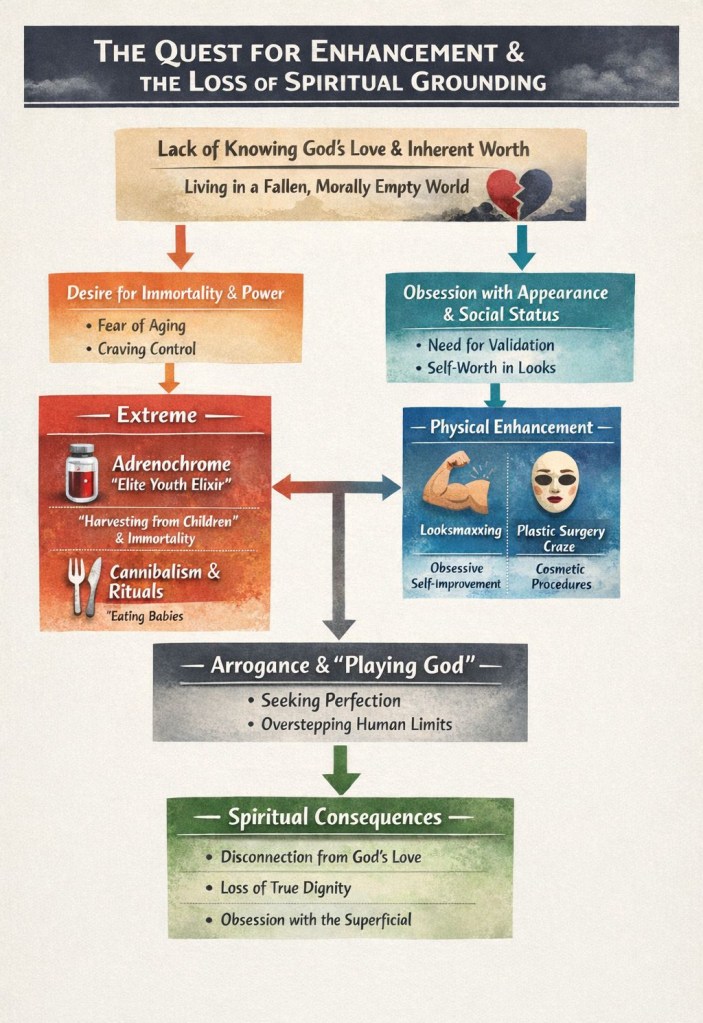
The following seven signs reveal how transhumanism, looksmaxxing, and the “playing God” mentality reflect a deeper spiritual disconnection — and why rediscovering our identity in God is the only foundation strong enough to withstand the pressures of a self-optimizing age.
1. Transhumanism and the Pursuit of Human Enhancement
Transhumanism is perhaps the most radical expression of humanity’s desire to reshape itself, overcome natural limits, and achieve perfection through science and technology. It is a movement that envisions a future where humans can radically enhance intelligence, physical ability, and longevity. Artificial intelligence, neural implants, gene editing, and cybernetic integration are no longer just theoretical; they are actively being researched and developed.
Brain-computer interfaces and neural implants could one day allow direct communication with machines or even memory enhancement. Genetic editing tools like CRISPR could prevent certain diseases — but they also tempt humans to select traits for “enhancement” rather than healing. Cybernetic limbs and synthetic organs offer incredible restoration, but also blur the line between human and machine, raising questions about identity and dignity.
While the possibilities are staggering, the spiritual and moral implications are profound. Transhumanism represents more than just science — it reflects the human heart’s deep longing to control life, transcend limitation, and define value on our own terms. The danger arises when enhancement is pursued not for healing, restoration, or stewardship, but to satisfy pride, vanity, or fear of mortality.
Technological marvels can be used for restoration and good, but they can also become instruments of deception when the enemy masks pride and self-exaltation as innovation or progress. What seems like human advancement can subtly lead hearts away from God.
Scripture reminds us of the dangers of this kind of pride:
Proverbs 16:18: “Pride goes before destruction, a haughty spirit before a fall.”
Genesis 3:5: “For God knows that when you eat from it your eyes will be opened, and you will be like God, knowing good and evil.”
Even with the most advanced technologies at our disposal, we are reminded that true human dignity and purpose are given by God, not defined by our abilities or enhancements.
2. Historical Lessons: Eugenics and the Nazi Regime
History offers chilling proof of what can happen when humanity attempts to redefine worth apart from God. The eugenics programs of the early 20th century, culminating in the atrocities of the Nazi regime, sought to engineer a “perfect” human race, eliminating those deemed genetically or physically unworthy. Millions of lives were devalued, and millions more destroyed.
Early 20th-century eugenics encouraged forced sterilizations in multiple countries, aiming to remove “undesirable” traits. Nazi Germany’s obsession with racial purity led to mass extermination and dehumanization, showing the catastrophic consequences of attempting to play God.
History reveals how the enemy works through human ambition, turning the desire for improvement into cruelty, oppression, and death. Those in power, deceived by pride and ideology, sought to play God — a timeless strategy of the enemy.
These events are more than lessons in politics or science — they are stark warnings about the spiritual consequences of pride and rebellion. Attempts to assume God’s role in determining value, life, and death lead inevitably to cruelty, injustice, and moral collapse.
Today, modern parallels are clear: abortion, euthanasia, extreme cosmetic enhancement, social media-driven appearance obsession, and radical life-extension experiments reflect the same human desire to control life apart from God.
Scripture makes the opposite clear:
Genesis 1:27: “So God created mankind in his own image, in the image of God he created them; male and female he created them.”
Psalm 139:13–14: “For you created my inmost being; you knit me together in my mother’s womb. I praise you because I am fearfully and wonderfully made.”
Every human life carries intrinsic worth. Attempts to assign value based on appearance, intelligence, or genetic traits reflect arrogance and a fundamental misunderstanding of God’s design. Modern enhancement pursuits echo these ancient desires to control and “perfect” humanity, but history reminds us of the tragic cost when human pride dominates divine instruction.
3. Obsession with Youth, Looks, and Appearance
Powerful individuals and groups often leverage social media, influencers, and cultural trends to shape society according to ideological agendas, subtly grooming the population to accept values and behaviors aligned with their vision. This manipulation is part of a spiritual battle, as Scripture reminds us:
“For we do not fight against flesh and blood, but against the rulers, against the authorities, against the powers of this dark world and against the spiritual forces of evil in the heavenly realms.” — Ephesians 6:12
Modern society amplifies the desire to look perfect, maintain youth, and command social approval. Social media platforms, fashion, fitness culture, and the booming cosmetic surgery industry create a world where appearance becomes an identity marker. Terms like “looksmaxxing” describe deliberate efforts to optimize attractiveness, from fitness and diet to grooming and fashion, and the cosmetic surgery industry makes these ideals increasingly attainable.
Procedures like rhinoplasty, Botox, or lip fillers normalize extreme focus on appearance. Fitness influencers and social media create constant comparison pressure, teaching people to measure worth externally. This can lead to obsessive behavior, mental health challenges, and spiritual distraction from God’s truth of inherent value.
Even the pursuit of beauty can become a tool of deception. The enemy entices hearts to measure worth by fleeting appearances, masking vanity and dissatisfaction as self-care, confidence, or empowerment.
While taking care of one’s body is not inherently wrong, these behaviors become spiritually dangerous when they replace recognition of intrinsic worth. The Bible teaches that external perfection is fleeting, but the heart reflects true worth:
1 Samuel 16:7: “The Lord does not look at the things people look at. People look at the outward appearance, but the Lord looks at the heart.”
Proverbs 31:30: “Charm is deceptive, and beauty is fleeting; but a person who fears the Lord is to be praised.”
Obsession with appearance is not simply vanity — it is a symptom of a deeper spiritual hunger for validation, control, and meaning.
4. The Pursuit of Longevity and Control
Beyond looks, many modern pursuits focus on extending life, preserving youth, and mastering the human body. Anti-aging medicine, regenerative therapies, extreme fitness regimens, and even ideas like adrenochrome as an elixir of vitality reveal the depth of human anxiety about mortality.
Regenerative medicine — stem cell therapies, organ regeneration, and gene therapy — aims to repair or replace damaged tissues, offering a glimpse at life extension. Anti-aging interventions and experimental pharmaceuticals, all promise to slow the aging process, but they can foster obsession and fear of the natural life cycle.
Fear of death and the desire to extend life beyond God’s design can also be exploited by the enemy. Even when pursuits appear noble — seeking health or longevity — they can become channels of deception when pride and fear drive the heart.
These pursuits are not inherently wrong when aimed at restoration or health, but they become spiritually dangerous when driven by fear of death, pride, or a refusal to accept the natural boundaries of life.
The Bible reminds us that life is a gift, not a possession to manipulate at will:
Job 12:10: “In his hand is the life of every creature and the breath of all mankind.”
Ecclesiastes 3:1–2: “There is a time for everything, and a season for every activity under the heavens… a time to be born and a time to die.”
True peace comes not from controlling life, but from trusting in God’s wisdom, timing, and care.
5. Spiritual Implications of Obsession and Arrogance
The enemy thrives when humans forget their God-given worth. He disguises pride, obsession, and the desire to surpass God’s design as ambition, success, or enlightenment, leading hearts into emptiness and moral compromise.
When people forget that their value comes from God, they often seek meaning in external achievements, appearance, or technological mastery.
This can manifest as:
Pride and arrogance, believing humans can surpass God’s design.
Obsessive focus on perfection, whether in appearance, intellect, or lifespan.
Emotional emptiness, feeling dissatisfied even after achieving worldly success.
Moral compromise, prioritizing self-interest over love, stewardship, and the care of others.
Historical examples, like the Nazi pursuit of “racial perfection,” illustrate how obsession and arrogance can lead to destruction on a massive scale. Modern parallels include extreme cosmetic procedures, abortion, euthanasia, social media pressures, and life extension experiments that ignore moral and spiritual consequences. Technological enhancement, when pursued without ethical or spiritual discernment, reflects a human heart seeking control over life itself rather than acknowledging God’s sovereignty.
Scripture reminds us that human worth is intrinsic, given by God, and not contingent on external measures:
Ephesians 2:10: “For we are God’s handiwork, created in Christ Jesus to do good works, which God prepared in advance for us to do.”
James 4:6: “God opposes the proud but gives grace to the humble.”
Security, identity, and purpose are found not in controlling life or chasing perfection, but in embracing God’s design with humility, gratitude, and love for others.
6. Integrating Knowledge, Enhancement, and Stewardship
Modern technologies and health innovations can serve humanity, but they require discernment, humility, and moral responsibility.
Genetic and technological enhancements can restore function, prevent disease, or improve quality of life — but they should never be pursued to glorify self or assert control over life itself. Cosmetic and lifestyle interventions can provide confidence or repair, yet obsession with appearance reflects spiritual misalignment if it becomes the primary source of self-worth. Radical life extension goals must be tempered by respect for God’s natural boundaries and the spiritual reality of mortality.
Discernment is key because the enemy often disguises self-aggrandizement as innovation or stewardship. Humility, obedience, and alignment with God’s design guard against this deception. Stewardship involves using gifts, knowledge, and technology responsibly — for healing, restoration, and service, not for prideful perfection or dominion over life. True advancement aligns with God’s purpose, not human ambition.
7. Lessons from History, Scripture, and Modern Culture
Modern culture reflects timeless human struggles: pride, obsession, fear of mortality, and desire for perfection.
Historical warnings like the Nazi eugenics program show the catastrophic consequences of attempting to determine worth apart from God. Modern trends — transhumanism, cosmetic obsession, anti-aging interventions, abortion, euthanasia, social media influence, and life-extension experiments — echo the same prideful desire to control life.
Scripture provides the guiding principle: true worth is intrinsic, life is a gift, and fulfillment comes from alignment with God, not external perfection:
Psalm 139:14: “I praise you because I am fearfully and wonderfully made.”
Proverbs 3:5–6: “Trust in the Lord with all your heart and lean not on your own understanding; in all your ways submit to him, and he will make your paths straight.”
Security, identity, and purpose are found not in controlling life or chasing perfection, but in embracing God’s design with humility, gratitude, and love for others. Modern obsessions, whether through technological enhancement, cosmetic trends, or social media influence, reflect ancient pride and rebellion against God. Yet His truth offers a timeless refuge, reminding us that intrinsic worth is found in His image, not human-imposed standards.
As believers, the return of Christ is not only a promise but a profound call to be ready. Christ Himself told us how He will return. Scripture declares that He will come personally, visibly, and in power and glory. Jesus said, “For as the lightning comes from the east and flashes to the west, so also will the coming of the Son of Man be” (Matthew 24:27). He also said, “They will see the Son of Man coming on the clouds of heaven, with power and great glory” (Matthew 24:30).
The angels testified at His ascension, “This same Jesus, who has been taken from you into heaven, will come back in the same way you have seen him go into heaven” (Acts 1:11). Paul wrote that “the Lord Himself will descend from heaven with a shout, with the voice of the archangel and with the trumpet of God” (1 Thessalonians 4:16), and Revelation declares, “Look, He is coming with the clouds, and every eye will see Him” (Revelation 1:7).
While we may not know when Christ will return, Scripture offers us clear guidance on how we should live in anticipation. Our lives are fragile—like a vapor here today and gone tomorrow. This truth underscores the urgency for us to get right with God and live in accordance with His Word.
We must also understand that tribulation, as warned in Scripture, is inevitable. We should not be surprised by it; rather, we should act with the awareness that God commands us to prepare for it. Regardless of whether the Church experiences tribulation pre-, mid-, or post-Rapture, God’s Word assures us of His faithfulness. While we may not know the exact time of Christ Jesus’ return, He has given us clear signs to watch for, including the rise of the Antichrist, widespread deception, and other prophetic events described in Scripture. The Rapture refers to the event described in 1 Thessalonians 4:16–17, when believers are caught up to meet the Lord.
Faithfulness and Obedience to Christ
Our allegiance is to Jesus, the Christ, the One who gave His life for us. Our obedience is the expression of that faithfulness, born out of love and reverence for Him, not fear. Tribulation, suffering, or even the threat of death will not separate us from God. Revelation 2:10 reminds us: “Be faithful, even to the point of death, and I will give you life as your victor’s crown.” Scripture teaches us to “fear Him who can kill both body and soul in hell” (Matthew 10:28). In this world, we are called to work out our salvation with fear and trembling (Philippians 2:12), acknowledging that our lives are not our own, and the fear of the Lord is the beginning of wisdom (Proverbs 9:10).
Understanding Tribulation
As believers, we are not promised a life free from hardship. Scripture makes it clear that tribulation is to be expected. As Peter wrote, “Do not be surprised at the fiery ordeal that has come on you to test you, as though something strange were happening to you” (1 Peter 4:12). Rather than feeling shocked when we face trials, we are told to expect them as a part of the Christian journey. Additionally, Jesus warned us that “What does it profit a man to gain the whole world but forfeit his soul?” (Mark 8:36). Your earthly status, wealth, or possessions will not save you, your denomination will not save you. We must wake up to the reality that our status or material wealth means nothing in light of eternity, you cannot buy salvation for yourself or relatives—dead or alive. Only faith in Christ and His finished work on the Cross will secure our salvation.
Jesus’ Teachings on the Signs of His Return
Jesus Himself gave us signs to look for in the Scriptures to help us recognize the approach of His return. In Matthew 24, Mark 13, and Luke 21, He spoke about wars, rumors of wars, famines, earthquakes, and widespread deception—signs that would increase as the time drew near. He warned that many would come in His name, claiming to be Christ, and that false prophets and deceivers would abound, even performing great signs and wonders to lead many astray, as the enemy Satan comes dressed as an angel of light, in many forms (Matthew 24:24). This deception is one of the major tools the enemy will use to mislead people and distract them from the truth of the gospel, hence we should read God’s Word for ourselves to know exactly what it says—let God be true and every man a liar (Romans 3:4).
The Book of Revelation and Christ’s Return
The Book of Revelation further outlines the events that will unfold before Christ’s return. It describes the rise of the Antichrist, the great tribulation, the seal, trumpet, and bowl judgments, and the ultimate victory of Christ over evil. Though the language is symbolic and filled with mysteries, it also provides us with the certainty of Christ’s final triumph and the establishment of a new heaven and new earth (Revelation 21:1). Revelation serves as both a warning and an encouragement to believers: be faithful and remain steadfast in your faith, for in the end, Christ will reign victorious, and His followers will share in that victory.
Urgency: Our Lives Are Like a Vapor
Our time here on earth is brief. James 4:14 reminds us, “What is your life? You are a mist that appears for a little while and then vanishes.” The brevity of life demands that we prioritize what truly matters: our relationship with Christ, our obedience to His Word, and our readiness for His return. We should never act as if we have an abundance of time to get right with God, for tomorrow is not promised.
Practical Steps for Preparing for Christ’s Return and Tribulation
Live in Holiness and Obedience
Holiness involves being set apart for God’s purposes. Obedience is a natural outflow of our love for Christ. As His followers, we should live to reflect His character—His love, kindness, patience, forgiveness.
Repent Regularly: Acknowledge and confess sin.
Follow God’s Word: Make the Bible your daily guide.
Avoid Temptation: Take deliberate steps to avoid sin.
Develop an Intimate Relationship with Christ
Having an intimate relationship with Jesus is foundational to preparing for His return.
Pray Daily: Talk to God about everything in your life.
Read Scripture: Let God’s Word shape and guide your life.
Worship and Give Thanks: Keep your heart focused on Him.
Be Watchful and Alert
Christ’s return could happen at any time. Be spiritually awake and prepared for whatever lies ahead.
Avoid Complacency: Keep your focus on eternal matters, not earthly distractions.
Stay Informed: Be watchful Bible prophecy and signs of the end times.
Encourage Others: Remind fellow believers of the importance of staying strong in their faith.
Bear Fruit for God’s Kingdom
A life that reflects Christ’s love and service is one that bears fruit.
Share the Gospel: Tell others about the love and hope found in Christ.
Serve Others: Meet the practical needs of those around you.
Grow in the Fruits of the Spirit: Let your life reflect the qualities of love, joy, peace, patience, and kindness (Galatians 5:22-23).
Preparing for Tribulation: Pre, Mid, or Post-Rapture
Pre-Tribulation:Rapture Could Happen Any Time We should live each day as if it is our last chance to share the love of Christ with others. Stay hopeful in the promise of God’s protection and deliverance. Keep your heart and mind ready to meet Jesus.
Mid-Tribulation:Persecution Before Deliverance Prepare your heart for persecution, trusting that God will provide strength. Reflect on the courage of Daniel in the lion’s den or Shadrach, Meshach, and Abednego in the fiery furnace. Let their unwavering faith inspire you.
Post-Tribulation:Full Tribulation Regardless of the severity of tribulation, remain hopeful and faithful. Keep close fellowship with fellow believers for mutual encouragement and support.
Practical Steps for All Scenarios
Build Your Faith: Trust in God’s promises, such as His promise to never leave you (Hebrews 13:5).
Strengthen Community: Join a church or small group for mutual encouragement.
Prepare Resources: As led by God, prepare practical essentials (food, water), but live without fear.
Conclusion
The return of Christ is a central reality of our faith. It compels us to live with urgency and purpose, reflecting His love, obedience, and readiness for His return. Jesus has already given us signs to watch for, including deception, wars, and natural disasters. As we study the Book of Revelation, we see the certainty of Christ’s victory over evil and His faithful return. Whether we face tribulation before, during, or after His return, we can trust in His promises. As Scripture affirms, “In all these things we are more than conquerors through Him who loved us” (Romans 8:37).
Prayer for Readiness and Faithfulness
Heavenly Father, Thank You for Your love and the promise of Christ’s return. Help us to live each day ready, reflecting Your character in our lives. Strengthen our faith and prepare our hearts for whatever lies ahead. May we bear fruit for Your Kingdom and stay steadfast in the hope of eternal life with You. In Jesus’ name, Amen.
The Gospel: A Call to Salvation
As we reflect on Christ’s return and the urgency to prepare, let us also remember the foundational truth of the Gospel: that salvation comes only through Jesus Christ.
To be saved or ‘born again’, we must:
Acknowledge our sin: Scripture declares, “For all have sinned and fall short of the glory of God” (Romans 3:23). Recognizing our need for forgiveness is the first step toward salvation.
Believe in Jesus Christ as Lord and Savior: Jesus said, “I am the way and the truth and the life. No one comes to the Father except through me” (John 14:6). His death on the cross paid the penalty for our sins, and His resurrection assures us of eternal life (Romans 10:9).
Repent and turn to God: True repentance means turning away from sin and aligning our lives with God’s will. As Acts 3:19 urges, “Repent, then, and turn to God, so that your sins may be wiped out, that times of refreshing may come from the Lord.”
Be baptized and receive the Holy Spirit: Baptism is a public declaration of faith, symbolizing our death to sin and resurrection to new life in Christ (Romans 6:4). Jesus also promises, “You will receive power when the Holy Spirit comes on you” (Acts 1:8), equipping us to live righteously and fulfill His purpose.
Do not delay. The urgency of Christ’s return calls us to repentance and faith today. If you have not yet made this decision, now is the time to receive the grace of God and begin living a life fully devoted to Him. As Scripture reminds us, “Now is the time of God’s favor, now is the day of salvation” (2 Corinthians 6:2).
————————
If you are ready to respond to Jesus’ gift of salvation:
How to be saved: The Path to Salvation – Click here