Screening An Un-Blanked-Out Documentary

“Therefore do not go on passing judgment before the time, but wait until the Lord comes who will both bring to light the things hidden in the darkness and disclose the motives of men’s hearts; and then each man’s praise will come to him from God.”

‭‭1 Corinthians‬ ‭4:5‬ ‭NASB‬‬

At the judgment seat of Christ, all of God’s ways will be seen to be perfectly just and righteous. That’s why we’re commanded to wait to judge — because there will come a day when even the secret motives of men’s hearts will be revealed, and then and only then can we judge righteously. Jesus says the same thing in Luke 12:2-3:

“But there is nothing covered up that will not be revealed, and hidden that will not be known. Accordingly, whatever you have said in the dark will be heard in the light, and what you have whispered in the inner rooms will be proclaimed upon the housetops.”
‭‭
The picture I have of the judgment seat is one where everyone who has ever lived will see my every thought, word, deed, and motive, and will be able to see that God’s judgment of my life is perfectly righteous. It’s as if a documentary of all my life — inward and outward — will be on a giant movie screen for everyone who’s ever lived to see. And all people, finally having “perfect information” so to speak, will come to the same exact conclusion that God does in His judgment of my life. For some, that may be an absolutely terrifying idea. But for Christians, we can take comfort knowing that God has “blotted out” those sinful spots on the tape (Psalm 51:9), because He chooses not to remember (Isaiah 43:25) any of the sins that we confess in the name of Jesus Christ (1 John 1:7,9). Praise God for that!!

But Christian, let me ask you a question: how will you feel if, when it’s “showtime” for your documentary in heaven, your entire movie is just a series of blanked-out scenes and bleeped-out speech? No sound, no video, all blank? Definitely no sin there to speak of, just hours and hours of silence. Non-footage, so to speak. It’s as if your life almost never took place. Will that be cause for rejoicing?

Or does that sound terrible to you? I must say that I will be utterly heartbroken if my documentary is all bleeped-out footage, with nothing worth screening in the final day! I want more than that! I want a life that brings God glory and honor and praise (Philippians 1:10-11), a life He can put on display to the rulers and authorities in the heavenly places as evidence of His trustworthiness and wisdom and power (Ephesians 3:10, Job 1:8), a life that is not merely stripped of all evidence of bad, but that fulfills all the good that God had in His heart when He made me (Ephesians 2:10)! (I encourage you to read those verses and see whether that is God’s hope for your life too.)

The Holy Spirit says that “each man’s work will become evident; for the day will show it because it is to be revealed with fire, and the fire itself will test the quality of each man’s work. If any man’s work which he has built on it remains, he will receive a reward. If any man’s work is burned up, he will suffer loss; but he himself will be saved, yet so as through fire” (‭‭1 Corinthians‬ ‭3:13-15‬)‬‬. I don’t know about you, but that’s not what I want the subtitle of my movie to be: “saved, yet so as through fire.” To be sure, I’m not interested in reward, except that it will be something I get to throw at my precious Savior’s feet (Revelation 4:10). What I’m interested in is a life that brings God praise and glory in the final day, and the way to do that is to seek for there to be something left on the tape after the fire blots out all of the footage that dishonors the Lord.

Lord, according to Your Holy Spirit’s work in me, I want an un-bleeped tape! I want my life to count for You! I want to be a part of the manifestation that shames the devil and brings glory to Jesus Christ in the final day, that extols His trustworthiness and power.

“But you are A CHOSEN RACE, A royal PRIESTHOOD, A HOLY NATION, A PEOPLE FOR God’s OWN POSSESSION, so that you may proclaim the excellencies of Him who has called you out of darkness into His marvelous light; for you once were NOT A PEOPLE, but now you are THE PEOPLE OF GOD; you had NOT RECEIVED MERCY, but now you have RECEIVED MERCY. Beloved, I urge you as aliens and strangers to abstain from fleshly lusts which wage war against the soul. Keep your behavior excellent among the Gentiles, so that in the thing in which they slander you as evildoers, they may because of your good deeds, as they observe them, glorify God in the day of visitation.”
‭‭1 Peter‬ ‭2:9-12‬ ‭NASB‬‬

Our good deeds may never be evident to worldly-minded people during our life on earth. But our hope is that, in the final day, when all things are known perfectly, and they watch the movies of our lives, they would have cause to glorify God. Not because there’s a blank tape (unlike their filthy tape), but there’s a tape filled with evidence of God’s glory.

—————————

**By Jeremy Utley © Copyright – Jeremy Utley. No changes whatsoever are to be made to the content of the article without written permission from the author at NCCF Church

Father I Know That All My Life

Father, I know that all my life is portioned out for me,
And the changes that are sure to come I do not fear to see;
But I ask Thee for a present mind intent on pleasing Thee.

I ask Thee for a thoughtful love, through constant watching wise,
To meet the glad with joyful smiles, and to wipe the weeping eyes;
And a heart at leisure from itself, to soothe and sympathize.

I would not have the restless will that hurries to and fro,
Seeking for some great thing to do or secret thing to know;
I would be treated as a child, and guided where I go.

Wherever in the world I am, in whatso’er estate,
I have a fellowship with hearts to keep and cultivate;
And a work of lowly love to do for the Lord on whom I wait.

So I ask Thee for the daily strength, to none that ask denied,
And a mind to blend with outward life while keeping at Thy side;
Content to fill a little space, if Thou be glorified.

And if some things I do not ask in my cup of blessing be,
I would have my spirit filled the more with grateful love to Thee,
More careful, not to serve Thee much, but to please Thee perfectly.

There are briers besetting every path that call for patient care;
There is a cross in every lot, and an earnest need for prayer;
But a lowly heart that leans on Thee is happy anywhere.

In a service which Thy will appoints there are no bonds for me;
For my inmost heart is taught “the truth” that makes Thy children “free”
And a life of self-renouncing love is a life of liberty.

—————

**By Anna Letitia Waring – 1850 / Photo by Lori McPherson

Lust Verses Love A Biblical Perspective

Most people know the difference between lust and love so what are they? What does the Bible define as love and as lust?

A Definition of Lust

Lust is an emotion or feeling of intense desire in the body and it can take nearly any form such as the lust for knowledge, the lust for sex or the lust for power. It is an overwhelming self-absorbed desire or craving for an object, person, or experience that might be good but in most cases, is not. For example, a man or a woman can lust after their spouse and since they are legally married, there is no sin in this, however lusting after someone else’s spouse or someone who’s not married is sin, so clearly, lust and love aren’t the same at all and in many ways, they are actually opposites of one another, for example we can lust after riches, for drugs, for alcohol, and for any number of things that are detrimental to our wellbeing.

A Definition of Love

The way the world defines love and the way that God defines love are not even close to the same thing. As far as the world sees, love is a strong and warm affection that someone has for another or others or for something. It could be like that of a parent for a child or a spouse for their mate or it could be a love for reading, eating, drugs, alcohol, or even shopping. Some of these are good and well, but others can lead to ruin. Love can certainly be a strong feeling of affection and concern toward another person, as that arising from a kinship or close friendship, which I have for my own spouse and children and grandchildren and even for my friends but from the biblical standpoint, love and lust are no co-equals since one can be good, while the other can lead to harm.

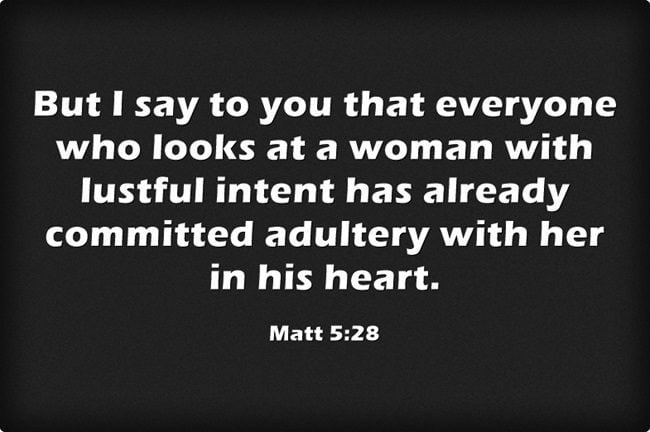
But-I-say-to-you-that

A Biblical Definition of Lust

I like what C.S. Lewis wrote many years ago. He wrote “If you look upon ham and eggs and lust, you have already committed breakfast in your heart.” This is a very good, biblical definition of lust in the heart. If you covet something or someone, that is lusting in the heart. Exodus 20:17 lists the tenth commandment as “You shall not covet your neighbor’s house. You shall not covet your neighbor’s wife, or his male or female servant, his ox or donkey, or anything that belongs to your neighbor” so lust is not just about looking at someone of the opposite sex, or for some, looking at someone with lust of the same sex, it is coveting what you don’t have. It is a passionate desire to have what someone else has.

What Lust Can Lead To

David let his lust carry him away as “One evening David got up from his bed and walked around on the roof of the palace. From the roof he saw a woman bathing. The woman was very beautiful” (2nd Sam 11:2) and so he lusted after her in his heart. This led to adultery and later, to the murder of Bathsheba’s husband, Uriah. This is why James wrote that “after desire (or lust) has conceived, it gives birth to sin; and sin, when it is full-grown, gives birth to death” (1:15). The proverbs say “Do not lust in your heart after her beauty or let her captivate you with her eyes” (6:25). Jesus said that it was “out of the heart come evil thoughts–murder, adultery, sexual immorality, theft, false testimony, slander” (Matt 15:19). Solomon understood this connection, writing that as a man “thinks within himself, so he is” (23:7a). You can commit adultery without ever committing the physical act. Jesus said that “that everyone who looks at a woman with lustful intent has already committed adultery with her in his heart” (Matt 5:28) and of course the same thing applies to women.

A Biblical Definition of Love

There are so many places that define love in the Bible that it will be hard to select only a few. Paul writes that “Love is patient and kind; love does not envy or boast; it is not arrogant or rude. It does not insist on its own way; it is not irritable or resentful; it does not rejoice at wrongdoing, but rejoices with the truth. Love bears all things, believes all things, hopes all things, endures all things” (1st Cor 13:4-7). The love of God is not about feelings or words but “God shows his love for us in that while we were still sinners, Christ died for us” (Rom 5:8). Love is a verb; it is what you do more than what you say or what you think. We know that Jesus did not feel like taking on all of the sins of humanity, but His great love for us on the cross proved what the love of God is like. He died for us while we were still wicked sinners and His enemies (Rom 5:8, 10).

Conclusion

The differences between love and lust are that we don’t covet what we don’t have. We shouldn’t covet (lust after) our neighbor’s spouse or their goods (Ex 20:17). Love, on the other hand, “does no wrong to a neighbor; therefore love is the fulfilling of the law” (Rom 13:10) and this means “You shall love your neighbor as yourself” (Matt 19:19) but above all “You shall love the Lord your God with all your heart and with all your soul and with all your mind” (Matt 22:37). The difference for believers is that we are told “Love your enemies and pray for those who persecute you” (Matt 5:44). The greatest display of love was not what Jesus felt or what God feels but it was revealed at Calvary. Jesus said “Greater love has no one than this, that someone lay down his life for his friends” (John 15:13) and that’s just what He did. Lust harms, love sacrifices.

—————-

**By Jack Wellman at what Christians wat to know / Photo by Mark Stebnicki at Pexels

Popular Articles

A Clear Gospel Message

The Abortion Debate

Human Trafficking / Child Abuse

The True Gift

True or False Conversion

Once Saved Always Saved?

The Judge – Upholding what is right comes at a cost

What is a True Christian or Believer

Prayer Speaking to God

Forgiving Others as God has Forgiving you

Prayer for forgiving others

Living Right Today

Shall We Sin So Grace May Abound?

Sin. It’s something most of us would rather not think about. For the unsaved person, sin is something that separates them from God, due to his perfect holiness. Yet for the Christian, their sin has been paid for. When God looks at them, he doesn’t see their sin, but instead righteousness.

How can that be? The answer is Jesus.

Jesus took the place of us on the cross. He paid the price of our sins with his very life and his holiness was accounted to us (2 Corinthians 5:21). God made it possible for us to be with him through the blood of his holy Son. Instead of condemnation, we receive grace. Instead of rightful punishment for our sins, God sees us as his sons and daughters. Indeed, this is the miracle of the Christian faith for all who believe.

But this brings up an important question. If our sin is already paid for, why should we stop sinning? In fact, doesn’t the vastness of our sin just make his grace more beautiful? Shall we sin that grace may abound?

Shall We Continue in Sin?

Paul demolished this dangerous line of thought in Romans 6. Christ died to free us from sin, not enable us to sin. When Jesus died, he was releasing us from our bondage to sin, because that is what sin is — slavery. Sin is what separates us from God. It’s damaging, and for the unredeemed, it is damning (Romans 6:23).


“For we know that our old self was crucified with him so that the body ruled by sin might be done away with, that we should no longer be slaves to sin — because anyone who has died has been set free from sin.” – Romans 6:6-7 

So, shall we then continue in sin that grace may abound? Paul replies with a resounding “God forbid” (Romans 6:2). To desire to continue in sin shows a misunderstanding of this abundant grace and a contempt for Jesus’ sacrifice. Either we believe what God says is true or we don’t. Either we take him at his word when he equates sin to death, or we do not believe him at all (Ephesians 2:1).

What is the point of the Christian faith if we get to pick and choose what we want to believe? Do we think God is that small, insignificant or somehow uninformed? Do we trifle with the very thing that God sent his Son to save us for? Do we misuse the grace that he gifted us with in his death and resurrection? Surely not.

Sin and Grace

Grace is a gift. Forgiveness of sins and his salvation are gifts. Grace is not, however, a license to sin. Throughout the Bible, fathers of our faith are seen distressed, tormented by their sin.

Consider David after his adultery with Bathsheba or Peter after denying Christ (Psalms 51:17 and Matthew 26:75). They did not discount their sin as simply something atoned for. Just because the Christian’s sin is paid for by Jesus, sin is still damaging to the believer and their relationship with God.

When David tried to ignore his sin, his “bones wasted away through my groaning all day long” (Psalms 32:3). He did, however, find freedom in confession.


“Then I acknowledged my sin to you and did not cover up my iniquity. I said, ‘I will confess my transgressions to the LORD’ – and you forgave the guilt of my sin.” – Psalms 32:5 

A Christian who pursues sin despite claiming Christ as their Savior is living outside the blessing and fullness of the relationship that comes with an obedient life. We cannot equate grace with freedom to sin. Instead, we should be thankful that grace provides freedom from sin and its eternal consequences.

Doesn’t that kind of grace make you want to obey the one who set you free?

What Is Sanctification?


“If you love me, you will obey my commandments. I will ask the Father, and he will give you another helper who will be with you forever. That helper is the Spirit of Truth. The world cannot accept him, because it doesn’t see or know him. You know him, because he lives with you and will be in you.” – John 14:5-17

The Christian’s spiritual journey doesn’t begin and end at a one-time prayer of confession. When we truly see our need for God, his grace and Christ’s sacrifice for us, we will want to obey him. Why? Because we will overflow with love and gratitude that the God of all creation cares enough to save us from ourselves. And if we love him, we trust him when he calls us to higher things. This pursuit toward Christ, and refining of our faith, is sanctification. Sanctification is progressing toward Christlikeness. A Christian cannot pursue both Christlikeness and sin.

So Christians, remember his abounding grace toward you. Turn from sin and embrace your new life as a vessel of light. You are dead to sin, alive in Christ.

Now go live it.

———

***By Lizzie Hoover at Grand Canyon University: gcu.edu / Photo by Mike Waters at Joyful Toons

How to Start a House Group Fellowship

The really good news is that, to start a house church, you can lay down the burdens of planning how to cope with buildings, programs, and outreach strategies. You don’t have to be an impressive leader (though you probably will have some leadership gifts). To start a house church, you simply need to open your home to friends and neighbours and take things one step at a time.

Pray First!

The first step to starting a house church is to pray. House-church ministry must be birthed in prayer. Though it is a simple step, without prayer and God’s leading, we invite trouble. Starting a house church cannot be just a good idea; it must be a God idea. If you feel that you are called to start a house church, gather a few like-minded people together and begin to pray so that you can receive a strategy from God. Many house churches have false starts that are directly linked to a lack of prayer.

Taking time to pray gives God the opportunity to work in our hearts and purify our motives. When house churches start up because of a reaction to something we don’t like about the established church, the house church’s identity is built from rebellion and discord. Healthy house churches, on the contrary, must begin with God’s leading and a desire to reach those who don’t know Jesus. What a person sows, the Bible teaches us, he also reaps. Therefore, if you begin a house church because of an offense toward an existing church or leader, you will sow the seeds of fault-finding and pride in the church you are creating.

Along with prayer, it is also important to look to the local Christian community’s leaders for spiritual guidance and advice as you launch a new church. From day one of the Lancaster Micro-Church Network, we have cultivated relationships with established believers in our local community and beyond to answer questions and explain to them the concept of micro-church. A wise Bible teacher once said, “Lone rangers get shot out of the saddle.” We agree. Healthy house-church movements are not exclusive groups who refuse to be accountable. Vibrant micro-church networks are spiritually connected to leadership in the Body of Christ.

Know Whom You Are Called to Reach

Every micro-church should know whom they are called to reach. Here’s a great suggestion from Tony and Felicity Dale, who together started a successful network of house churches in Texas:

Draw together people from your circle of influence. We had a number of business associates who were not Christian, but whom we had come to know pretty well over a period of months or years. We asked a dozen of them to join us in a study of business principles while enjoying pizza in our home, using the book of proverbs as our textbook.
There were no rules to our discussion; everybody’s opinion was valid and there was no such thing as a wrong answer. Gradually we introduced prayer and worship and over the course of a year, every one of them became a Christian. They formed the nucleus of our original house church.

When the first micro-church in the Lancaster Micro-Church Network started in our (Larry’s) home a few years ago, we asked God for pre-Christians or new believers to join us—we also asked for labourers to help in the endeavour. However, we ran into some immediate problems. First of all, lots of believers wanted to come and check it out. Some of these Christians were looking for the latest Christian fad. They liked the idea that the micro-church met on a Wednesday, not a Sunday, and that it met in a living room, not a sanctuary.

But we were not starting something new for the sake of starting something new! Since we had a mandate from the Lord to reach new believers, we asked inquiring Christians not to come to our meetings. Having too many older Christians in the group would make the pre-Christians feel uncomfortable.

Jim Petersen, in his book Church Without Walls, clearly describes what can happen if a “migratory flock from neighbouring churches” invades a new church simply because they are curious:

I have a friend who was a part of a team that set out to start a church. The congregation was divided into house churches, each of which was assigned an elder who helped shepherd the members of that house church. Centralised activities were kept at a minimum for the sake of keeping people free to minister to their families and unbelieving friends.

The weekly meetings were dynamic. I will never forget the first one I visited. People of all sorts were there, from men in business suits to ponytails. Many were new believers. The Bible teaching was down to earth, aimed at people’s needs. I loved it.

So did most everyone else who visited. The word got around and soon the migratory flock from neighbouring churches came pouring in. Their needs consumed the energies of the leaders of this young church. Their wants gradually set the agenda. The inertia of the traditions of these migrants engulfed this very creative effort and shaped it accordingly.

So what’s the problem, we ask? The problem is that the vision that original team had for taking the church into society through the efforts of every believer was frustrated.

My wife and I knew that the vision the Lord had given to us to reach a new generation had to be safeguarded in the early days of our new micro-church network, and the young leaders of our network wisely set clear perimeters. They asked God to bring pre-Christians, new believers, and labourers—and the Lord honoured their request.

The Size of the House Church Matters

Quite soon, my wife and I had a second problem in our home-based micro-church. The pre-Christians attending invited their friends, and within 6 months of starting, we had 50 people in our living room on a given night. It was way too large!

It is wise to keep the number of people to between 6 and 12. From my experience, groups less than 6 strong tend to dwindle and be lacklustre because of the decreased number of relationships and interactions possible. However, groups over 12 tend to lose intimacy and every-member participation. It is perhaps not surprising, then, that rapid church planting movements today reproduce small house churches numbering between 10 and 30 people.

Frequency of Meeting

House churches should meet at least once a week to maintain a sense of connectedness. Again, though, we must emphasise the importance of flexibility. Some micro-churches meet at the same location every week, while others move the meeting place by rotating turns in members’ houses. Some groups meet more frequently, others less often. Some house churches meet during the week, others on weekends.

It is crucial that meeting together is an expression of the members’ desire to build community together—not just a religious duty to add more meetings to their already busy lives. If gathering together is done around food and for the purpose of fellow-shipping, it is more natural. Choose times that are convenient for everyone involved and then make an effort to connect with the other members (even just by phone or e-mail) outside of official meeting times. Building a spiritual family takes more than an hour or two one night a week!

Meeting Components

One thing is certain about house-church meetings: they should not be a smaller scale duplicate of a typical Sunday morning meeting. A house-church gathering should not look like an “escaped meeting captured by a living-room,” as one young man described house churches that do little more than replicate and repeat the traditional church service format: worship, teaching, prayer.

Instead, we have learned that there are often four basic components to a micro-church gathering: eating, meeting, small groups, and “the meeting after the meeting.

Although eating (usually a meal) is one of the elements of a house-church gathering, sometimes there may not be food. One week the house church may help someone trim their shrubs and have a time of prayer afterwards, and the next week they may come together for a whole smorgasbord of worship, prayer, teaching, and fellowship. Every week should be fresh and informal as people meet to discuss the life of Jesus and life with Jesus.

—Larry Kreider and Floyd McClung; excerpted from their book Starting a House Church (Regal Publishers, 2007) / Picture by Fauxes at pexels / By Small Groups