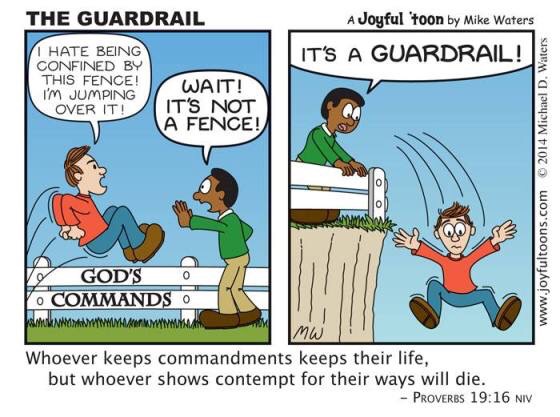
Sin. It’s something most of us would rather not think about. For the unsaved person, sin is something that separates them from God, due to his perfect holiness. Yet for the Christian, their sin has been paid for. When God looks at them, he doesn’t see their sin, but instead righteousness.
How can that be? The answer is Jesus.
Jesus took the place of us on the cross. He paid the price of our sins with his very life and his holiness was accounted to us (2 Corinthians 5:21). God made it possible for us to be with him through the blood of his holy Son. Instead of condemnation, we receive grace. Instead of rightful punishment for our sins, God sees us as his sons and daughters. Indeed, this is the miracle of the Christian faith for all who believe.
But this brings up an important question. If our sin is already paid for, why should we stop sinning? In fact, doesn’t the vastness of our sin just make his grace more beautiful? Shall we sin that grace may abound?
Shall We Continue in Sin?
Paul demolished this dangerous line of thought in Romans 6. Christ died to free us from sin, not enable us to sin. When Jesus died, he was releasing us from our bondage to sin, because that is what sin is — slavery. Sin is what separates us from God. It’s damaging, and for the unredeemed, it is damning (Romans 6:23).
“For we know that our old self was crucified with him so that the body ruled by sin might be done away with, that we should no longer be slaves to sin — because anyone who has died has been set free from sin.” – Romans 6:6-7
So, shall we then continue in sin that grace may abound? Paul replies with a resounding “God forbid” (Romans 6:2). To desire to continue in sin shows a misunderstanding of this abundant grace and a contempt for Jesus’ sacrifice. Either we believe what God says is true or we don’t. Either we take him at his word when he equates sin to death, or we do not believe him at all (Ephesians 2:1).
What is the point of the Christian faith if we get to pick and choose what we want to believe? Do we think God is that small, insignificant or somehow uninformed? Do we trifle with the very thing that God sent his Son to save us for? Do we misuse the grace that he gifted us with in his death and resurrection? Surely not.
Sin and Grace
Grace is a gift. Forgiveness of sins and his salvation are gifts. Grace is not, however, a license to sin. Throughout the Bible, fathers of our faith are seen distressed, tormented by their sin.
Consider David after his adultery with Bathsheba or Peter after denying Christ (Psalms 51:17 and Matthew 26:75). They did not discount their sin as simply something atoned for. Just because the Christian’s sin is paid for by Jesus, sin is still damaging to the believer and their relationship with God.
When David tried to ignore his sin, his “bones wasted away through my groaning all day long” (Psalms 32:3). He did, however, find freedom in confession.
“Then I acknowledged my sin to you and did not cover up my iniquity. I said, ‘I will confess my transgressions to the LORD’ – and you forgave the guilt of my sin.” – Psalms 32:5
A Christian who pursues sin despite claiming Christ as their Savior is living outside the blessing and fullness of the relationship that comes with an obedient life. We cannot equate grace with freedom to sin. Instead, we should be thankful that grace provides freedom from sin and its eternal consequences.
Doesn’t that kind of grace make you want to obey the one who set you free?
What Is Sanctification?
“If you love me, you will obey my commandments. I will ask the Father, and he will give you another helper who will be with you forever. That helper is the Spirit of Truth. The world cannot accept him, because it doesn’t see or know him. You know him, because he lives with you and will be in you.” – John 14:5-17
The Christian’s spiritual journey doesn’t begin and end at a one-time prayer of confession. When we truly see our need for God, his grace and Christ’s sacrifice for us, we will want to obey him. Why? Because we will overflow with love and gratitude that the God of all creation cares enough to save us from ourselves. And if we love him, we trust him when he calls us to higher things. This pursuit toward Christ, and refining of our faith, is sanctification. Sanctification is progressing toward Christlikeness. A Christian cannot pursue both Christlikeness and sin.
So Christians, remember his abounding grace toward you. Turn from sin and embrace your new life as a vessel of light. You are dead to sin, alive in Christ.
Now go live it.
———
***By Lizzie Hoover at Grand Canyon University: gcu.edu / Photo by Mike Waters at Joyful Toons
“For my thoughts are not your thoughts, neither are your ways my ways,” declares the Lord. “As the heavens are higher than the earth, so are my ways higher than your ways and my thoughts than your thoughts. ~ Isaiah 55:8-9
The total sovereignty of God over all people and circumstances, is a matter in which many believers remain in doubt. They may give lip-acknowledgment to it, but they don’t believe it “works” in the situations of daily life. Yet the Scriptures are full of examples of how God worked sovereignly on behalf of His people – and often in the most unlikely ways.
Many of us are familiar with the obviously miraculous ways in which God worked on behalf of His people – such as the deliverance of the Israelites from Egypt etc. But we have often missed seeing the greater miracles by which God turned the tables on Satan when Satan attacked God’s people.
The case of Joseph is a classic. God had a plan for that eleventh son of Jacob to make him the second ruler in Egypt by the time he was thirty. Joseph was a God-fearing lad and therefore he was hated by Satan. And so Satan instigated his elder brothers to get rid of him. But God ensured that they didn’t take Joseph’s life. They managed, however, to sell him off to some Ishmaelite traders. But where do you think those traders took Joseph? To Egypt, of course!
That was the fulfilment of Step One in God’s plan! In Egypt, Joseph was bought by Potiphar. This too was arranged by God. Potiphar’s wife was an evil woman. Taking a fancy to Joseph, she tried to entice him again and again. Finally when she found that she could not succeed, she accused Joseph falsely and had him cast in jail. But who do you think Joseph met in the jail? Pharaoh’s cupbearer! God had arranged for Pharaoh’s cupbearer also to be jailed at the same time so that Joseph could meet him. That was Step Two in God’s plan.
God’s third step was to allow Pharaoh’s cupbearer to forget about Joseph for two years. “Yet the chief cupbearer did not remember Joseph, but forgot him. It happened at the end of two full years that Pharoah had a dream…. Then the chief cupbearer spoke to Pharaoh…(Genesis 40:23; 41:1,9). That was the time, according to God’s time-table, for Joseph to be released from prison. Psalm 105:19, 20 says, “Until the time that His word came to pass, the word of the Lord tested him. Then the king sent and released him and set him free.” Joseph was now 30 years old.
God’s time had come. And so God gave Pharaoh a dream. And God reminded the cupbearer also of Joseph as the interpreter of his dream. Thus Joseph came before Pharaoh and became the second ruler in Egypt. God’s timing of events in Joseph’s life couldn’t have been more perfect! We would never have thought of arranging things the way God did. If we had the power to plan Joseph’s life, we would probably have prevented people from doing him any harm. But the way God did it was better. It’s a far greater miracle when the evil that people do to us is turned to fulfill God’s purposes for us! God takes great delight in turning the tables on Satan, so that all things work together for the good of His elect.
Let us look at one more example from the Old Testament, so that our minds can be firmly established in this truth. In the book of Esther, we read of how God rescued the Jews from being slaughtered as a race. But it is amazing to see how God did it – through one small incident – that the king could not sleep one night. Haman and his wife had been plotting one night to get the king’s permission to hang Mordecai on a gallows the next morning, as a prelude to destroying all the Jews.
But while Haman and his wife were making their wicked plans, God was working on behalf of Mordecai too. “The Keeper of Israel never slumbers or sleeps.” (Psalm 121:4). God prevented the king from sleeping that night, “During that night the king could not sleep so he gave an order to bring the book of records, the chronicles, and they were read before the king” (Esther 6:1). The king listened to his nation’s history for many hours, until the day began to break. Then the reading came to the place where it was recorded that Mordecai had once saved the king from being assassinated. The king asked his servants what honour had been bestowed on Mordecai for this, and they replied that nothing had been done. God’s timing of events was again perfect. At that very moment Haman walked in, planning to ask the king for permission to hang Modecai. Before Haman could open his mouth, the king asked Haman what he thought could be done for one whom the king desired to honour. Haman, conceited man that he was, thought that the king was referring to him, and so suggested a great parade of honour for such a man. “Go and do that for Mordecai, quickly,” the king said.
How wonderfully our God can turn the tables on Satan. Haman finally hung on the very same gallows that he had made for Mordecai. As the Bible says, “He who digs a pit (for another) will fall into it (himself). And he who rolls a stone (at another) will find the stone rolling back (to crush him)” ( Proverbs 26:27). Haman, in this story, is a type of Satan who is always planning some evil against us. God won’t stop him, because God has a far better plan. He wants to turn the tables on Satan. The pit that the Devil digs for us will be the one that he himself falls into finally. Zephaniah 3:17 says (in one translation) that God is silently planning for us in love, all the time.
While Mordecai was sleeping peacefully that night, quite ignorant of all the wicked plans that Haman and his wife were making against him, God was also planning to protect Mordecai. So Mordecai could have slept just as peacefully, even if he had known of Haman’s wicked plans. Why not? If God was on his side, who could be against him?
Once we have seen the sovereignty of God, we will stop blaming people for anything. We’ll no longer be afraid of Satan, fearing that he might harm us in some way. We won’t be afraid of sickness or disease or anything else in this world.
—————
**Copyright – Zac Poonen. No changes whatsoever are to be made to the content of the article without written permission from the author at cfcindia.com / Photo by Johannes Plenio at pexels
All of us come across others’ who say things so well that there is simply nothing left to add. Nancy DeMoss Wolgemuth created just such a piece in the form of a bookmark which you can download here, from her series Brokenness: The Heart God Revives
Proud people focus on the failures of others. Broken people are overwhelmed with a sense of their own spiritual need.
Proud people have a critical, fault-finding spirit; they look at everyone else’s faults with a microscope but their own with a telescope. Broken people are compassionate; they can forgive much because they know how much they have been forgiven.
Proud people are self-righteous; they look down on others. Broken people esteem all others better than themselves.
Proud people have an independent, self-sufficient spirit. Broken people have a dependent spirit; they recognize their need for others.
Proud people have to prove that they are right. Broken people are willing to yield the right to be right.
Proud people claim rights; they have a demanding spirit. Broken people yield their rights; they have a meek spirit.
Proud people are self-protective of their time, their rights, and their reputation. Broken people are self-denying.
Proud people desire to be served. Broken people are motivated to serve others.
Proud people desire to be a success. Broken people are motivated to be faithful and to make others a success.
Proud people desire self-advancement. Broken people desire to promote others.
Proud people have a drive to be recognized and appreciated. Broken people have a sense of their own unworthiness; they are thrilled that God would use them at all.
Proud people are wounded when others are promoted and they are overlooked. Broken people are eager for others to get the credit; they rejoice when others are lifted up.
Proud people have a subconscious feeling, “This ministry/church is privileged to have me and my gifts”; they think of what they can do for God. Broken people’s heart attitude is, “I don’t deserve to have a part in any ministry”; they know that they have nothing to offer God except the life of Jesus flowing through their broken lives.
Proud people feel confident in how much they know. Broken people are humbled by how very much they have to learn.
Proud people are self-conscious. Broken people are not concerned with self at all.
Proud people keep others at arms’ length. Broken people are willing to risk getting close to others and to take risks of loving intimately.
Proud people are quick to blame others. Broken people accept personal responsibility and can see where they are wrong in a situation.
Proud people are unapproachable or defensive when criticized. Broken people receive criticism with a humble, open spirit.
Proud people are concerned with being respectable, with what others think; they work to protect their own image and reputation. Broken people are concerned with being real; what matters to them is not what others think but what God knows; they are willing to die to their own reputation.
Proud people find it difficult to share their spiritual need with others. Broken people are willing to be open and transparent with others as God directs.
Proud people want to be sure that no one finds out when they have sinned; their instinct is to cover up. Broken people, once broken, don’t care who knows or who finds out; they are willing to be exposed because they have nothing to lose.
Proud people have a hard time saying, “I was wrong; will you please forgive me?” Broken people are quick to admit failure and to seek forgiveness when necessary.
Proud people tend to deal in generalities when confessing sin. Broken people are able to acknowledge specifics when confessing their sin.
Proud people are concerned about the consequences of their sin. Broken people are grieved over the cause, the root of their sin.
Proud people are remorseful over their sin, sorry that they got found out or caught. Broken people are truly, genuinely repentant over their sin, evidenced in the fact that they forsake that sin.
Proud people wait for the other to come and ask forgiveness when there is a misunderstanding or conflict in a relationship. Broken people take the initiative to be reconciled when there is misunderstanding or conflict in relationships; they race to the cross; they see if they can get there first, no matter how wrong the other may have been.
Proud people compare themselves with others and feel worthy of honor. Broken people compare themselves to the holiness of God and feel a desperate need for His mercy.
Proud people are blind to their true heart condition. Broken people walk in the light.
Proud people don’t think they have anything to repent of. Broken people realize they have need of a continual heart attitude of repentance.
Proud people don’t think they need revival, but they are sure that everyone else does. Broken people continually sense their need for a fresh encounter with God and for a fresh filling of His Holy Spirit.
—————-
**Article by Searching4Wisdom @ Biblical Perspectives on Narcissism.com / Photo by Pixabay
Be sober, be watchful: your adversary the devil, as a roaring lion, walketh about, seeking whom he may devour: whom withstand stedfast in your faith, knowing that the same sufferings are accomplished in your brethren who are in the world. ~ 1 Peter 5:8-9
That no advantage may be gained over us by Satan: for we are not ignorant of his devices. ~ 2 Corinthians 2:11
Resist the Devil
These two scriptural passages indicate to us how full of evil devices Satan is. His basic work is to camouflage whatever he does so that people will not know it is his doing! He even fashions himself into an angel of light (2 Corinthians 11:14). All his works are done under the cover of deceit. When he speaks a lie, he speaks of his own: for he is a liar and he always lies (John 8:44). Of all that he has ever done, he has never willingly and openly acknowledged anything as his work. If he were to make a public report of his works, probably nobody would want them; everyone would probably resist them. For this reason, he always disguises his work in a multitude of ways.
The Work of Satan
Satan’s works are manifold. In order for a Christian to walk well before God, he must learn how to resist Satan. In order to do that, he must discern what is the work of Satan. According to the judgment of the Bible, many so-called natural things are actually Satanic works. From a human point of view we may consider something to be incidental, natural, or circumstantial, but the Bible distinctly labels it as the work of the devil. If we are to follow a straight course, God’s children must not be ignorant of the devices of Satan—how full of wiles he is, how pretentious and deceptive. We should recognize him in order to resist him.
The Work of Satan in the Human Mind
Let us now mention a few of Satan’s devices so that we may resist him and overcome him before the Lord. “For the weapons of our warfare are not of the flesh, but mighty before God to the casting down of strongholds; casting down imaginations, and every high thing that is exalted against the knowledge of God, and bringing every thought into captivity to the obedience of Christ” (2 Corinthians 10:4-5).
Satan surrounds man with strongholds so as to prevent him from obeying Christ. The special field of his work is found in man’s mind or thought life. Oftentimes man is bombarded with speculations or imaginations which are adverse to the obedience of Christ. Paul says the weapons of our warfare against these are not of the flesh. These imaginations must first be destroyed before we can bring our thoughts into captivity to the obedience of Christ.
The sphere of Satan’s operation is in man’s thought life. He will inject a thought, an imagination, which appears to be your own. Under this deception, you accept it and use it as if it were yours, though in actuality it is his. Do remember that many things in the life of a Christian begin with speculations or imaginations. Many sins are first committed in the imagination of the mind. Many unpleasantnesses among brothers and sisters arise from these fancies.
Then there are those sudden thoughts. Sometimes a thought will flash into one’s mind that a certain brother is wrong. Many of God’s children do not recognize such thoughts as the work of Satan. A person may consider such a thought as his own and take it as true, thinking that the brother really is wrong. And yet, this is not true. It is Satan who has put the thought into his mind. How is he to resist the devil? He must say, “I do not want this thought. I return it to you, Satan.” Should he accept it, it will become his own thought. It is Satan’s at the start, but it will become his if he keeps it.
Christians need to know what Satanic temptation is. Satanic temptation enters mainly, if not exclusively, in the form of thought. When Satan tempts people, he does not attach a label saying, “This is Satanic temptation!” If people knew it was of Satan they would resist it. No, he sneaks in stealthily without causing a ripple. All his temptations are formulated so as not to easily arouse the Christians. He does not want them to suspect him; he would rather have them sleep on. So he surreptitiously injects a thought into their mind. Once they accept it, it has become a foothold for him.
This is why the children of God must learn how to resist inordinate thoughts. However, they also should be careful lest they become overly attentive. Any excess in this respect will cause further confusion of the thoughts, causing them to fall further into the wiles of the enemy. If one is concentrating on his thoughts, his eyes will not be focusing on the Lord. We must, indeed, resist improper thoughts, yet we should not be wholly occupied with our thoughts.
I would like to cry aloud that over these years I have seen two extremes: some people exercise no restraint in their thoughts, others are totally taken up with dealing with their thoughts. The latter are just as deceived by Satan as the former. Further, they are likely candidates for a nervous breakdown. So we need to maintain the right balance. We should not allow Satan to tempt us by injecting his thoughts; neither should we be engrossed in how to deal with our thoughts. If we are constantly taken up with dealing with our thoughts, then we have fallen into Satan’s temptation, for, instead of having our eyes on the Lord, they are on our thoughts.
Satanic thoughts can be quite easily withstood. There is a saying frequently quoted by many servants of the Lord that goes, “You cannot forbid a bird to fly over your head, but you certainly can forbid it to make a nest in your hair.” Do remember, then, that though you cannot prohibit many thoughts from passing through your mind, you can prohibit them from nesting in you. As a thought flashes through you, you may thrust it away by simply saying, “I do not want it. I will not accept it. I reject it.” Then you will see that it is thrown out.
Many of God’s children have great difficulty with their thoughts. They cannot easily control them. Of the many letters I have received over these past years, the one question most frequently asked is, “How can I control my thoughts?” Some confess that they find it especially difficult to control their thoughts during their prayer time. At this point there is something I would like to say briefly. “Finally, brethren, whatsoever things are true, whatsoever things are honorable, whatsoever things are just, whatsoever things are pure, whatsoever things are lovely, whatsoever things are of good report; if there be any virtue, and if there be any praise, think on these things” (Phil. 4:8), the Bible tells us. Think on these things! God’s children should learn to engage their thoughts in positive thinking. The more they use their mind positively, the less their thoughts will be out of control. Many are not able to control their thoughts because they do not think; they are passive in their thought life. This gives Satan the opportunity to insert some of his many ready-made thoughts into their minds.
Satan will not find it so easy to inject his thought into your mind if you learn to use your mind for thinking on things spiritual, good, righteous, holy, peaceful, and loveable. When your mind is positively engaged and your thoughts are not idle, Satan has no opportunity. But if a Christian’s mind is unoccupied and idle, then that passive, ungirded mind of his is open to Satanic infiltration.
Because of this, God’s children ought to exercise their minds as they exercise their bodies. This will prevent the intrusion of Satanic thoughts. Learn to recognize what thoughts are unclean, divisive, and slanderous, and then learn to resist them as soon as they are discovered to be of the enemy. Many thoughts are distinctly Satanic and therefore can be easily rejected. Some thoughts, though, are quite subtle and therefore not so easily repudiated. Nonetheless, we must learn to resist all of them.
Satan is neither omniscient nor omnipresent. He is, however, acquainted with many things, for through his evil spirits—the sinful angels—he has spread an intelligence network throughout the earth. When we are idle, Satan easily puts something that is known to him, but not to us, into our thought. He injects the intelligence that his secret service has obtained into our thoughts. He makes us fancy something, imagine something, and thus thrusts his intelligence into our mind. As soon as we ponder it and accept it, it becomes real to us. God’s children, therefore, must reject all communications from Satan, even if such communications do shed light on things. We should refuse to know anything that does not come to our knowledge by revelation received through prayer.
A child of God must not be curious or nosy. If he is not, he will escape many Satanic thoughts. If he is, Satan will supply him endlessly with some of the many things he knows. The Christian at first may think that such knowledge is beneficial. However, if he continues to accept these thoughts, he will soon become a pawn in Satan’s hand. Satan will employ the Christian’s mind to do his work. It is for this reason that one must resist all causeless thoughts. Whenever a thought about another brother’s fault flashes into one’s mind, if it comes from the thought of the mind and not from the consciousness of the Spirit, it should be rejected. If it is accepted, it will eventually become a personal conviction. One who thinks a brother has done him wrong will soon reckon it to be real. Consequently, he will break fellowship with his brother.
Unless these sudden thoughts are cut off at the beginning, they will get out of hand afterward. When Satanic temptations first invade the mind, they are relatively easy to deal with; but once they become “facts” in the mind, they are most difficult to get rid of. For this reason we must deal with thoughts. We must reject all unclean thoughts lest we sin. We must actively use our mind so as not to live a loose and dissipated life. Under God’s light, we shall see that many sins come through receiving temptations in the thought life.
Let me reiterate: after a thought is first resisted, the matter is considered closed. When the thought comes the second time, it should be ignored. In other words, when a thought first comes to you, resist it by faith, believing that it has fled away. Should it present itself the second time, it comes as a lie, not the truth. Therefore, you must reckon it as false and declare that you have already resisted it. Take this position until the thought flees. If you acknowledge the returned thought as true, you shall soon find it so attached to you that you can hardly throw it off. Many defeats may be attributed to this error. If you resist the devil, he will flee from you. This is the word of the Lord and it is totally trustworthy. Whatever Satan says is undependable. The Lord says, “Resist the devil, and he will flee from you” (Jas. 4:7). Therefore, that which comes back again must be a fake and should be totally discredited.
Why are the minds of so many Christians confused? It is because they are always resisting. “Resist the devil, and he will flee from you,” says the Bible. Resist him once, and he will flee. You ought to believe that he has fled away. You do not need to resist him many times. Simply believe that he has fled, for this is in accordance with God’s Word. Whatever then comes back is not true. You can well afford to ignore it, and, if you do, it will soon disappear. It lurks just outside the door, trying to peep in; if you reckon it as true, it will immediately step in. So, the basic principle is: resist the first time, ignore the second time. If a second time indeed comes, you do not even need to resist; all that is necessary is to not pay the slightest attention. To resist the second time is to discredit the first resistance; to resist the third time is to refute the first and the second resistances, and so on. Each new resistance means one more distrust of your former resistance. Because you do not believe what the Lord has said, “Resist the devil, and he will flee from you,” you resist to the hundredth time. You will be occupied with resisting from dawn to dusk. The more you think, the more confused you become. The more you use your mind, the more severely you suffer. Therefore, do not resist foolishly. Simply believe that once resisted the devil will flee.
———
**By Watchman Nee from his book “Love One Another” / Picture by Knowledge Media
In Ezekiel 16:49-50, God describes the real sins of Sodom that led to the destruction of that city (in Genesis 19). Most of us have always associated Sodom with sodomy (homosexuality) and other sexual sins. But sexual sin was the ultimate result of a way of life. What was it that led them into such depths of evil? Here we are told that Sodom’s sins were actually:
1.Pride
2. Laziness
3. Gluttony (love of good food)
4. Neglecting the poor and needy
These were the reasons why God wiped out that city. It is interesting to note that God does not even mention their sexual sin. Sexual sin in Sodom was the result of their lazy, comfortable life-style. What can we learn from this? That there is a close connection between:
Pride and sexual sin.
Laziness and sexual sin.
Gluttony and sexual sin.
A lack of concern for other people and sexual sin.
Consider just these four areas. Many of you who are young have to admit that you are finding it very difficult to overcome your sexual passions. That is an extremely difficult area. But why not begin by overcoming in these four easier areas? You may, then, find it easier to overcome in the sexual area.
Begin first of all, by humbling yourself in all situations. Avoid all arrogance.
Then begin to be hard-working and diligent in whatever you do.
Then try fasting – avoiding food – once in a while.
And fourthly, begin to think a little more about the needs of people around you and see how you can help them.
Try this prescription for one year and you may discover that overcoming your sexual passions becomes easier. We cannot overcome any sin without grace from God – but He gives His grace only to the humble; and He helps only those who are kind and helpful to others.