NEW LOCK-DOWN RULES FOR CHRISTIANS, AS YOU OBSERVE THE GOVERNMENT RULES, ALSO TRY TO OBSERVE HEAVENLY RULES AS WELL:
🔹 Wash your heart with Christ’s blood. (Psalm 73:1) 🔹 Keep a social distance from evil. (Job 28:28 ) 🔹 Avoid the crowd of wickedness and wicked men. (Psalm 1:1) 🔹 Cover your mind from being infected from the sneeze of sin and hatred. (Leviticus 19:17) 🔹 Do not shake hands with abomination. (Deuteronomy 25:16) 🔹 Do not hug or embrace hear say and false teachings. (2 Peter 2:1) 🔹 Be safe so that you will be saved. (Jeremiah 17:14) 🔹 Sanitise your life with the Word of God. (Psalm 1:2) 🔹 In case you notice any symptoms of sin, call the helpline of Christ in PRAYER. (Jeremiah 33:3) 🔹 Always remember to boost your spiritual immunity with Faith and the Power of the Holy Spirit. (Jude1:20)
“Indeed, all who desire to live a godly life in Christ Jesus will be persecuted…” 2 Timothy 3:12
Jesus said in John 16:33 “In the world you will have tribulation. But take courage; I have overcome the world”. He never promised that we would escape tribulation – whether small tribulations or the great one. But He did say that we could overcome even as He overcame. He is far more interested in making us over-comers than in saving us out of tribulation, because He is far more interested in our character than in our comfort. Neither did Jesus ever say that escaping the great tribulation was a reward for faithfulness, as some teach. On the contrary, He said that those who forsook everything to follow Him would have even more tribulations than others who didn’t follow Him (Mark.10:30). When He prayed to His Father for His disciples, He said, “I do not ask Thee to take them out of the world, but to keep them from the evil.” (John.17:15). He did NOT want His disciples to be raptured out of the world at that time, just because they were going to face tribulation.
” Perseverance is a great virtue that is emphasised throughout the New Testament.” In the 3rd-century when Christians were being thrown to the lions in the Roman amphitheatres and being burnt at the stake in different parts of the Roman empire, the Lord did not rescue them from such tribulations. The God Who shut the lions’ mouths and took away the power of the fiery furnace in Daniel’s day, did NOT do such miracles for these disciples of Jesus – for these were new-covenant Christians who were going to glorify God through death. Like Jesus their Master, they neither asked for, nor expected twelve legions of angels to come and protect them from their enemies. From heaven, God watched the Bride of His Son being torn to pieces by lions and being burnt to ashes; and He was glorified in their testimony – for they had “followed the Lamb, wherever He went”, even unto a violent physical death (Rev.14:4). The only word that the Lord spoke to them was, “Be faithful until death and I will give you a crown of life” (Rev.2:10). Even today, when the disciples of Jesus are being tortured and persecuted for His Name in many lands, the Lord does not take them away from the earth. And He will not rapture us to heaven before the great tribulation either. He will do something far better. He will make us overcomers in the midst of the great tribulation.
Jesus is far more interested in saving us from evil than in saving us from tribulation. He permits us to go through tribulation because He knows that, that is the only way that we can become spiritually strong.
Such a message is strange teaching indeed to a comfort-loving Christendom that has been coddled in their pews every Sunday for years by ear-tickling preachers. But this is the message that the apostles preached to the early churches. “They (the apostles Paul and Barnabas) strengthened the souls of the disciples, encouraging them to continue in the faith, saying, ‘Through many tribulations we must enter the kingdom of God'” (Acts 14:22).
The little trials that we face at home and at work now, are but a preparation for the greater ones that will come in the days to come. That is why it is essential that we are faithful now. For God says, “If you have run with footmen and they have tired you out, then how can you compete with horses?” (Jer.12:5). In Revelation Chapter 1:9,10 John refers to himself as a “fellow-partaker in the tribulation which is in Jesus”. Every wholehearted disciple of Jesus should be prepared to partake in the “tribulation which is in Jesus”, as long as he is in this world. John did not get this unveiling while living in comfort. He received it, while experiencing tribulation at Patmos, because he had been faithful to “the word of God and the testimony of Jesus” (Rev.1:9). He had to experience tribulation himself in order to be able to write about the saints experiencing the great tribulation from the Antichrist in the last days. God takes us through trials and tribulations first before giving us a ministry to others who are facing tribulation. Perseverance is a great virtue that is emphasised throughout the New Testament. Jesus Himself said “They will deliver you to tribulation. But the one who endures to the end shall be saved” (Matt.24:9,13).
“PRIDE GOES BEFORE DESTRUCTION, AND A HAUGHTY SPIRIT BEFORE A FALL.” – PROVERBS 16:18
A – Pride loves ATTENTION and honour from men. It loves compliments and flattery. The humble fear this since they recognise the temptation to steal God’s glory. The humble follow the principle to “Serve God then run away”, such as Jesus did when people tried to make Him king (John 6:15). We may not be able to run away from these moments physically, but in our heart we should be running away from all temptations to indulge in proud thoughts and steal the glory of God. Pride does many good works while secretly hoping someone noticed, being happy at the thought that someone apart from God may be thinking well of us.
B – Pride is a spirit of BLAME. When something goes wrong, it assumes some other person or situation is at fault (Matthew 7:3). The proud make excuses when it is their fault, and can easily find reason why their mistake is actually the fault of another.
C – Pride is COMPARISON. It’s one piece of dust saying to another piece of dust “look at how great I am, because I’m a bit bigger than you.” (Psalm 103:14, 2 Corinthians 10:12)
D – Pride is DISOBEDIENCE to God. The main characteristic of humility was shown in Jesus’ obedience even to the point of death (Philippians 2:8). Pride is plain and simple disobedience to the Lord in anything.
E – Pride is ENTITLEMENT, it’s feeling that we deserve something from anyone, because of who we are or what we’ve done. For example: it is unwilling to be frugal in money because it feels entitled to buy what it likes. Or it can be an unwillingness to eat simple food, or take a simple vacation rather than a more luxurious one. Humility is never entitled, but keeps an attitude of unworthiness / undeservedness (Luke 17:10, Luke 5:8). Humility recognises that all we have comes from God (1 Corinthians 4:7).
F – Pride loves to FIGHT (it is contentious, very quick to argue). It sets itself to quarrel as long as it takes, until it wins the argument. Humility is letting the other person win the argument, and then changing the conversation to something else you can agree on without fighting, like sports or the weather.
G – Pride GLORIES in past good works it has done. Pride is revisiting the good works we’ve done in our mind and patting ourselves on the back, taking satisfaction in what we’ve done “with our own hands” instead of giving God the glory (Daniel 4:30-37).
H – Pride is very HARSH with other people in words or actions, it’s lacking in a critical fruit of the Spirit: gentleness (Galatians 5:23). Humility is gentleness (careful not to harm another even in little ways, such as a careless hurtful word or joke about someone). But pride leads to uncontrolled anger that ends up lashing out in harsh ways at others.
I – Pride is IMPATIENT. For example, a proud person gets quickly frustrated with a coworker who is slow to respond, with a slow driver on the road, or with a crying child because he feels he deserves much quiet time to himself.
J – Pride JUSTIFIES itself (Luke 16:15), and JUDGES others, looking down on others in the heart (Matt 7:1). It often joins hands with the accuser (Revelation 12:10), focusing on the sins of others, and excusing its own sins.
K – Pride often gets puffed up with KNOWLEDGE (1 Corinthians 8:1). Pride is assuming that we see and understand things more clearly than others.
L – Pride is having LOFTY thoughts of yourself (Romans 12:3). Pride assumes we are indispensable in the kingdom of God or at our occupation, for example. Both will get along fine without us after we are gone! I once heard a saying, “The graveyards are filled with indispensable people.” So many millions of “important” people in the past have lived and died, but the world kept on going. (1 Peter 1:24-25)
M – Pride is MISERLY. Not only with its money, but with its time. It can often get offended when someone asks a favour of us, as if they have no right to. This is because it considers my plans and obligations as more important than somebody else’s; so it is unwilling to be inconvenienced. For example, pride is fixing lunch for myself if I’m hungry but leaving my kids without food until they get cranky and start asking. Or it’s consistently leaving messes for my wife to clean up, without considering her work. Jesus cleaned up even a small linen cloth after He was resurrected (John 20:7). Humility is very considerate of others (Philippians 2:4). Pride is being consistently too busy to help my spouse or child with little things. It’s is an unwillingness to be interrupted.
N – Pride is being NOSY. It’s being a busybody in other people’s matters (2 Thessalonians 3:11) – pride assumes that we deserve to know what’s going on in another person’s life or that our opinion about it matters.
O – Pride is very OPINIONATED about many matters outside of the things of God. Jesus was not very opinionated outside of the things of God. We should hold tightly to God’s word, but outside of that it’s possible to be very strongly opinionated as well, expressing our strong feelings about such and such matter which has nothing to do with us. Paul said, “I will not boast in anything except for in the cross of Christ” (Galatians 6:14). I heard a saying once which blessed me; “The more we grow in Christ the less eager we are to share our own opinions.”
P – Pride is PRESUMPTION: it’s the assumption that I know what’s going to happen in the future, or holding tightly to my own plans which I for sure will carry out (James 4:14-16) – we should only say “If the Lord wills it.” Pride depends on self (and is quite confident in it!), rather than God.
Q – Pride is QUICK to speak, and slow to listen, rather than the other way around (James 1:19). A proud person loves talking about himself a lot – pride assumes that my life is more interesting than that of another. A proud person often dominates a conversation. The proud don’t listen very carefully to sermons or when reading Scripture since they feel they are pretty good people already, they may listen or read for knowledge which they can boast about later, but the humble have a keen eye and ear specifically for personal application they can take for themselves since they recognise their need and want to improve in the areas of their need/sin. The ear of need is what Jesus referred to as “ears to hear” (Matthew 11:15). Pride is being very eager to share with others what the Lord has showed us (because we feel clever and want to impress people), but not valuing the other truths that our brothers and sisters have to share. It’s being very interested to speak, but having little interest to listen.
R – Pride is the ROOT of every sin. Grace is God’s power to keep me from sin (Romans 6:14, 2 Corinthians 12:9), and God gives grace to the humble (1 Peter 5:5). That means: if I sinned, I didn’t get grace because there was pride in me somewhere. At the root of every sin is pride.
S – Pride refuses SERVING in ‘Low’ tasks (which we consider ‘below’ us), either in the home (like washing dishes or doing laundry), or in the workplace, such as some menial task which we consider someone else’s job. Humility is quietly willing to take the low, dirty responsibilities which nobody else wants (John 13:14).
T – The proud are THANKLESS and ungrateful, since they feel they are quite deserving of the good that comes to them. The proud may sing praise songs on Sundays but know nothing of thanking the Lord from the depths of their heart in secret, praising Him with a hymn of thanks in their heart when no one else sees, because they do not really believe they are that sinful and needed the Lord’s mercy all that much (Luke 7:47).
U – Pride is UNFORGIVING and UNAPOLOGETIC. Pride stays cold against someone even after they’ve apologised for wrongs against us. And it refuses to acknowledge or apologise for a wrong it has committed. Pride gets offended when rebuked or corrected (Proverbs 15:5). In that case, pride defends itself or worse – criticises the one giving the rebuke.
V – Pride is VENGEFUL. In subtle ways pride will hold a grudge, such as keeping a cold shoulder against someone for some time, even if on the outside they say with their mouth “I forgive you.” (Romans 12:19)
W – Pride is WITHOUT SYMPATHY for the suffering of others, and it’s full of jealousy for the success of others. Since it is so self-centered, pride can easily rejoice in its own ease and comfort, even while a brother is deeply mourning. Its attitude is “I’m glad that didn’t happen to me.” Alternately, it is easily jealous and so it doesn’t rejoice when a brother or sister is rejoicing. (Romans 12:15)
X – Pride is placing EXpectations on others. We are not God that we should command people what they should do and expect so many things from them. But pride gets angry at others when they don’t do what we want – even toward the Lord Himself. Pride makes demands from God for selfish reasons that aren’t promised in His Word (James 4:2-3).
Y – Pride is very unYIELDING and stubborn. It will not consider or yield to the opinion or desire of another, it will not back down until it gets its way. Jesus granted the request of even a demon when it asked to be cast into pigs! (Mark 5:12-13) But the motto of pride is “MY will be done.”
Z – Pride is ZEALOUS for one’s own honour (Matthew 23:6), and self preservation. Pride is thinking only about myself and my family, and unconcern for others outside of that circle. It is void of genuine love and concern for others.
“There is a way that appears to be right, but in the end it leads to death.” Proverbs 14:12
Someone asks: “While it’s true that most yoga positions are designed to be positions of worship to Hindu gods, I find it hard to believe that there’s any danger in practicing them when it’s just being done as an exercise.” Let’s look at this from a purely logical point of view. First of all, anyone who truly understands yoga (such as a Hindu) will tell you that yoga positions were never designed to be exercises. They were designed to do one of two things – worship one of more than three million Hindu gods and/or facilitate the flow of prana (life force energy) through the body. As Fr. Pacwa states in his book, “ . . . (H)indus did not devise these exercises for athletic limbering or muscle building. All were meant to lead the practitioner to enlightenment and awareness of his or her inner divinity.”
Legendary guru B.K.S. Iyengar confirms this in his book, Light on Yoga, where he says that some yoga positions “are also called after gods of the Hindu pantheon and some recall the Avataras, or incarnation of Divine Power.” Having said all that, we come to a purely logical conclusion – it’s not possible to “just do them as an exercise” when the so-called “exercises” aren’t just exercises. That would be like saying the sign of the cross can be used as a triceps exercise. Sure, you can use it that way, but it’s not – and never will be – a triceps exercise. Like yoga positions, it can never be a mere “physical action” or “neutral” because it has a profound spiritual meaning.
Others attempt to lend Christian names to these poses while practicing them; however, none of these actions negates the intrinsic Hindu meanings in these poses, at least not according to Norberto Carerra. In his pastoral instruction on the New Age, Carerra writes: “However much proponents insist that these techniques are valuable as methods, and imply no teaching contrary to Christianity, the techniques in themselves . . . in their own context, the postures and exercises, are designed for their specific religious purpose. Even when they are carried out within a Christian atmosphere, the intrinsic meaning of these gestures remains intact.”
So even if you think you’re stretching your back, if you’re using the Sun Stretch to do so, whether you intend to or not, you’re still posing in a position of worship to the Sun god because that’s what this pose was designed to do. It was never designed as a back stretch. It works the same way with someone who uses the sign of the cross to work out their triceps. They may indeed be working out these muscles, but regardless of their intentions, they’re still working out these muscles by making a sign of profession of faith in the Triune God.
My advice is that if the idea of posing yourself in a position of worship to a Hindu god is even remotely bothersome to you, stop doing it. There are plenty of other exercises/stretches you can do that work just as well as yoga.
“Take no part in the unfruitful works of darkness, but instead expose them.” Ephesians 5:11 ESV
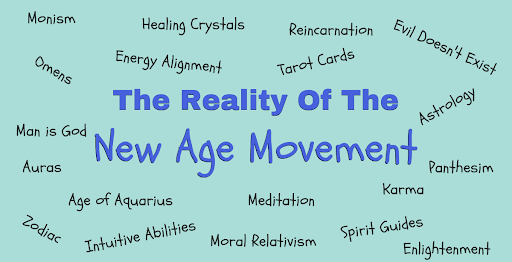
New Age spirituality says: God is either in all things or he is all things.
Christianity says: “For by him all things were created … all things were created by him and for him. He is before all things, and in him all things hold together” (Col. 1:16-17). We worship the Creator, not what he’s created (Rom. 1:25).
Be wary of: Panentheism, which says “God is in the tree,” or pantheism, which says “God is the tree,” as opposed to theism (Christianity), which says “God created the tree and holds it together by his power.”
New Age spirituality says: We’re on a continual journey to “know all” by achieving cosmic consciousness (also referred to as Nirvana, “going clear,” Christ-consciousness, individual divinity, or fulfilling the dharma).
Christianity says: Satan tempted Eve with knowledge he claimed would make her like God (Gen. 3:4-5), but we can never know as much as God (Isa. 55:8-9, Job 38). While the God of Christianity doesn’t require us to numb our mind, he compels us to love him with all our heart and all our mind (Matt. 22:37).
Be wary of: Ideas or belief systems that promise you can become like God through acquiring knowledge. Ultimate spiritual truth can only be found through God’s Word, the Bible, and in a personal relationship with Jesus Christ, who is the only “way and the truth and the life” (John 14:6).
New Age spirituality says: People work through their bad karma, or the overall effects of wrong actions, by being reincarnated, or physically reborn into a different body, until they achieve their divine destiny of becoming a god, or becoming one with the universe.
Christianity says: There’s no second chance after this life: “Man is destined to die once, and after that to face judgment” (Heb. 9:27). There’s only one “divine destiny”—salvation—achieved only through Jesus Christ: “For there is no other name under heaven given to men by which we must be saved” (Acts 4:12), and “For it is by grace you have been saved, through faith—and this not from yourselves, it is the gift of God—not by works, so that no one can boast” (Eph. 2:8).
Be wary of: Any teaching that includes reincarnation or encourages works to reach a higher level of spirituality or to earn salvation.
New Age spirituality says: You can shape reality by the power of your thoughts, or by speaking something into existence.
Christianity says: “Now listen, you who say, ‘Today or tomorrow we will go to this or that city, spend a year there, carry on business and make money.’ Why, you do not even know what will happen tomorrow. … Instead, you ought to say, ‘If it is the Lord’s will, we will live and do this or that'” (James 4:13-15). “Whatever is true … think about such things” (Phil. 4:8).
Be wary of: Teachings that tell you you can project your thoughts or words into existence, rather than recognizing God is the source of all power to shape reality.
New Age spirituality says: One can separate consciousness from the body, or have an out-of-body experience in order to be connected with the “Universal Soul.”
Christianity says: God didn’t create our consciousness to be separate from our body. Rather, he created us to be conscious within our body (Gen. 2:7). Only through God’s Holy Spirit dwelling in us can we be connected to the Creator (John 14:26).
Be wary of: Any teaching that includes leaving your body or allowing a “spirit guide” to enter it.
New Age spirituality says: The essential doctrines of the truth of life are within man.
Christianity says: “He who trusts in himself is a fool” (Prov. 28:26). The cause of the fall of man was our desire to become our own master, to determine for ourselves what’s good and bad instead of relying on God’s teachings found in the Bible, the only true source. Yoga and New Age teach the same lie Satan tempted Eve with in the Garden of Eden: “You will be as God” (Gen. 3:5), which was designed to keep her (and us) away from the one true God (John 17:3).
Be wary of: Basing your beliefs on what you sense is true, what you “hear” God saying in your mind, or any emotional experience without making sure your thought is in agreement with the Bible.




 The Sisterhood Hub