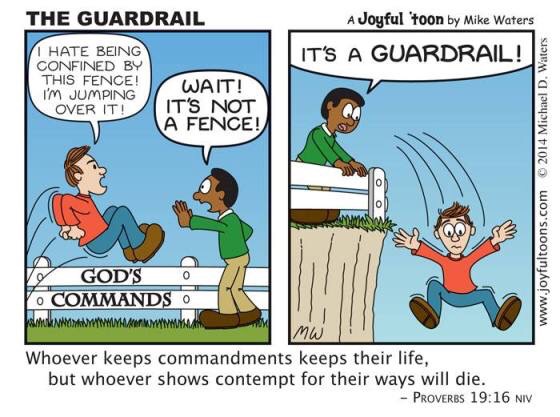
Shall We Sin So Grace May Abound?

Sin. It’s something most of us would rather not think about. For the unsaved person, sin is something that separates them from God, due to his perfect holiness. Yet for the Christian, their sin has been paid for. When God looks at them, he doesn’t see their sin, but instead righteousness.

How can that be? The answer is Jesus.

Jesus took the place of us on the cross. He paid the price of our sins with his very life and his holiness was accounted to us (2 Corinthians 5:21). God made it possible for us to be with him through the blood of his holy Son. Instead of condemnation, we receive grace. Instead of rightful punishment for our sins, God sees us as his sons and daughters. Indeed, this is the miracle of the Christian faith for all who believe.

But this brings up an important question. If our sin is already paid for, why should we stop sinning? In fact, doesn’t the vastness of our sin just make his grace more beautiful? Shall we sin that grace may abound?

Shall We Continue in Sin?

Paul demolished this dangerous line of thought in Romans 6. Christ died to free us from sin, not enable us to sin. When Jesus died, he was releasing us from our bondage to sin, because that is what sin is — slavery. Sin is what separates us from God. It’s damaging, and for the unredeemed, it is damning (Romans 6:23).


“For we know that our old self was crucified with him so that the body ruled by sin might be done away with, that we should no longer be slaves to sin — because anyone who has died has been set free from sin.” – Romans 6:6-7 

So, shall we then continue in sin that grace may abound? Paul replies with a resounding “God forbid” (Romans 6:2). To desire to continue in sin shows a misunderstanding of this abundant grace and a contempt for Jesus’ sacrifice. Either we believe what God says is true or we don’t. Either we take him at his word when he equates sin to death, or we do not believe him at all (Ephesians 2:1).

What is the point of the Christian faith if we get to pick and choose what we want to believe? Do we think God is that small, insignificant or somehow uninformed? Do we trifle with the very thing that God sent his Son to save us for? Do we misuse the grace that he gifted us with in his death and resurrection? Surely not.

Sin and Grace

Grace is a gift. Forgiveness of sins and his salvation are gifts. Grace is not, however, a license to sin. Throughout the Bible, fathers of our faith are seen distressed, tormented by their sin.

Consider David after his adultery with Bathsheba or Peter after denying Christ (Psalms 51:17 and Matthew 26:75). They did not discount their sin as simply something atoned for. Just because the Christian’s sin is paid for by Jesus, sin is still damaging to the believer and their relationship with God.

When David tried to ignore his sin, his “bones wasted away through my groaning all day long” (Psalms 32:3). He did, however, find freedom in confession.


“Then I acknowledged my sin to you and did not cover up my iniquity. I said, ‘I will confess my transgressions to the LORD’ – and you forgave the guilt of my sin.” – Psalms 32:5 

A Christian who pursues sin despite claiming Christ as their Savior is living outside the blessing and fullness of the relationship that comes with an obedient life. We cannot equate grace with freedom to sin. Instead, we should be thankful that grace provides freedom from sin and its eternal consequences.

Doesn’t that kind of grace make you want to obey the one who set you free?

What Is Sanctification?


“If you love me, you will obey my commandments. I will ask the Father, and he will give you another helper who will be with you forever. That helper is the Spirit of Truth. The world cannot accept him, because it doesn’t see or know him. You know him, because he lives with you and will be in you.” – John 14:5-17

The Christian’s spiritual journey doesn’t begin and end at a one-time prayer of confession. When we truly see our need for God, his grace and Christ’s sacrifice for us, we will want to obey him. Why? Because we will overflow with love and gratitude that the God of all creation cares enough to save us from ourselves. And if we love him, we trust him when he calls us to higher things. This pursuit toward Christ, and refining of our faith, is sanctification. Sanctification is progressing toward Christlikeness. A Christian cannot pursue both Christlikeness and sin.

So Christians, remember his abounding grace toward you. Turn from sin and embrace your new life as a vessel of light. You are dead to sin, alive in Christ.

Now go live it.

———

***By Lizzie Hoover at Grand Canyon University: gcu.edu / Photo by Mike Waters at Joyful Toons

Sovereignty of God

“For my thoughts are not your thoughts, neither are your ways my ways,” declares the Lord. “As the heavens are higher than the earth, so are my ways higher than your ways and my thoughts than your thoughts.
~ Isaiah 55:8-9

The total sovereignty of God over all people and circumstances, is a matter in which many believers remain in doubt. They may give lip-acknowledgment to it, but they don’t believe it “works” in the situations of daily life. Yet the Scriptures are full of examples of how God worked sovereignly on behalf of His people – and often in the most unlikely ways.

Many of us are familiar with the obviously miraculous ways in which God worked on behalf of His people – such as the deliverance of the Israelites from Egypt etc. But we have often missed seeing the greater miracles by which God turned the tables on Satan when Satan attacked God’s people.

The case of Joseph is a classic. God had a plan for that eleventh son of Jacob to make him the second ruler in Egypt by the time he was thirty. Joseph was a God-fearing lad and therefore he was hated by Satan. And so Satan instigated his elder brothers to get rid of him. But God ensured that they didn’t take Joseph’s life. They managed, however, to sell him off to some Ishmaelite traders. But where do you think those traders took Joseph? To Egypt, of course!

That was the fulfilment of Step One in God’s plan! In Egypt, Joseph was bought by Potiphar. This too was arranged by God. Potiphar’s wife was an evil woman. Taking a fancy to Joseph, she tried to entice him again and again. Finally when she found that she could not succeed, she accused Joseph falsely and had him cast in jail. But who do you think Joseph met in the jail? Pharaoh’s cupbearer! God had arranged for Pharaoh’s cupbearer also to be jailed at the same time so that Joseph could meet him. That was Step Two in God’s plan.

God’s third step was to allow Pharaoh’s cupbearer to forget about Joseph for two years. “Yet the chief cupbearer did not remember Joseph, but forgot him. It happened at the end of two full years that Pharoah had a dream…. Then the chief cupbearer spoke to Pharaoh…(Genesis 40:23; 41:1,9). That was the time, according to God’s time-table, for Joseph to be released from prison. Psalm 105:19, 20 says, “Until the time that His word came to pass, the word of the Lord tested him. Then the king sent and released him and set him free.” Joseph was now 30 years old.

God’s time had come. And so God gave Pharaoh a dream. And God reminded the cupbearer also of Joseph as the interpreter of his dream. Thus Joseph came before Pharaoh and became the second ruler in Egypt. God’s timing of events in Joseph’s life couldn’t have been more perfect! We would never have thought of arranging things the way God did. If we had the power to plan Joseph’s life, we would probably have prevented people from doing him any harm. But the way God did it was better. It’s a far greater miracle when the evil that people do to us is turned to fulfill God’s purposes for us! God takes great delight in turning the tables on Satan, so that all things work together for the good of His elect.

Let us look at one more example from the Old Testament, so that our minds can be firmly established in this truth. In the book of Esther, we read of how God rescued the Jews from being slaughtered as a race. But it is amazing to see how God did it – through one small incident – that the king could not sleep one night. Haman and his wife had been plotting one night to get the king’s permission to hang Mordecai on a gallows the next morning, as a prelude to destroying all the Jews.

But while Haman and his wife were making their wicked plans, God was working on behalf of Mordecai too. “The Keeper of Israel never slumbers or sleeps.” (Psalm 121:4). God prevented the king from sleeping that night, “During that night the king could not sleep so he gave an order to bring the book of records, the chronicles, and they were read before the king” (Esther 6:1). The king listened to his nation’s history for many hours, until the day began to break. Then the reading came to the place where it was recorded that Mordecai had once saved the king from being assassinated. The king asked his servants what honour had been bestowed on Mordecai for this, and they replied that nothing had been done. God’s timing of events was again perfect. At that very moment Haman walked in, planning to ask the king for permission to hang Modecai. Before Haman could open his mouth, the king asked Haman what he thought could be done for one whom the king desired to honour. Haman, conceited man that he was, thought that the king was referring to him, and so suggested a great parade of honour for such a man. “Go and do that for Mordecai, quickly,” the king said.

How wonderfully our God can turn the tables on Satan. Haman finally hung on the very same gallows that he had made for Mordecai. As the Bible says, “He who digs a pit (for another) will fall into it (himself). And he who rolls a stone (at another) will find the stone rolling back (to crush him)” ( Proverbs 26:27). Haman, in this story, is a type of Satan who is always planning some evil against us. God won’t stop him, because God has a far better plan. He wants to turn the tables on Satan. The pit that the Devil digs for us will be the one that he himself falls into finally. Zephaniah 3:17 says (in one translation) that God is silently planning for us in love, all the time.

While Mordecai was sleeping peacefully that night, quite ignorant of all the wicked plans that Haman and his wife were making against him, God was also planning to protect Mordecai. So Mordecai could have slept just as peacefully, even if he had known of Haman’s wicked plans. Why not? If God was on his side, who could be against him?

Once we have seen the sovereignty of God, we will stop blaming people for anything. We’ll no longer be afraid of Satan, fearing that he might harm us in some way. We won’t be afraid of sickness or disease or anything else in this world.

—————

**Copyright – Zac Poonen. No changes whatsoever are to be made to the content of the article without written permission from the author at cfcindia.com / Photo by Johannes Plenio at pexels

Prayer Binds Satan’s Hands, but a Spirit of Negativity Binds God’s Hands

Beware, brethren, lest there be in any of you an evil heart of unbelief in departing from the living God;” – Hebrews 3:12


INTRODUCTION

BINDING SATAN’S HANDS

So Satan is desiring to cause disaster in our homes, in our marriages, in our churches, and in our own hearts – but we have the power to bind his works by praying, and by praying in unity. Husband and wife can bind things in their children’s lives, members in the church can bind things when they pray with one another, etc. See again in Matthew 18 verse 19, “Again I say to you, that if two of you agree on earth about anything that they may ask, it shall be done for them by My Father who is in heaven.” So that’s binding Satan’s hands. But there’s another verse which is very interesting in Matthew 13:58, and also similarly in Mark 6:5-6 – that says that the Lord was not able to do many works for His own hometown because they had such unbelief: Matthew 13:58 “And He did not do many miracles there because of their unbelief.” Mark 6:6:5-6 “And He could do no miracle there except that He laid His hands on a few sick people and healed them. And He wondered at their unbelief…”

BINDING GOD’S HANDS

We say we want to bind Satan’s hands, but I believe we read in this verse itself that we by our unbelief may be tying ropes instead around God’s hands in our life!  Maybe He’s able to work in many other people’s lives the way He wants, but with regard to my own life His hands may be tied if I have unbelief! Wow. Imagine the Father reaching down from Heaven to (figuratively) lift up a boy and care and comfort and encourage him.  And as the Father is reaching down from Heaven to help this boy, the boy reaches up to His Father’s hands… but he doesn’t take His loving hands and hold them and receive His loving care; instead the boy places handcuffs on His Dad’s wrists, and then takes a rope and wraps up the wrists and hands that were reaching down to lift him up!  I believe this is exactly what we do when we don’t trust our Father, and we don’t believe He can help.  When we focus not on the hope and promises we have in Christ, and His power, but instead on how bad the situation is. 

NEGATIVITY

I think one word for this which often sums up unbelief is: “Negativity”. A spirit of negativity is the spiritual equivalent of tying ropes around the hands of the Father who is trying to reach down to pick me up and love me. I sometimes had to repent of and ask God to forgive me for my ‘sighs’ of negativity. I don’t always use words, but have often let out a ‘sigh’ of unbelief that with my groan was actually in reality saying “Oh great I have to deal with this again.” And when I think about what it implies I have to admit that it is saying that what God has chosen to allow is bad. It’s not for my good (it denies the plain truth of Romans 8:28). Or at least, with my negativity I’m confessing that the trouble/hassle of the trial is not worth the good that it would bring. But there’s something important about faith: Faith is not just believing that what God says is true, but it’s also believing that it’s as valuable as He says it is! It’s not only believing His Word, but believing it to the point that we’re enthusiastic about it (I believe we see this in the parables of the treasure / pearl of great price Matthew 13:44-45). And so I’ve seen I have to repent of negativity. We have to have a constant attitude of faith that just as the Lord turned the worst thing that ever happened in the universe (the death of Jesus) into the best thing (Jesus dying for us, rising again and saving us forever) – we have to be confident every ‘bad’ thing is not bad, it’s actually good if we love the Lord, and if it’s fully submitted to Him so that He can do something with it. And it’s not just ‘good’, but it’s REALLY REALLY good! A faith filled Christian MUST be an optimistic Christian. Always hopeful, always patient, exulting in tribulation instead of cursing it. Romans 5:3-4 “And not only this, but we also exult in our tribulations, knowing that tribulation brings about perseverance; 5:4 and perseverance, proven character; and proven character, hope;” “Rejoicing in hope, persevering in tribulation” (Romans 12:12), Be “imitators of those who through faith and patience inherit the promises” (Hebrews 6:12)

CONCLUSION

So I see now more of the seriousness with which I need to take unbelief, when I see what it is – unbelief actually is tying up the hands of God so that He cannot work. Unbelief is not an ‘innocent sin’, committed by poor unlucky people who deserve pity from a God who has been too hard on them!  It’s tying ropes around the very One who’s loved us from the beginning, and Who wants to help us even more than we want to help ourselves.  But accepting every single situation that comes our way (both good, and difficult) as from His loving hand is what frees Him up to work mightily in our life, and also is the very thing we can do which pleases Him (Hebrews 11:6).


———————

**By Bobby McDonald © Copyright – Bobby McDonald. No changes whatsoever are to be made to the content of the article without written permission from the author at NCCF Church / Photo by Jan Antonsen from Pexels

How to Start a House Group Fellowship

The really good news is that, to start a house church, you can lay down the burdens of planning how to cope with buildings, programs, and outreach strategies. You don’t have to be an impressive leader (though you probably will have some leadership gifts). To start a house church, you simply need to open your home to friends and neighbours and take things one step at a time.

Pray First!

The first step to starting a house church is to pray. House-church ministry must be birthed in prayer. Though it is a simple step, without prayer and God’s leading, we invite trouble. Starting a house church cannot be just a good idea; it must be a God idea. If you feel that you are called to start a house church, gather a few like-minded people together and begin to pray so that you can receive a strategy from God. Many house churches have false starts that are directly linked to a lack of prayer.

Taking time to pray gives God the opportunity to work in our hearts and purify our motives. When house churches start up because of a reaction to something we don’t like about the established church, the house church’s identity is built from rebellion and discord. Healthy house churches, on the contrary, must begin with God’s leading and a desire to reach those who don’t know Jesus. What a person sows, the Bible teaches us, he also reaps. Therefore, if you begin a house church because of an offense toward an existing church or leader, you will sow the seeds of fault-finding and pride in the church you are creating.

Along with prayer, it is also important to look to the local Christian community’s leaders for spiritual guidance and advice as you launch a new church. From day one of the Lancaster Micro-Church Network, we have cultivated relationships with established believers in our local community and beyond to answer questions and explain to them the concept of micro-church. A wise Bible teacher once said, “Lone rangers get shot out of the saddle.” We agree. Healthy house-church movements are not exclusive groups who refuse to be accountable. Vibrant micro-church networks are spiritually connected to leadership in the Body of Christ.

Know Whom You Are Called to Reach

Every micro-church should know whom they are called to reach. Here’s a great suggestion from Tony and Felicity Dale, who together started a successful network of house churches in Texas:

Draw together people from your circle of influence. We had a number of business associates who were not Christian, but whom we had come to know pretty well over a period of months or years. We asked a dozen of them to join us in a study of business principles while enjoying pizza in our home, using the book of proverbs as our textbook.
There were no rules to our discussion; everybody’s opinion was valid and there was no such thing as a wrong answer. Gradually we introduced prayer and worship and over the course of a year, every one of them became a Christian. They formed the nucleus of our original house church.

When the first micro-church in the Lancaster Micro-Church Network started in our (Larry’s) home a few years ago, we asked God for pre-Christians or new believers to join us—we also asked for labourers to help in the endeavour. However, we ran into some immediate problems. First of all, lots of believers wanted to come and check it out. Some of these Christians were looking for the latest Christian fad. They liked the idea that the micro-church met on a Wednesday, not a Sunday, and that it met in a living room, not a sanctuary.

But we were not starting something new for the sake of starting something new! Since we had a mandate from the Lord to reach new believers, we asked inquiring Christians not to come to our meetings. Having too many older Christians in the group would make the pre-Christians feel uncomfortable.

Jim Petersen, in his book Church Without Walls, clearly describes what can happen if a “migratory flock from neighbouring churches” invades a new church simply because they are curious:

I have a friend who was a part of a team that set out to start a church. The congregation was divided into house churches, each of which was assigned an elder who helped shepherd the members of that house church. Centralised activities were kept at a minimum for the sake of keeping people free to minister to their families and unbelieving friends.

The weekly meetings were dynamic. I will never forget the first one I visited. People of all sorts were there, from men in business suits to ponytails. Many were new believers. The Bible teaching was down to earth, aimed at people’s needs. I loved it.

So did most everyone else who visited. The word got around and soon the migratory flock from neighbouring churches came pouring in. Their needs consumed the energies of the leaders of this young church. Their wants gradually set the agenda. The inertia of the traditions of these migrants engulfed this very creative effort and shaped it accordingly.

So what’s the problem, we ask? The problem is that the vision that original team had for taking the church into society through the efforts of every believer was frustrated.

My wife and I knew that the vision the Lord had given to us to reach a new generation had to be safeguarded in the early days of our new micro-church network, and the young leaders of our network wisely set clear perimeters. They asked God to bring pre-Christians, new believers, and labourers—and the Lord honoured their request.

The Size of the House Church Matters

Quite soon, my wife and I had a second problem in our home-based micro-church. The pre-Christians attending invited their friends, and within 6 months of starting, we had 50 people in our living room on a given night. It was way too large!

It is wise to keep the number of people to between 6 and 12. From my experience, groups less than 6 strong tend to dwindle and be lacklustre because of the decreased number of relationships and interactions possible. However, groups over 12 tend to lose intimacy and every-member participation. It is perhaps not surprising, then, that rapid church planting movements today reproduce small house churches numbering between 10 and 30 people.

Frequency of Meeting

House churches should meet at least once a week to maintain a sense of connectedness. Again, though, we must emphasise the importance of flexibility. Some micro-churches meet at the same location every week, while others move the meeting place by rotating turns in members’ houses. Some groups meet more frequently, others less often. Some house churches meet during the week, others on weekends.

It is crucial that meeting together is an expression of the members’ desire to build community together—not just a religious duty to add more meetings to their already busy lives. If gathering together is done around food and for the purpose of fellow-shipping, it is more natural. Choose times that are convenient for everyone involved and then make an effort to connect with the other members (even just by phone or e-mail) outside of official meeting times. Building a spiritual family takes more than an hour or two one night a week!

Meeting Components

One thing is certain about house-church meetings: they should not be a smaller scale duplicate of a typical Sunday morning meeting. A house-church gathering should not look like an “escaped meeting captured by a living-room,” as one young man described house churches that do little more than replicate and repeat the traditional church service format: worship, teaching, prayer.

Instead, we have learned that there are often four basic components to a micro-church gathering: eating, meeting, small groups, and “the meeting after the meeting.

Although eating (usually a meal) is one of the elements of a house-church gathering, sometimes there may not be food. One week the house church may help someone trim their shrubs and have a time of prayer afterwards, and the next week they may come together for a whole smorgasbord of worship, prayer, teaching, and fellowship. Every week should be fresh and informal as people meet to discuss the life of Jesus and life with Jesus.

—Larry Kreider and Floyd McClung; excerpted from their book Starting a House Church (Regal Publishers, 2007) / Picture by Fauxes at pexels / By Small Groups

Needing the Flow of Oil

The Church needs the power and filling of the Holy Spirit

In the Old Testament, the Holy Spirit is pictured as oil. The oil made the lampstand burn in the tabernacle. The priests needed to make sure that the oil was always there.

You know that in the parable that Jesus spoke about his second coming, it was the lack of oil in the lamp that prevented some virgins from being ready. They were virgins. They were all virgins. It’s not five virgins and five harlots. All ten had a lamp that was burning. We know that all ten had lamps that were burning because when the bridegroom came at midnight what the foolish virgins said was: Our lamps are dying out. It’s not that they were never burning. External light speaks of what Jesus said: Let your light so shine before men that they may see your good works (your external works) and glorify your Father in heaven. Lamp speaks about our external testimony. Here are virgins that had a good external testimony like most people in the church. But among virgins with a good external testimony, five were not ready for the coming of Christ because they lacked something.

Five of them, in their garments, maybe in a pocket in their garments, they had a hidden flask of oil. That was the only difference. They had a hidden life which the other five didn’t have. That is what ensured that their lamps would still be burning when the bridegroom came. So what the Lord was emphasizing there was their hidden life before God.

External testimony does not necessarily make us ready for the coming of the Lord.

He answered and said to those five virgins in Matthew 25:12: “I do not know you” . What does that mean? It means “I do not have that intimate, personal relationship with you”.

Knowing is used in the Old Testament for the most intimate relationship in marriage. Adam knew his wife. It speaks of that close, intimate relationship between a husband and wife. Spiritually, it speaks of a close, intimate relationship with Jesus.

In secret and private, Adam knew his wife. Others knew their wives. It is always in private and secret. It is that secret of Jesus knowing me spiritually, very intimately. Jesus could say like: You did a lot of things for me but I didn’t know you intimately. You didn’t have an intimate walk with me in secret. So Jesus said: Be on the alert.

This light is also described in Revelation 1. He said: The lampstand is the church.

The ultimate goal of the Lord and of the Holy Spirit is to bring together a whole lot of people who are gripped by the challenge of this inner life and who want to have a vessel or flask full of oil and to bring them together and make them one in a church and not just as individuals who have an inner life. There were five wise virgins and they were meant to be one. This is a picture of a church. There were a number of people who had this inner life who were together ready for the coming of the Lord and that is God’s ultimate goal.

The ultimate goal of God in this day and age is to build a church. Not a bunch of holy individuals, even if they have an inner life, who float around but holy individuals who come together, five of them or ten of them, wise virgins with flasks of oil in their hidden life, who come together and are a corporate testimony for the Lord. The main thing that the Church needs is that flow of oil that keeps it burning all the time.

————————-

**Transcript adaption of the message: The Church – The Pillar of Truth – Atlanta 2013 by Zac Poonen © Copyright – Zac Poonen. No changes whatsoever are to be made to the content of the article without written permission from the author. https://www.cfcindia.com/  / Photo by Burak Kebapci