

In our modern era, humanity stands at a crossroads. Science and technology now offer possibilities once confined to science fiction — genetic editing, longevity research, neural enhancement, cosmetic transformation, artificial intelligence, and even the dream of transcending biological limits. What was once impossible is now within reach.
Across history, human beings have wrestled with the temptation to control, perfect, and redefine life itself. From the atrocities of the Nazi eugenics program — which sought to rank human worth by genetics — to today’s movements in transhumanism and extreme appearance culture, the underlying impulse remains the same: to determine value apart from the Creator, to overcome limits rather than receive them, to elevate human will above divine design.
This desire is not new. It is ancient. It is the impulse to “be like God” — not in holiness or love, but in authority over life itself.
At the heart of this cultural moment lies a crisis of identity. When human worth is no longer anchored in being created in the image of God, it becomes negotiable — measured by beauty, intelligence, productivity, longevity, or genetic advantage. The result is a generation pressured to optimize rather than receive, to compete rather than rest, to enhance rather than belong.
Scripture offers a radically different foundation:
“For you created my inmost being; you knit me together in my mother’s womb. I praise you because I am fearfully and wonderfully made.” — Psalm 139:13–14
“So God created mankind in his own image…” — Genesis 1:27
Human dignity is not earned. It is given. It is not engineered. It is bestowed. When this truth is forgotten, pride expands, control intensifies, and moral lines blur. But when identity is rooted in God’s love, technology becomes a tool rather than a master, enhancement becomes stewardship rather than rebellion, and human life remains sacred rather than commodified.
The following seven signs reveal how transhumanism, looksmaxxing, and the “playing God” mentality reflect a deeper spiritual disconnection — and why rediscovering our identity in God is the only foundation strong enough to withstand the pressures of a self-optimizing age.
1. Transhumanism and the Pursuit of Human Enhancement
Transhumanism is perhaps the most radical expression of humanity’s desire to reshape itself, overcome natural limits, and achieve perfection through science and technology. It is a movement that envisions a future where humans can radically enhance intelligence, physical ability, and longevity. Artificial intelligence, neural implants, gene editing, and cybernetic integration are no longer just theoretical; they are actively being researched and developed.
Brain-computer interfaces and neural implants could one day allow direct communication with machines or even memory enhancement. Genetic editing tools like CRISPR could prevent certain diseases — but they also tempt humans to select traits for “enhancement” rather than healing. Cybernetic limbs and synthetic organs offer incredible restoration, but also blur the line between human and machine, raising questions about identity and dignity.
While the possibilities are staggering, the spiritual and moral implications are profound. Transhumanism represents more than just science — it reflects the human heart’s deep longing to control life, transcend limitation, and define value on our own terms. The danger arises when enhancement is pursued not for healing, restoration, or stewardship, but to satisfy pride, vanity, or fear of mortality.
Technological marvels can be used for restoration and good, but they can also become instruments of deception when the enemy masks pride and self-exaltation as innovation or progress. What seems like human advancement can subtly lead hearts away from God.
Scripture reminds us of the dangers of this kind of pride:
Proverbs 16:18: “Pride goes before destruction, a haughty spirit before a fall.”
Genesis 3:5: “For God knows that when you eat from it your eyes will be opened, and you will be like God, knowing good and evil.”
Even with the most advanced technologies at our disposal, we are reminded that true human dignity and purpose are given by God, not defined by our abilities or enhancements.
2. Historical Lessons: Eugenics and the Nazi Regime
History offers chilling proof of what can happen when humanity attempts to redefine worth apart from God. The eugenics programs of the early 20th century, culminating in the atrocities of the Nazi regime, sought to engineer a “perfect” human race, eliminating those deemed genetically or physically unworthy. Millions of lives were devalued, and millions more destroyed.
Early 20th-century eugenics encouraged forced sterilizations in multiple countries, aiming to remove “undesirable” traits. Nazi Germany’s obsession with racial purity led to mass extermination and dehumanization, showing the catastrophic consequences of attempting to play God.
History reveals how the enemy works through human ambition, turning the desire for improvement into cruelty, oppression, and death. Those in power, deceived by pride and ideology, sought to play God — a timeless strategy of the enemy.
These events are more than lessons in politics or science — they are stark warnings about the spiritual consequences of pride and rebellion. Attempts to assume God’s role in determining value, life, and death lead inevitably to cruelty, injustice, and moral collapse.
Today, modern parallels are clear: abortion, euthanasia, extreme cosmetic enhancement, social media-driven appearance obsession, and radical life-extension experiments reflect the same human desire to control life apart from God.
Scripture makes the opposite clear:
Genesis 1:27: “So God created mankind in his own image, in the image of God he created them; male and female he created them.”
Psalm 139:13–14: “For you created my inmost being; you knit me together in my mother’s womb. I praise you because I am fearfully and wonderfully made.”
Every human life carries intrinsic worth. Attempts to assign value based on appearance, intelligence, or genetic traits reflect arrogance and a fundamental misunderstanding of God’s design. Modern enhancement pursuits echo these ancient desires to control and “perfect” humanity, but history reminds us of the tragic cost when human pride dominates divine instruction.
3. Obsession with Youth, Looks, and Appearance
Powerful individuals and groups often leverage social media, influencers, and cultural trends to shape society according to ideological agendas, subtly grooming the population to accept values and behaviors aligned with their vision. This manipulation is part of a spiritual battle, as Scripture reminds us:
“For we do not fight against flesh and blood, but against the rulers, against the authorities, against the powers of this dark world and against the spiritual forces of evil in the heavenly realms.” — Ephesians 6:12
Modern society amplifies the desire to look perfect, maintain youth, and command social approval. Social media platforms, fashion, fitness culture, and the booming cosmetic surgery industry create a world where appearance becomes an identity marker. Terms like “looksmaxxing” describe deliberate efforts to optimize attractiveness, from fitness and diet to grooming and fashion, and the cosmetic surgery industry makes these ideals increasingly attainable.
Procedures like rhinoplasty, Botox, or lip fillers normalize extreme focus on appearance. Fitness influencers and social media create constant comparison pressure, teaching people to measure worth externally. This can lead to obsessive behavior, mental health challenges, and spiritual distraction from God’s truth of inherent value.
Even the pursuit of beauty can become a tool of deception. The enemy entices hearts to measure worth by fleeting appearances, masking vanity and dissatisfaction as self-care, confidence, or empowerment.
While taking care of one’s body is not inherently wrong, these behaviors become spiritually dangerous when they replace recognition of intrinsic worth. The Bible teaches that external perfection is fleeting, but the heart reflects true worth:
1 Samuel 16:7: “The Lord does not look at the things people look at. People look at the outward appearance, but the Lord looks at the heart.”
Proverbs 31:30: “Charm is deceptive, and beauty is fleeting; but a person who fears the Lord is to be praised.”
Obsession with appearance is not simply vanity — it is a symptom of a deeper spiritual hunger for validation, control, and meaning.
4. The Pursuit of Longevity and Control
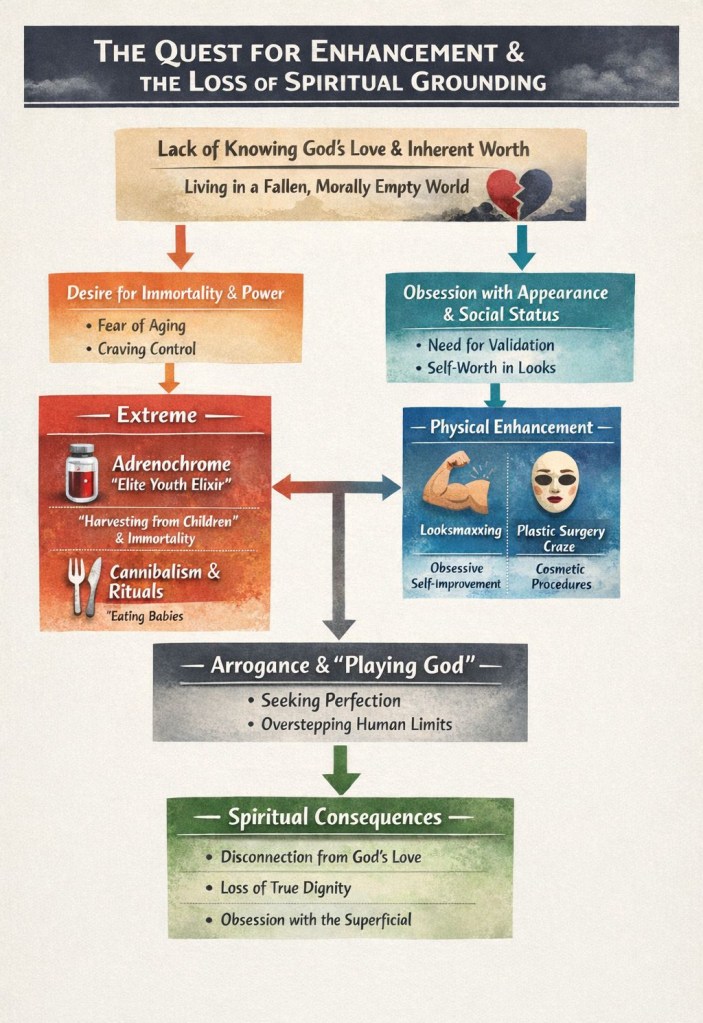
Beyond looks, many modern pursuits focus on extending life, preserving youth, and mastering the human body. Anti-aging medicine, regenerative therapies, extreme fitness regimens, and even ideas like adrenochrome as an elixir of vitality reveal the depth of human anxiety about mortality.
Regenerative medicine — stem cell therapies, organ regeneration, and gene therapy — aims to repair or replace damaged tissues, offering a glimpse at life extension. Anti-aging interventions and experimental pharmaceuticals, all promise to slow the aging process, but they can foster obsession and fear of the natural life cycle.
Fear of death and the desire to extend life beyond God’s design can also be exploited by the enemy. Even when pursuits appear noble — seeking health or longevity — they can become channels of deception when pride and fear drive the heart.
These pursuits are not inherently wrong when aimed at restoration or health, but they become spiritually dangerous when driven by fear of death, pride, or a refusal to accept the natural boundaries of life.
The Bible reminds us that life is a gift, not a possession to manipulate at will:
Job 12:10: “In his hand is the life of every creature and the breath of all mankind.”
Ecclesiastes 3:1–2: “There is a time for everything, and a season for every activity under the heavens… a time to be born and a time to die.”
True peace comes not from controlling life, but from trusting in God’s wisdom, timing, and care.
5. Spiritual Implications of Obsession and Arrogance
The enemy thrives when humans forget their God-given worth. He disguises pride, obsession, and the desire to surpass God’s design as ambition, success, or enlightenment, leading hearts into emptiness and moral compromise.
When people forget that their value comes from God, they often seek meaning in external achievements, appearance, or technological mastery.
This can manifest as:
Pride and arrogance, believing humans can surpass God’s design.
Obsessive focus on perfection, whether in appearance, intellect, or lifespan.
Emotional emptiness, feeling dissatisfied even after achieving worldly success.
Moral compromise, prioritizing self-interest over love, stewardship, and the care of others.
Historical examples, like the Nazi pursuit of “racial perfection,” illustrate how obsession and arrogance can lead to destruction on a massive scale. Modern parallels include extreme cosmetic procedures, abortion, euthanasia, social media pressures, and life extension experiments that ignore moral and spiritual consequences. Technological enhancement, when pursued without ethical or spiritual discernment, reflects a human heart seeking control over life itself rather than acknowledging God’s sovereignty.
Scripture reminds us that human worth is intrinsic, given by God, and not contingent on external measures:
Ephesians 2:10: “For we are God’s handiwork, created in Christ Jesus to do good works, which God prepared in advance for us to do.”
James 4:6: “God opposes the proud but gives grace to the humble.”
Security, identity, and purpose are found not in controlling life or chasing perfection, but in embracing God’s design with humility, gratitude, and love for others.
6. Integrating Knowledge, Enhancement, and Stewardship
Modern technologies and health innovations can serve humanity, but they require discernment, humility, and moral responsibility.
Genetic and technological enhancements can restore function, prevent disease, or improve quality of life — but they should never be pursued to glorify self or assert control over life itself. Cosmetic and lifestyle interventions can provide confidence or repair, yet obsession with appearance reflects spiritual misalignment if it becomes the primary source of self-worth. Radical life extension goals must be tempered by respect for God’s natural boundaries and the spiritual reality of mortality.
Discernment is key because the enemy often disguises self-aggrandizement as innovation or stewardship. Humility, obedience, and alignment with God’s design guard against this deception. Stewardship involves using gifts, knowledge, and technology responsibly — for healing, restoration, and service, not for prideful perfection or dominion over life. True advancement aligns with God’s purpose, not human ambition.
7. Lessons from History, Scripture, and Modern Culture
Modern culture reflects timeless human struggles: pride, obsession, fear of mortality, and desire for perfection.
Historical warnings like the Nazi eugenics program show the catastrophic consequences of attempting to determine worth apart from God. Modern trends — transhumanism, cosmetic obsession, anti-aging interventions, abortion, euthanasia, social media influence, and life-extension experiments — echo the same prideful desire to control life.
Scripture provides the guiding principle: true worth is intrinsic, life is a gift, and fulfillment comes from alignment with God, not external perfection:
Psalm 139:14: “I praise you because I am fearfully and wonderfully made.”
Proverbs 3:5–6: “Trust in the Lord with all your heart and lean not on your own understanding; in all your ways submit to him, and he will make your paths straight.”
Security, identity, and purpose are found not in controlling life or chasing perfection, but in embracing God’s design with humility, gratitude, and love for others. Modern obsessions, whether through technological enhancement, cosmetic trends, or social media influence, reflect ancient pride and rebellion against God. Yet His truth offers a timeless refuge, reminding us that intrinsic worth is found in His image, not human-imposed standards.
—-—————-
*** Photo by Cottonbro Studio at Pexels


 The Sisterhood Hub