Above all else, guard your heart, for everything you do flows from it. Keep your mouth free of perversity; keep corrupt talk far from your lips. (Proverbs 4:23-24)
A Spiritual Check UP
Did I speak any idle words today?
Did I indulge in overeating or laziness or any other filthy lust?
Have I spoken or thought evil of anyone today?
Did I act in a selfish way towards anyone today?
Was I happy or even unconcerned about someone else’s failure?
Did I seek the kingdom of God and His righteousness first today?
Did I look for opportunities to witness for Christ and to do good?
Did I doubt the love or the power or the sovereignty of God today?
Was I proud of any accomplishment?
Was I discouraged or depressed over anything?
Did I do or say anything, which was not profitable or edifying?
Did I do to others as I would want them to do to me?
Was I carnally inquisitive or a busybody in anyone’s affairs?
Did I waste money on anything useless today?
Did I tell another what was told to me in confidence?
Was I impatient with anyone today?
How did I treat servants and those on a lower social scale?
Did I speak a word of encouragement or appreciation to anyone?
Did I show my love to the members of my family?
Did I consider myself as better than anyone else?
Did I pass judgment on anyone today – even in my thoughts?
Is there anyone I have not forgiven totally, from my heart?
Did I believe any evil story, without verifying the information?
Were my thoughts morally pure today?
Have I prayed for those who hate me and persecute me?
Was I jealous of anyone today?
Did I value and delight in my fellow-believers?
Was I concerned about the spiritual & physical needs of my brethren?
Is it possible that I might have hurt someone thoughtlessly?
Did I keep my word and my promises?
Was I a servant to all whom I came across today?
Have I cast my every care and burden on the Lord?
Was I concerned about the opinion of any man?
Did I waste any time today, or did I use the day profitably?
Was I alert to hear what the Lord had to say to me today?
Did I try to live simply, avoiding luxury as far as possible?
Did I share something of spiritual value with my children today?
Did I try to help my wife (husband) in her (his) work today?
Did I despise anyone who doesn’t have the same light as I have?
Is there any thought in my heart that is not good, towards anyone?
“And He said to me, “Do not seal up the words of the prophecy of this book, for the time is near. Let the one who does wrong, still do wrong; and the one who is filthy, still be filthy; and let the one who is righteous, still practice righteousness; and the one who is holy, still keep himself holy.” “Behold, I am coming quickly, and My reward is with Me, to render to every man according to what he has done. I am the Alpha and the Omega, the first and the last, the beginning and the end.”
Blessed are those who wash their robes, so that they may have the right to the tree of life, and may enter by the gates into the city. Outside are the dogs and the sorcerers and the immoral persons and the murderers and the idolaters, and everyone who loves and practices lying. “I, Jesus, have sent My angel to testify to you these things for the churches. I am the root and the descendant of David, the bright morning star.”
The Spirit and the bride say, “Come.” And let the one who hears say, “Come.” And let the one who is thirsty come; let the one who wishes take the water of life without cost. I testify to everyone who hears the words of the prophecy of this book: if anyone adds to them, God will add to him the plagues which are written in this book; and if anyone takes away from the words of the book of this prophecy, God will take away his part from the tree of life and from the holy city, which are written in this book. He who testifies to these things says, “Yes, I am coming quickly.” Amen. Come, Lord Jesus. The grace of the Lord Jesus be with all. Amen.”
Do you know what animal kills the most humans every year? It is not the untamed tiger or the mammoth elephant or the venomous snake. It is the tiny mosquito. One study found that mosquitoes kill 20 times more humans than snakes every year.
And the mosquito doesn’t kill you by its strength. It kills you by a small little prick that infects you with a deadly disease. Then it is off to transmit it to the next human being.
If I found a venomous snake in the house, I would drop whatever I am doing to get rid of that snake. It doesn’t matter if I am talking to the CEO of the company, or even the president of my country. I will drop whatever I am doing to drive the venomous snake out of my house.
But because I live by what my eyes see, I dismiss the harmless-looking mosquito. And I am a fool if I do not recognize the FACT that the infection-carrying mosquito that flies around in my house is 20 times more dangerous than a venomous snake in my house.
This has a simple spiritual application. A lot of us are worried about the huge trials. We marvel at people who are able to stand strong for Jesus when faced with threats of great evil or death. And we absolutely should: To be willing to die for Jesus is a tremendous act of courage, and an evidence of a deep loyalty and the supernatural grace that God makes available at such intense times of trial.
But these kinds of spiritual persecutions are like venomous snakes that enter our house. The vast majority of us do not face these kinds of spiritual threats on a daily basis. What we do face are spiritual mosquitoes that slip into our house and are ignored.
The small mosquito of inconvenience because of changes in the routine, children growing up, etc. The Lord asks us to drive out all the mosquitoes of complaint (in thought and word and feelings). Philippians 2:14
The small mosquito of being offended by the actions of someone else. The Lord asks us to violently drive out all self-pity. Matthew 16:23
The small mosquito of envy towards the blessing of God on another brother. Jesus tells us to love as Christ loved us (1 Corinthians 13:4; John 13:34)
The small mosquito of lust in my interactions with others. The Lord tells us to repent of lust just as we would repent if we had committed physical adultery (Matthew 5:28)
The small mosquito of unkind words towards loved ones. Jesus tells us that anger in our heart or words is as serious as murdering our loved ones (Matthew 5:22)
Spiritual mosquitoes cause the most havoc in Christians. The devil and his forces might find that sincere Christians watch for spiritual serpents and tigers and lions and so on. But we can be casual to allow his spiritual mosquitoes to fly in and out of our everyday lives. And the biggest cause for spiritual death among Christians are the tiny mosquitoes that are allowed to remain.
Solomon used a similar analogy of “little foxes” that were ruining the vineyard that was in blossom – Song of Songs 2:15 – Catch the foxes for us, the little foxes that are ruining the vineyards, while our vineyards are in blossom. These were not the adult scary-looking foxes. These were the foxes while they were still cute and harmless-looking.
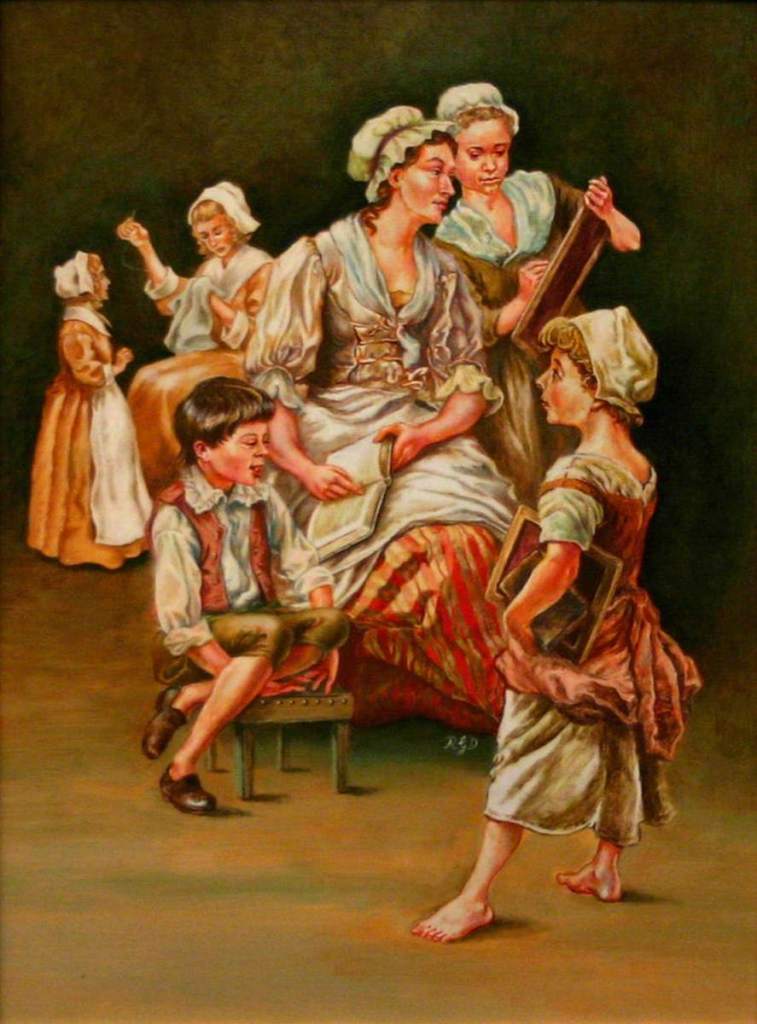
Artwork Susanna Wesley with Five Children by Richard Gilmore Douglas
AN ADMIRING SON
Susanna’s devotion to her faith and her family clearly shaped her son John Wesley’s character and had an impact on countless lives.
Few mums know what it’s like to raise 10 children like Susanna Wesley. Her son John, the founder of the Methodist movement, published a letter in which his mum shared her “principal rules” for parenting, covering things big and small.
Because our understandings of child development have changed greatly in the nearly 300 years since Susanna was raising her kids, we might not agree with all of her advice. But some still rings true today.
RELIGIOUS EDUCATION
Devotions – “The children of this family were taught, as soon as they could speak, the Lord’s prayer, which they were made to say at rising and bedtime constantly,” Susanna reminded her son.
Worship and Music – When the Wesley children were a little older, the day began with reading or singing a psalm, reading an Old Testament chapter, and saying private prayers — all before breakfast. At the end of the school day, they paired up to read a psalm and a New Testament chapter.
Sabbath – Sundays were special in the Wesley house. The children “were very early made to distinguish the sabbath from other days,” Susanna wrote. Even when the kids were very young, they were expected to participate in the family prayers, “which they used to do by signs before they would kneel or speak.”
EDUCATION
Focus – In the Wesley household, nine to noon and two to five were reserved for the children’s education, a top priority for Susanna. “It is almost incredible what a child may be taught in a quarter of a year, by a vigorous application,” she remembered.
No goofing off – Susanna expected the children’s full attention during the education hours. “Rising out of their places, or going out of the room, was not permitted unless for good cause, and running into the yard, garden or street, without leave, was always esteemed a capital offence.” I imagine Susanna smiling as she wrote that last line to her now grown son.
Reading – Each child was taught to read at age 5, both the boys and the girls. Susanna noted, “[P]utting children to learn sewing before they can read perfectly is the very reason why so few women can read fit to be heard, and never to be well understood.” She would not allow that for her daughters or sons.
ORDER AND DISCIPLINE
Routine – The Wesley house ran on a tight schedule. “The children were always put into a regular method of living,” she wrote. Times were assigned for naps, education, meals, and bedtime.
Self-regulation – Susanna was convinced that “self-will is the root of all sin and misery,” and worked to help her children develop self-control.
Positive reinforcement – Susanna believed, “That every signal [sic] act of obedience…should always be commended and frequently rewarded.” When the thought is there, but the execution lacking, Susanna adds that parents should then “sweetly” direct the child on “how to do better for the future.”
Discipline – When needed, Susanna strived to discipline appropriately. “Some [infractions] should be overlooked and taken no notice of, and others mildly reproved,” she wrote, “but no willful transgression ought ever to be forgiven children without chastisement, less or more, as the nature and circumstances of the offence require.”
Forgiveness – Susanna taught that a child should never be punished for the same offense twice, and “that if they amended they should never be upbraided with it afterwards.”
Peace – The child-filled Wesley household was not chaotic. “The family usually lived in as much quietness as if there had not been a child among them,” Susanna remembers.
SLEEP
Bedtime – After dinner at 6, the process of getting the children ready for bed began at 7 p.m. with the youngest child. All children were in bed by 8 p.m., whether they were ready for sleep or not. “[T]here was no such thing allowed of in our house as sitting by a child till it fell asleep,” she wrote.
Naps – As infants, the children napped on a schedule. “This was done to bring them to a regular course of sleeping,” Susanna reasoned.
MEALS AND DINING
Dining – Mealtime was family time. When the children were young, “At dinner their little table and chairs were set by ours,” Susanna recalls, near enough to be supervised. Children graduated to the dining room table, “As soon as they could handle a knife and fork.”
No snacking – “Drinking or eating between meals was never allowed,” Susanna shares, “unless in case of sickness which seldom happened.”
Choosing meals – The children were expected to eat what was served. “They were never suffered [permitted] to choose their meat, but always made to eat such things as were provided by the family,” Susanna wrote.
Medicine – “They were so constantly used to eat and drink what was given them,” she remembers, “that when any of them was ill there was no difficulty in making them take the most unpleasant medicine.”
MANNERS
Polite speech – Susanna expected her children to be polite. If they wanted something they were to ask, and were given “nothing they cried for, and instructed to speak handsomely for what they wanted.”
No lying – Susanna believed that children were tempted to lie when they feared punishment. “To prevent this,” she reasoned, “a law was made that whoever was charged with a fault, of which they were guilty, if they would ingenuously confess it, and promise to amend,” they would not be punished.
Respect for property – The Wesley children were taught to keep their hands off of another’s stuff, even “in the smallest matter, though it were but of the value of a farthing [1/4 of a penny], or a pin; which they might not take from the owner without, much less Money against his consent.”
John Wesley shared this advice from his mom in his published Journal as he reflected on her death. The entry is dated August 1st, 1742, the day of her funeral. He hoped it would help others caring for “a numerous family.”
*Susanna Wesley gave birth to 19 children (including two sets of twins). Unfortunately, nine died in infancy or soon after.
The Bride (Wisdom), we read builds her house on SEVEN PILLARS. These seven pillars are listed for us in James 3:17, and the true church is built on these pillars. By these characteristics, we can identify the Bride of Christ anywhere:
Purity : The first and most important pillar in the true church is purity. This is not a hollow pillar of a merely external purity. No. It is solid through and through. It is purity of the heart, and it grows from the seed of the fear of God deep within the heart. It is not by clever brains but by pure hearts that the true church of Christ is built. We cannot build the church if we don’t have spiritual revelation on God and His ways – and only the pure in heart will be allowed to see God in their hearts (Matthew 5:8).
Peaceableness : Righteousness and peace always go together. They are twins. The kingdom of God is righteousness and peace (Romans 14:17). True wisdom is never argumentative or quarrelsome. It does not strive. It maintains harmonious relationships with everyone, as far as possible. It is impossible to quarrel with a man who is filled with Divine wisdom, for such a man is a peaceable man. He may be firm and he may be hated by compromisers. But he is always peaceable. Jesus told His disciples that when they travel to preach the gospel, they should stay only in the house of “men of peace” (Luke 10:5-7). We must be men of peace, if we are to build God’s house.
Consideration : The Bride of Christ is always fair to others, gentle, patient, forbearing and courteous. She is never harsh or rough but always considerate of the feelings of others. When the church is supported by this pillar, it becomes easy to bear with one another – even if some are slow of understanding or crude in their manners. The problem, we begin to realise, is not the crudeness of our brother or sister, but the impatience that dwells within us. And so we fight the right enemy – our Self-life – and not our brothers and sisters.
Willingness to Yield : One who cannot receive admonishment and exhortation, or who feels that he has gone beyond that stage, is truly foolish, even if he is an elder or an older man ( Ecclesiastes 4:13). In India especially, many people have the heathen idea that “older people are wiser”. This may be true in earthly matters but certainly not in spiritual matters. Jesus did not choose any of the older people in the synagogues to be his apostles. He chose young men. Older people in the church often find it difficult to receive exhortation from a younger brother who may be the elder in the church and also far more godly. But that is because of their pride. Those who are willing to receive correction become wise (Proverbs 13:10). And so where the brothers and sisters in a church are eager to receive exhortation and correction, a truly glorious church will be built. The wise man loves those who exhort him faithfully and will eagerly seek out their company. ‘Submit to one another’ (Ephesians 5:21) are the words written on this pillar.
Fullness of Mercy and its Good Fruits : The Bride of Christ is full of mercy – not just occasionally merciful. She has no problem forgiving anyone, freely and cheerfully from the heart. She does not judge or condemn others, but rather exercises compassion towards them like her Bridegroom. This mercy is not just a mental attitude but finds expression in good fruits that are brought forth in her actions. She does good in all the ways she can to all the people she can at all the times she can.
Steadfastness : A brother who has Divine wisdom will be free from all crookedness. He will be wholehearted and straightforward, with a single eye, free from doubts and hesitation. He will not be double-minded, but strong in faith in God, and he won’t be looking at his own weaknesses, but at the promises of God. Such a brother knows that victory over all conscious sin is possible here and now. He is a dependable person – who can be trusted at all times to keep his word. He is steadfast and unmovable. You cannot make him bend his convictions or to compromise in any matter. He is straight and upright as a rod.
Freedom from Hypocrisy : The Bride has more spiritual content inwardly than others can see in her externally. Her hidden life is better than the opinion that others have of her external life. This is the exact opposite of the ‘spiritual adulteress’ or the ‘Harlot,’ whose so-called spirituality is only meant for receiving the honour of men. What she has is actually ‘religiosity’ and not true spirituality. The bride watches her inner thoughts, motives and attitudes far more than her external words and actions. She longs for God’s approval over her inner life and cares nothing at all for man’s approval of her external life. By this test, each of us can know whether we are part of the Bride or of the Harlot.
The Bride of Christ has the seed of wisdom implanted in her heart and so she will have these seven characteristics growing in her year by year. Although she is still far from perfect, she is pressing on and growing towards perfection.










 The Sisterhood Hub