
“Woe to those who call evil good and good evil, who substitute darkness for light and light for darkness, who substitute bitter for sweet and sweet for bitter.” ~ Isaiah 5:20
The tale of The Emperor’s New Clothes has captivated readers for centuries, serving as a sharp critique of human vanity, pride, and collective denial. Hans Christian Andersen’s story, however, speaks with renewed relevance in today’s society, where the desire to fit in often outweighs honesty, and social pressures can obscure truth and clarity. Isaiah’s warning in the Bible, “Woe to those who call evil good and good evil, who put darkness for light and light for darkness…” (Isaiah 5:20), resonates deeply in our time. We see modern forms of this inversion in the gaslighting of false truths, narratives that exclude anyone who doesn’t conform, and a “collective narcissism” that prioritizes appearance over integrity. This article revisits the moral insights of Andersen’s story, drawing a parallel to today’s cultural landscape where narratives conflict and individuals face pressure to align with popular opinion or risk exclusion. In a world that frequently blurs lines between right and wrong, Andersen’s cautionary tale offers timeless wisdom, reminding us that courage and innocence, like that of the young child in the story, are essential to speak truth against illusion.
The Tale
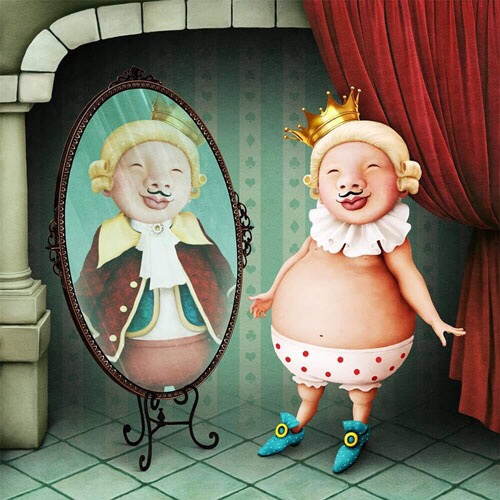
Once upon a time… there was an emperor who loved nothing more than fine clothes. He spent all his money on luxurious fabrics and exquisite outfits, caring little for his army, his people, or anything else. He had a new coat for every hour of the day, and instead of attending important meetings, he would simply admire his wardrobe.
One day, two swindlers arrived in the city. They claimed to be master weavers and boasted that they could make the most beautiful fabric in the world—so light and fine that it was almost invisible. But there was something special about it: only the wise and worthy could see it. Anyone who was foolish or unfit for their position would be unable to see the fabric at all.
The emperor was intrigued. “If I had clothes made from this marvellous fabric,” he thought, “I would know who in my kingdom is wise and who is foolish!” So he gave the swindlers a large sum of money and instructed them to begin work immediately.
The two men set up their looms and pretended to weave, though there was nothing on their looms at all. They demanded the finest silk and the purest gold thread, which they stuffed into their bags while they worked at their empty looms late into the night.
Curious about their progress, the emperor sent his most trusted minister to inspect the fabric. The minister entered the workshop, but—oh dear!—he saw nothing. There was no fabric at all!
“Can it be that I am unfit for my position?” the minister thought, his heart pounding. “No one must know!” So he cleared his throat, smiled, and exclaimed, “Ah! Such beautiful colours! Such fine patterns!”
The swindlers beamed with pride. “We are so pleased you like it!” they said, pretending to cut and stitch the invisible fabric.
When the minister returned to the emperor, he reported that the fabric was indeed magnificent. The emperor, eager to see it himself, visited the workshop with his highest officials.
But when he looked at the looms, he saw nothing. Nothing at all!
“Am I a fool? Am I unworthy to be emperor?” he wondered, horrified. But rather than admit it, he smiled and nodded. “It is exquisite!” he declared. His officials, too afraid to say otherwise, all agreed. “Majestic! Stunning!” they cried.
The day of the grand parade arrived, and the swindlers pretended to dress the emperor in his new clothes. They fussed and adjusted the imaginary garments, exclaiming how light and comfortable they were. The emperor stood before a mirror, unable to see anything, yet unwilling to admit the truth.
He stepped out into the streets, and the people of the city gasped. No one could see his clothes—but no one wanted to be thought foolish, so they all cheered, “How splendid! What a marvellous outfit!”
Then, from the crowd, a small child’s voice rang out:
“But he isn’t wearing anything at all!”
A hush fell over the crowd. The people looked at one another, and soon, they began to murmur, “He isn’t wearing anything!”
The emperor felt his face burn with embarrassment. He knew they were right—but what could he do? He straightened his back, held his head high, and continued to march proudly through the streets as his attendants hurried after him, pretending to carry the train of his non-existent robe.
And so, the emperor remained the most foolish of all, trapped by his own vanity and fear of the truth.
Conclusion
The Emperor’s New Clothes remains a poignant reminder that truth can become distorted when pride and conformity overpower self-honesty. Just as the Emperor continued his procession, fully aware of his own nakedness, society today often maintains a facade rather than confront uncomfortable truths. The moral of Andersen’s tale encourages us to value integrity over appearances and to prioritize truth over the allure of fitting in. Let this story inspire us to cultivate discernment, maintain our faith, and seek peace rooted in truth and honesty, drawing courage from the child who dared to speak out. As we navigate a world prone to deception, may we hold firm to what is right and shine light in places obscured by societal pressures.
“Open the gates that the righteous nation may enter, the nation that keeps faith. You will keep in perfect peace those whose minds are steadfast, because they trust in you.” ~ Isaiah 26:2-3
Prayer
Heavenly Father, thank You for the gift of truth that lights our path. In a world that often values appearance over integrity, help me to see with clear eyes and a discerning heart. Give me the courage to speak truth with humility, even when it’s difficult, and to stand firm in my faith, grounded in Your wisdom. Shield my heart from pride and fear of judgment, so I may live with honesty and peace. May Your spirit of clarity and grace be my guide, as I seek to honor You in all I say and do. In Jesus’ name, I pray. Amen.
** How to be saved: The Path To Salvation: HERE
—————-
**By Hans Christian Andersen / Illustration by readmio

 The Sisterhood Hub